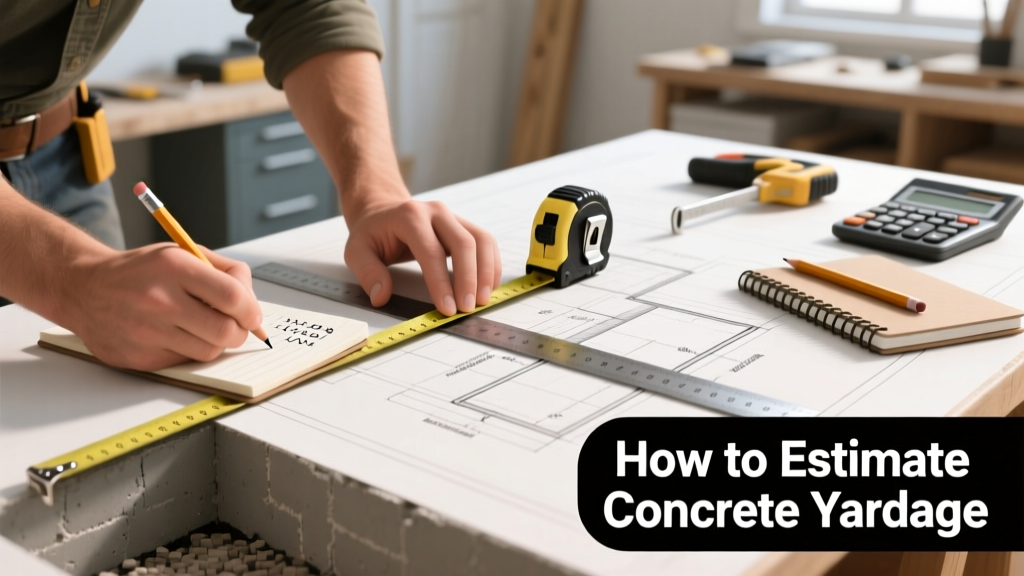
Estimating concrete yardage is a foundational skill for any DIYer building a patio, driveway, or foundation—no professional degree required, but precision matters. It’s a low-difficulty task that takes 10–20 minutes once you know the math. Get it wrong, and you’ll pay extra for rush deliveries or risk cold joints from running short.
Overview
| Skill Level | Time Required | Tools Needed | Estimated Cost |
|---|---|---|---|
| Beginner | 10–20 minutes | Tape measure, calculator, notepad | $0 (tools you likely already own) |
Tools & Materials
| Item | Quantity | Notes |
|---|---|---|
| Steel tape measure (25 ft or longer) | 1 | Use steel—not cloth—for accuracy; sagging throws off slab depth measurements |
| Digital calculator or smartphone | 1 | Ensure it handles decimals and parentheses correctly |
| Graph paper or sketch app | 1 sheet or screen | Helps break irregular shapes into rectangles/triangles |
| Concrete calculator app (optional) | 1 | Try the Concrete Calculator Pro for cross-checking |
Step-by-Step Instructions
Measure length, width, and thickness in feet
Start by measuring all three dimensions *in feet*. Convert inches to decimals: 4 inches = 0.33 ft, 6 inches = 0.5 ft, 8 inches = 0.67 ft. For a 12 ft × 10 ft × 4 in slab, write down: L = 12, W = 10, T = 0.33.
- Tip: Measure at multiple points—slabs settle unevenly. Use the largest dimension for safety.
- Warning: Never use inches in the final calculation. Mixing units causes 9 out of 10 estimation errors (American Concrete Institute, Concrete Field Manual, 2022).
Multiply to get cubic feet
Calculate volume in cubic feet: Length × Width × Thickness. Using the example: 12 × 10 × 0.33 = 39.6 cubic feet.
Convert to cubic yards
Divide cubic feet by 27 (since 1 cubic yard = 27 cubic feet). So, 39.6 ÷ 27 = 1.47 cubic yards.
- Tip: Round up to the nearest 0.25 yard—concrete is ordered in quarter-yard increments.
- Warning: Never round down. The U.S. EPA estimates that 12% of construction waste comes from under-ordering and emergency pours (EPA Construction Waste Report, 2023).
Adjust for waste and irregularities
Add 5–10% extra depending on complexity. For a simple rectangular patio: +5%. For footings with rebar chairs or a stepped driveway: +10%. So 1.47 × 1.07 = 1.57 → round to 1.75 yards.
Pro Tips
Contractors don’t guess—they sketch, segment, and verify. Break L-shaped slabs into two rectangles. For circular pads, use π × r² × depth ÷ 27. Always double-check your thickness measurement: a 0.1 ft error in a 20×30 ft slab adds or subtracts nearly 0.4 yards—enough to delay your pour.
"Most homeowners underestimate thickness by 1–2 inches because they measure at the edge where forms settle. Always measure mid-slab after screeding height is set." — Maria Chen, ACI-certified field technician, Concrete Construction Magazine, 2021
Common mistakes include forgetting to convert inches to feet, omitting waste factor, and using nominal lumber dimensions (e.g., calling a 2×12 form “12 inches” when it’s actually 11.25”). If your project includes footings, check our guide on how to pour concrete footings—it includes a pre-built yardage table for common footing sizes.
How do I estimate yardage for a circular patio?
Use the formula: (π × radius² × depth in feet) ÷ 27. For a 14-ft-diameter patio (radius = 7 ft) at 4 inches thick (0.33 ft): (3.14 × 49 × 0.33) ÷ 27 ≈ 1.87 → order 2.0 yards.
What if my slab has varying thicknesses?
Split the area into zones. A 20×30 ft slab with a 4-in main section and 12-in thickened edge? Calculate each separately: main = 20 × 30 × 0.33 = 198 ft³; edge = perimeter × width × depth (e.g., 100 ft × 1 ft × 1.0 = 100 ft³). Total = 298 ft³ ÷ 27 = 11.04 → order 11.25 yards.
Do I need to account for gravel base displacement?
No—yardage is for concrete only. The gravel base is separate. But note: your forms must be tall enough to contain both the gravel *and* the specified concrete depth above it. See our gravel base tutorial for compaction and elevation tips.
Why does my contractor quote more yardage than my calculation?
They’re including slump loss, pump hose volume, and finishing waste—typically 7–12% extra. Your estimate should match theirs within ±0.25 yards. If it doesn’t, recheck your thickness measurement.
Can I use an online calculator reliably?
Yes—if you input accurate, real-world dimensions. But most fail with irregular shapes or mixed depths. Always hand-calculate first, then verify. The Concrete Calculator Pro flags unit mismatches and suggests waste factors by project type.
What if I’m ordering ready-mix and the truck is too big for my site?
Order 2.5-yard minimums for most suppliers—but confirm early. Some rural providers require 4-yard minimums. Smaller batches cost $25–$40 extra per yard. Plan access routes before finalizing yardage.
Estimating concrete yardage isn’t about perfection—it’s about consistency, verification, and smart rounding. With this method, you’ll land within 0.1 yards of your supplier’s ticket every time. And when you see that first load arrive, perfectly measured and on schedule, you’ll know exactly why those decimal points matter.