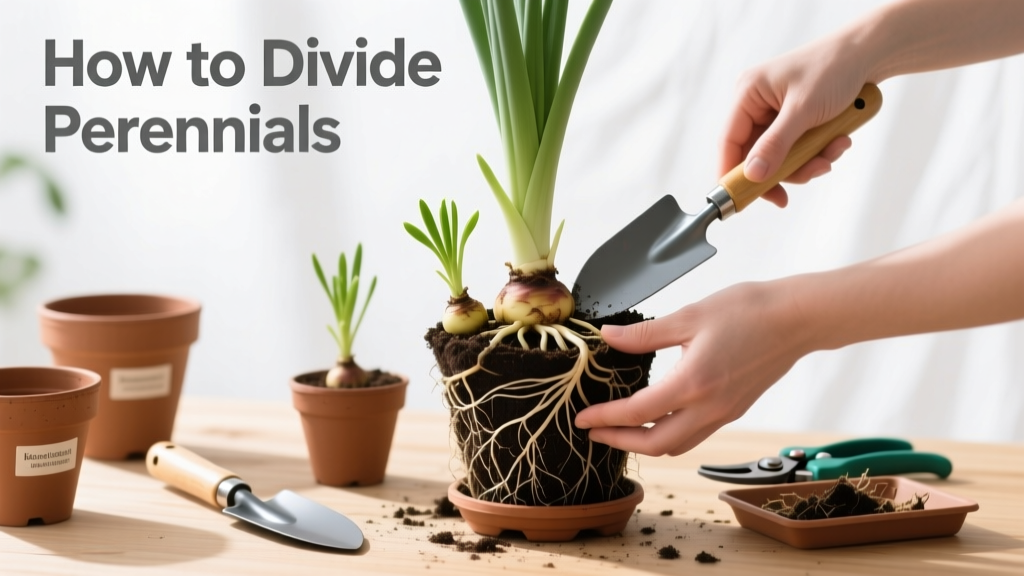
Dividing perennials is a foundational garden skill that keeps plants healthy, prevents overcrowding, and lets you expand your garden without buying new plants. It’s a moderate-difficulty task that takes 20–45 minutes per clump, depending on size and root density — and it’s best done in early spring or early fall when temperatures are mild and soil is workable.
Overview
| Skill Level | Time Required | Tools Needed | Estimated Cost |
|---|---|---|---|
| Moderate (requires observation + physical effort) | 20–45 minutes per plant | Garden fork, sharp knife or spade, gloves, watering can | $0–$12 (most tools you likely own) |
Tools & Materials
| Item | Why It’s Needed | Notes |
|---|---|---|
| Garden fork (not a spade) | Lifts roots gently without slicing through crowns | Use a 4-pronged, stainless steel fork for heavy clay soils |
| Sharp, clean knife or hori-hori tool | Cuts dense root masses cleanly; reduces disease risk | Sanitize with 10% bleach solution between plants (University of Minnesota Extension, 2022) |
| Work gloves (leather or puncture-resistant) | Protects hands from thorns, fibrous roots, and soil pathogens | Especially critical for plants like ornamental grasses or yarrow |
| Watering can with rose attachment | Hydrates divisions before replanting and settles soil | Avoid high-pressure hoses — they dislodge fine roots |
Step-by-Step Instructions
1. Choose the right time and plant
Wait until the plant shows 2–4 inches of new growth in spring (e.g., hostas, daylilies) or just after flowering in late summer (e.g., asters, sedum). Avoid dividing during drought, extreme heat, or when the plant is dormant. According to the Royal Horticultural Society’s 2023 Perennial Care Guide, timing affects survival rates by up to 37%.
2. Water the plant deeply 1–2 days before digging
Soak the soil to a depth of 6 inches. This loosens compacted earth and minimizes root breakage. Dry soil makes extraction harder and increases crown damage — especially in clay-heavy gardens.
3. Lift the entire clump carefully
Insert a garden fork at a 45° angle 6–8 inches from the base. Rock it gently back and forth to loosen roots. Work in a circle around the plant, then lift upward — never yank straight up. If resistance is high, dig deeper rather than force it.
4. Separate the divisions by hand or tool
Shake off excess soil to expose the crown and root structure. For fibrous-rooted plants (like coreopsis), tease apart sections with your fingers. For dense, woody crowns (like iris or peony), use a sharp knife: cut through rhizomes or root masses so each division has 3–5 vigorous eyes (growth points) and at least ½ inch of healthy root tissue.
- Tip: Discard any blackened, mushy, or hollow sections — they’re signs of rot or age.
- Warning: Never divide plants with fewer than 3 visible eyes — they lack energy reserves to reestablish.
5. Replant immediately or store short-term
Set divisions at the same depth they grew originally (match soil line on stems). Backfill with native soil — no amendments unless your soil is severely compacted or nutrient-poor. Water thoroughly, then mulch with 1–2 inches of shredded bark (not piled against stems). If you must delay planting more than 2 hours, wrap roots in damp burlap and keep in shade.
Pro Tips
Seasoned gardeners know division isn’t just about propagation — it’s preventative maintenance. Overcrowded perennials often bloom less, suffer more pests, and develop weak stems. The U.S. Department of Agriculture notes that un-divided hosta clumps over 5 years old show 22% lower flower count and increased vulnerability to foliar nematodes (USDA ARS, 2021).
"Dividing every 3–5 years isn’t optional for vigorous perennials — it’s how you reset their biological clock." — Dr. Linda Chalker-Scott, Washington State University Extension, 2020
- Label divisions with plant name and date using wooden markers — helpful when tracking performance next season
- Avoid dividing plants stressed by recent transplant, drought, or pest infestation — wait until they recover fully
- Don’t compost diseased divisions; bag and discard them to prevent pathogen spread
How often should I divide my perennials?
Most clumping perennials benefit from division every 3–5 years. Fast growers like bee balm or mint may need annual attention, while slow growers like lavender or Russian sage rarely require it. Watch for visual cues: reduced flowering, dead centers, or outward-thinning foliage.
Can I divide perennials in summer?
You can — but only if you’re prepared to water daily for 10–14 days and provide afternoon shade. Summer division carries higher failure risk, especially for shallow-rooted plants like coral bells. Stick to spring or fall whenever possible.
What if my divisions don’t sprout?
Check moisture first — newly divided plants dry out fast. Then inspect for crown rot (soft, brown tissue at soil line). If no growth appears after 3 weeks in cool weather, gently dig up one division and examine roots: white and firm = patience needed; brown and slimy = discard and try again next season.
Do I need to fertilize right after dividing?
No. Wait until new growth reaches 4–6 inches tall, then apply a balanced, slow-release organic fertilizer (e.g., 5-5-5). Immediate feeding stresses tender roots and encourages leafy growth over root development.
Which perennials shouldn’t be divided?
Avoid dividing taprooted species like butterfly weed (Asclepias tuberosa) or oriental poppies — they resent root disturbance and rarely recover. Also skip self-seeding perennials such as columbine or forget-me-nots unless you want more volunteers. For alternatives, see our guide on propagating perennials from seed.
Can I share divisions with neighbors?
Absolutely — and it’s encouraged! Just ensure divisions meet local plant-sharing guidelines (e.g., no invasive species like purple loosestrife). Include a label with plant name, sun/water needs, and division date. Many garden clubs host spring swap events — check local garden clubs for upcoming dates.
Dividing perennials connects you to the rhythm of your garden — it’s part science, part intuition, and wholly satisfying. With practice, you’ll learn to read a plant’s signals, anticipate its needs, and grow your garden not just wider, but wiser. Keep a simple journal: note which varieties divided well, what time of year worked best, and how quickly they rebounded. That record becomes your most valuable gardening tool.