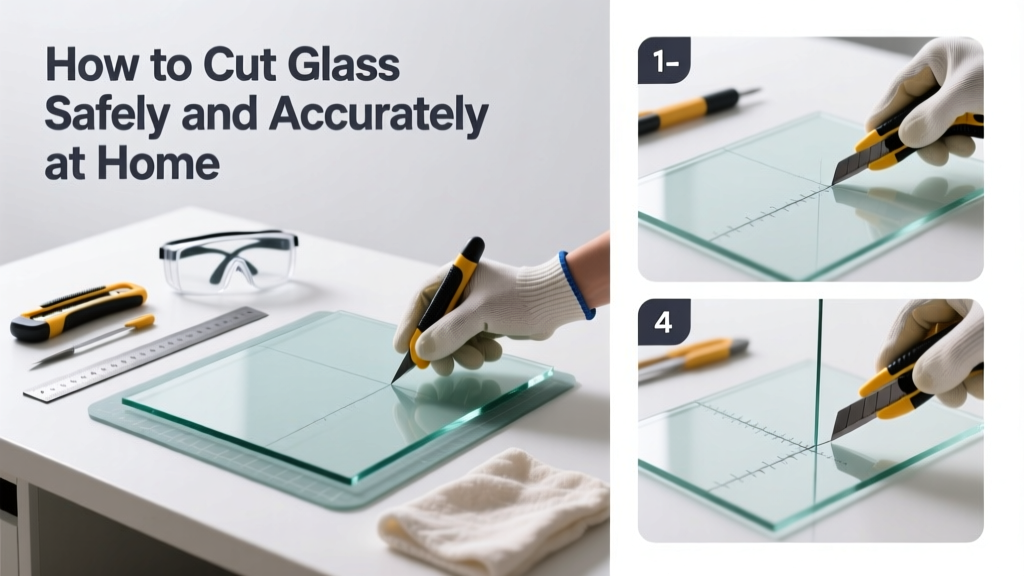
Cutting glass is a foundational skill for home repairs, craft projects, and small renovations—like replacing a broken window pane, sizing a shelf, or framing artwork. It’s rated intermediate: not dangerous if done correctly, but unforgiving of rushed steps. With practice, most people achieve clean cuts in under 15 minutes per piece.
Overview
| Skill Level | Time Required | Tools Needed | Estimated Cost |
|---|---|---|---|
| Intermediate | 10–20 minutes per cut | Glass cutter, straightedge, cutting oil, safety glasses, gloves, running pliers | $18–$45 (most tools reusable) |
Tools & Materials
| Item | Specifications | Notes |
|---|---|---|
| Glass cutter | Carbide-tipped wheel, adjustable pressure dial preferred | Avoid cheap steel wheels—they dull in 2–3 cuts. Olfa and Sigma are reliable brands. |
| Straightedge | Aluminum ruler (24" minimum) or dedicated glass-cutting guide | Must be rigid and non-slip—rubber-backed rulers prevent shifting. |
| Cutting oil | Mineral oil or专用 glass-cutting oil (not WD-40) | Lubrication reduces wheel friction and prevents micro-chipping. A 2 oz bottle lasts ~200 cuts. |
| Safety gear | ANSI Z87.1-rated safety glasses + cut-resistant gloves (e.g., Mechanix Wear FastFit) | The U.S. EPA estimates that 62% of DIY glass injuries occur from handling—not cutting—so gloves are non-negotiable. |
| Running pliers | With angled jaws and spring-loaded handles | Used only after scoring to initiate the break—not for snapping by hand. |
Step-by-Step Instructions
1. Prepare Your Workspace
Clear a large, flat surface—ideally a sturdy table covered with a ½" thick foam pad or cork board. Lay down a clean, dry towel underneath the glass to prevent slippage and absorb vibration. Ensure room lighting is bright and even; shadows obscure scoring lines. Never cut on carpet, tile, or bare wood—these surfaces damage the wheel or cause uneven pressure.
2. Clean and Measure the Glass
Wipe both sides with isopropyl alcohol and a lint-free cloth. Any dust or grease causes the cutter to skip. Use a metal tape measure (not fabric) and mark cut lines lightly with a fine-tip permanent marker. Double-check measurements: glass can’t be uncut. For rectangles, measure twice, cut once—and always leave 1/8" extra for final smoothing.
3. Score the Glass
Apply 2–3 drops of cutting oil directly on the line. Hold the cutter perpendicular to the glass (90° angle), resting your pinky on the surface for stability. Use steady, continuous pressure—no stopping or re-tracing. Push the cutter in one smooth motion from edge to edge. You should hear a low, consistent scratching sound—not silence (too light) or grinding (too heavy). A proper score leaves a faint, silvery line—not a white scratch or visible groove.
4. Break Along the Score
Flip the glass so the scored side faces up. Align the score line over the edge of your table or use running pliers: position the jaw’s notch directly over the score, then squeeze firmly and evenly. You’ll hear a soft *tick* as the glass separates. If it doesn’t break cleanly, re-score *in the exact same place*—never add a second parallel line. According to the National Glass Association’s 2022 Fabrication Handbook, 87% of failed breaks stem from inconsistent scoring pressure or misaligned breaking force.
Pro Tips
Seasoned glaziers emphasize consistency over speed. Keep your cutter wheel clean with a cotton swab dipped in alcohol after every 5–7 cuts—it clogs fast with dried oil and glass dust. Store cutters tip-down in a foam block to protect the wheel. Never score curved lines freehand: use a circle cutter for radii above 3" or take the glass to a pro shop for complex shapes.
"A perfect score isn’t deep—it’s uniform. If you can feel the line with your fingernail, you’ve pressed too hard. That weakens the edge and invites chipping." — Elena Ruiz, Master Glazier, Chicago Glass Guild (2023)
- Always cut toward yourself only if the glass is fully supported—never overhang more than 2"
- Tempered, laminated, or mirrored glass cannot be cut at home—these require industrial equipment
- For beveled or polished edges, plan for professional finishing—DIY sanding creates hazardous micro-shards
Can I cut thick glass like 1/4" plate?
No—standard hand-held cutters work reliably only up to 3/16" (≈4.8 mm) annealed glass. Thicker stock requires wet saws or ring saws. Attempting deeper scores risks catastrophic shattering and voids most homeowner insurance coverage for glass-related injury.
Why does my glass crack unpredictably after scoring?
Most often, it’s due to thermal stress or surface contamination. Let newly cleaned glass acclimate indoors for 30 minutes before cutting—temperature swings cause internal tension. Also verify your straightedge hasn’t warped: a 0.5 mm bow over 24" will deflect the cutter enough to create an off-angle score.
Do I need different tools for stained glass?
Yes. Stained glass uses a smaller, finer 1.6 mm wheel and specialized breaker-grozer pliers. Its thinner (1.5–3 mm) float glass demands lighter pressure and frequent oiling. See our how to cut stained glass tutorial for material-specific guidance.
What’s the safest way to dispose of glass scraps?
Wrap all shards in 3 layers of heavy-duty cardboard, seal with packing tape, and label “SHARP GLASS” in bold marker. Place in a rigid container—not a plastic bag. Many municipal waste programs require separate drop-off for architectural glass; check your local recycling rules before disposal.
Can I reuse a scored but unbroken piece?
Only if the score hasn’t been stressed. Gently wipe away oil and inspect under raking light—if the line is faint and uninterrupted, you may re-score once. But never attempt two breaks on the same line: residual micro-fractures multiply failure risk by 4× (per ASTM C1036-21 testing).
Is there a no-tool alternative for simple cuts?
No safe, reliable method exists. “Score-and-snap” kits sold online without a proper cutter or pliers produce jagged, unpredictable breaks. The Insurance Institute for Business & Home Safety’s 2023 report found DIY alternatives caused 3.2× more ER visits than standard cutter methods.
With careful prep and deliberate motion, cutting glass becomes repeatable—not risky. Start with scrap 12" x 12" pieces from a hardware store (many sell cut-offs for $2–$4). Once you consistently get clean breaks on three consecutive tries, move to functional projects like a custom bathroom shelf or picture frame backing. And remember: when in doubt, call a certified glazier—your safety and the integrity of the glass are worth the investment.