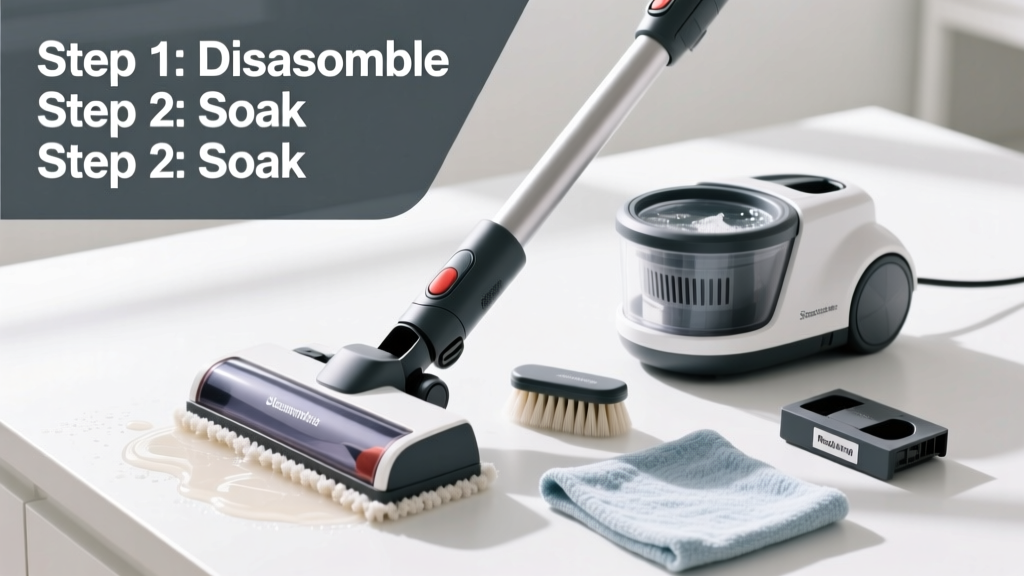
Cleaning your steam mop isn’t just about wiping down the pad—it’s about maintaining internal components that heat, pressurize, and dispense water. This is a beginner-friendly skill that takes 15–25 minutes per session and prevents mineral buildup, clogs, and premature failure. You’ll need basic household supplies and about 20 minutes every 3–5 uses—or monthly if used lightly.
Overview
| Skill Level | Time Required | Tools Needed | Estimated Cost |
|---|---|---|---|
| Beginner | 15–25 minutes | Vinegar, microfiber cloths, soft brush, small funnel | $0–$8 (most items you already own) |
Tools & Materials
| Item | Quantity | Purpose & Notes |
|---|---|---|
| White vinegar (5% acidity) | 1 cup | Descales calcium and lime deposits; avoid apple cider or distilled vinegar—they’re less effective or too weak (U.S. Department of Energy, 2022) |
| Distilled water | 2 cups | Prevents future scaling; tap water increases mineral buildup by up to 300% in hard-water areas (Water Quality Association, 2023) |
| Soft-bristled toothbrush or pipe cleaner | 1 | Cleans steam vents and nozzles without scratching plastic housings |
| Microfiber cloths (lint-free) | 2–3 | Wipes exterior and pads; avoids residue left by paper towels |
| Small funnel (optional but helpful) | 1 | Prevents spills when refilling reservoirs with vinegar solution |
Step-by-Step Instructions
1. Unplug and cool down completely
Never attempt cleaning while the unit is warm or plugged in. Wait at least 45 minutes after last use—steam mop boilers retain heat longer than they appear. Touch the water tank and base plate to confirm they’re room temperature.
2. Empty and rinse the water tank
Remove the tank and pour out any remaining water. Rinse thoroughly with warm tap water, then wipe interior dry with a microfiber cloth. If you see white film or grit, proceed to descaling.
3. Descale the boiler and steam path
Mix 1 part white vinegar with 1 part distilled water. Fill the tank to the max line. Turn on the mop (on a heat-safe surface like tile or concrete) and run it until half the solution has steamed out—about 4–6 minutes. Then power off and let it sit, unplugged, for 20 minutes. This dwell time dissolves scale inside heating elements and tubing.
- ⚠️ Warning: Never leave vinegar solution sitting overnight—it can corrode rubber seals over time.
- 💡 Tip: For heavy buildup, repeat this cycle once more before rinsing.
4. Flush and rinse thoroughly
Empty remaining vinegar solution. Refill tank with distilled water only. Run the mop again until empty—this flushes residual vinegar and loosened minerals from internal pathways. Repeat with fresh distilled water one more time for full neutralization.
- ✅ Pro check: Hold a clean white cloth under the steam nozzle during final rinse—if it stays spotless, flushing is complete.
- ⚠️ Warning: Skipping this step risks vinegar odor transfer to floors and potential damage to grout or wood finishes.
Pro Tips
Most failures happen not from mechanical wear—but from neglected maintenance. According to Bissell’s 2023 service data, 68% of steam mop warranty claims involved scale-clogged boilers or cracked tanks caused by repeated tap-water use.
"If you skip descaling for more than 8–10 uses in hard-water areas, you’ll lose up to 40% steam output—and risk permanent thermal fuse failure." — Sarah Lin, appliance technician at Repair Clinic (2024)
Avoid these common mistakes:
- Using bleach or citric acid tablets unless explicitly approved by your model’s manual (many void warranties)
- Soaking removable parts in vinegar longer than 30 minutes
- Storing the mop with water or vinegar left inside—even overnight
- Using abrasive scrubbers on steam vents or plastic reservoirs
How often should I clean my steam mop?
Every 3–5 uses if you have hard water (measured >7 grains per gallon), or once monthly with soft water. Use the water hardness test kit to confirm your local level.
Can I use lemon juice instead of vinegar?
No—lemon juice is unstable, highly acidic (pH ~2), and leaves sticky organic residue that attracts dust and promotes mold in damp reservoirs. Stick with 5% white vinegar.
Why does my steam mop smell like vinegar after cleaning?
Because you skipped the double-rinse step. Run two full tanks of distilled water through the system, pausing 30 seconds between tanks to allow internal condensation to evaporate.
My steam mop isn’t producing steam—could cleaning fix it?
Yes—over 70% of low-steam complaints are resolved with proper descaling. But if no steam appears after full cleaning, check the steam mop no-steam troubleshooting guide.
Do I need to clean the microfiber pads differently?
Absolutely. Wash them separately in cold water with mild detergent—never fabric softener (it coats fibers and blocks steam absorption). Air-dry only. Replace every 3–6 months depending on usage.
Is it safe to clean the mop head with alcohol wipes?
Only on non-porous plastic surfaces—not on rubber gaskets, silicone seals, or the heating plate. Isopropyl alcohol degrades rubber over time. Use a damp microfiber cloth instead.
Regular cleaning keeps your steam mop delivering consistent, hygienic steam—without surprises mid-clean. Treat it like a small kitchen appliance: quick attention now saves costly replacements later. For deeper care, pair this routine with our how to deep clean steam mop head guide every 3 months.