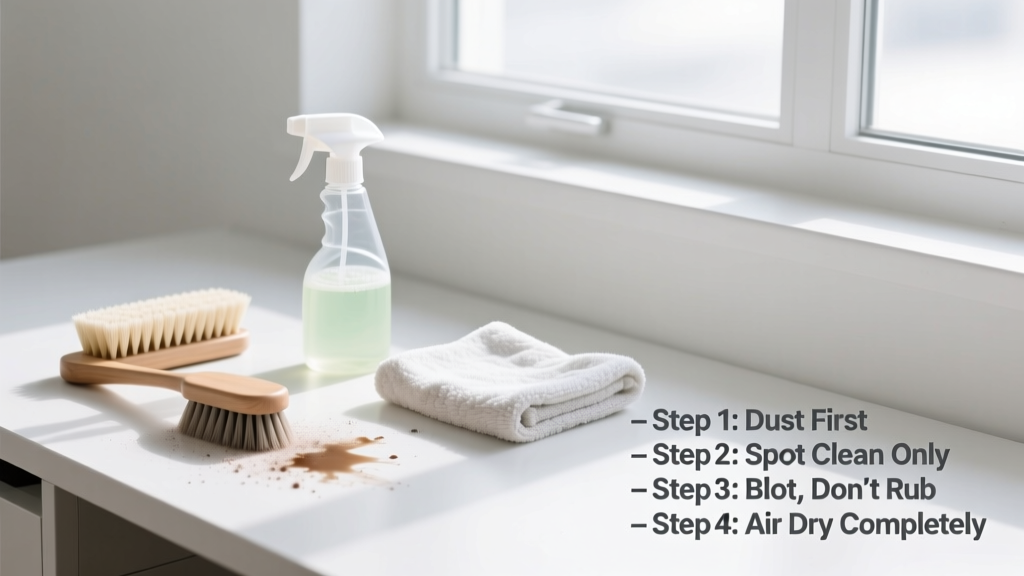
Cleaning microfiber furniture is a practical skill that balances gentleness with effectiveness—no special certification needed, but technique matters. It’s a low-difficulty task requiring about 30–45 minutes for a standard two-seater sofa, plus drying time. You’ll need common household items and one specialized tool: a soft-bristled brush or microfiber-specific upholstery brush.
Overview
| Skill Level | Time Required | Tools Needed | Estimated Cost |
|---|---|---|---|
| Beginner | 30–45 min active + 4–6 hrs dry time | Soft brush, white vinegar, isopropyl alcohol (91%), distilled water, clean cloths | $0–$12 (most items likely already in home) |
Tools & Materials
| Item | Specification | Why It Matters |
|---|---|---|
| White vinegar | Distilled, 5% acidity | Breaks down organic soils without residue; safe for colorfast microfiber (per colorfastness test) |
| Isopropyl alcohol | 91% concentration (not 70%) | Evaporates fast, lifts oily residues without swelling fibers—critical for food or makeup stains |
| Microfiber brush | Natural bristle or nylon, stiff-but-flexible | Loosens embedded dust without fraying fabric; avoid wire brushes—they shred microfiber |
| Clean lint-free cloths | 100% cotton or undyed microfiber | Prevents lint transfer and dye bleeding; never use paper towels—they leave fibers and scratch |
Step-by-Step Instructions
Vacuum first—don’t skip this
Use an upholstery attachment on low suction. Work in 12-inch sections, brushing *with* the nap (in the direction the fibers lie) before vacuuming. This lifts surface dust and prevents grinding grit deeper into the weave. Vacuum both seat cushions and crevices—microfiber traps 3x more dust than cotton upholstery, according to the American Lung Association’s 2022 Indoor Air Quality Report.
Spot-treat stains immediately
Mix 1 part 91% isopropyl alcohol with 1 part distilled water in a spray bottle. Lightly mist—not soak—the stain. Blot gently with a folded lint-free cloth, rotating to a clean area as it absorbs. Never rub: friction pushes stain deeper and mats fibers. For ink or permanent marker, dab with alcohol alone using a cotton swab—then follow with vinegar-water rinse to neutralize residual alcohol.
Deep-clean soiled areas
Combine 1 tbsp white vinegar + 1 cup distilled water + 1 tsp mild dish soap (fragrance- and dye-free). Spray lightly onto a cloth—not the furniture—and wipe in small circles, following the nap. Rinse the cloth frequently in clean water. Wipe again with plain distilled water on a fresh cloth to remove soap residue, which attracts dust over time.
Air-dry thoroughly before use
Let cushions air-dry upright, not flat, with fans circulating air *around* (not directly at) the fabric. Avoid heat sources—microfiber melts at 482°F (250°C), and hair dryers can distort pile. Full dry time: 4–6 hours. Sitting on damp microfiber compresses wet fibers, causing permanent flattening.
Pro Tips
Microfiber isn’t indestructible—it’s engineered polyester or polyamide with ultra-fine filaments. Aggressive cleaning collapses those filaments, reducing its liquid-repellent properties. The U.S. Department of Energy notes that properly maintained microfiber retains >90% of its original performance after 5 years; neglected pieces lose up to 40% absorbency and stain resistance in under 18 months.
“Never use bleach, steam cleaners, or enzyme cleaners on microfiber. They degrade the polymer structure and void most manufacturer warranties.” — Sarah Lin, Textile Care Specialist, Fabricare Institute (2023)
- Test all solutions on an inconspicuous seam or underside first—even ‘safe’ cleaners can react with factory-applied stain guards
- Rotate cushions weekly. Uneven wear causes premature pilling, especially on lower-density microfiber (under 200 g/m²)
- Keep pets’ claws trimmed. A single deep scratch can unravel 3–5 inches of microfiber weave
Can I use baking soda to deodorize?
Yes—but sparingly. Sprinkle food-grade baking soda only on dry fabric, let sit 15 minutes, then vacuum thoroughly. Don’t leave it overnight: residual powder embeds in fibers and dulls the finish. For persistent odors, try activated charcoal sachets placed under cushions instead.
What if my microfiber has a “W/S” or “S” code?
“W” means water-based cleaners are approved; “S” means solvent-only (alcohol or dry-cleaning fluid); “W/S” means either is acceptable. These codes appear on the furniture’s law tag—usually under the seat cushion or along the frame. Ignoring them risks delamination or fiber stiffening.
Why does my microfiber look streaky after cleaning?
Streaks usually mean uneven moisture application or using tap water (minerals leave deposits). Always use distilled water, apply solutions to cloths—not fabric—and wipe in consistent, overlapping strokes following the nap. Let each section dry fully before moving to the next.
Can I machine-wash removable microfiber covers?
Only if the care label says “machine washable.” Most aren’t—heat and agitation break down the split-fiber structure. If approved, use cold water, gentle cycle, and hang-dry. Never tumble-dry: even low heat shrinks and hardens microfiber permanently.
How often should I deep-clean microfiber furniture?
Every 6–12 months for low-traffic rooms; every 3–4 months in homes with kids, pets, or high humidity. Between deep cleans, vacuum weekly and spot-treat spills within 5 minutes. According to the Carpet and Rug Institute’s 2021 Maintenance Benchmark Study, households that vacuum microfiber twice weekly reduce visible soiling by 68% compared to monthly cleaning.
Does microfiber attract pet hair more than other fabrics?
No—it actually repels it better than leather or velvet, thanks to its tight, static-resistant weave. But pet hair *sticks* more stubbornly when the fabric is dusty or slightly damp. Regular vacuuming with a brush-roll attachment (not beater bar) removes hair efficiently—see our pet hair removal guide for technique details.
Maintaining microfiber furniture isn’t about perfection—it’s about consistency and respect for the material’s engineering. With these steps, your sofa stays soft, stain-resistant, and visually fresh for years. For tougher jobs like ink set-in for over 48 hours or large-area water damage, consult a certified textile cleaner—find one through the IICRC directory.