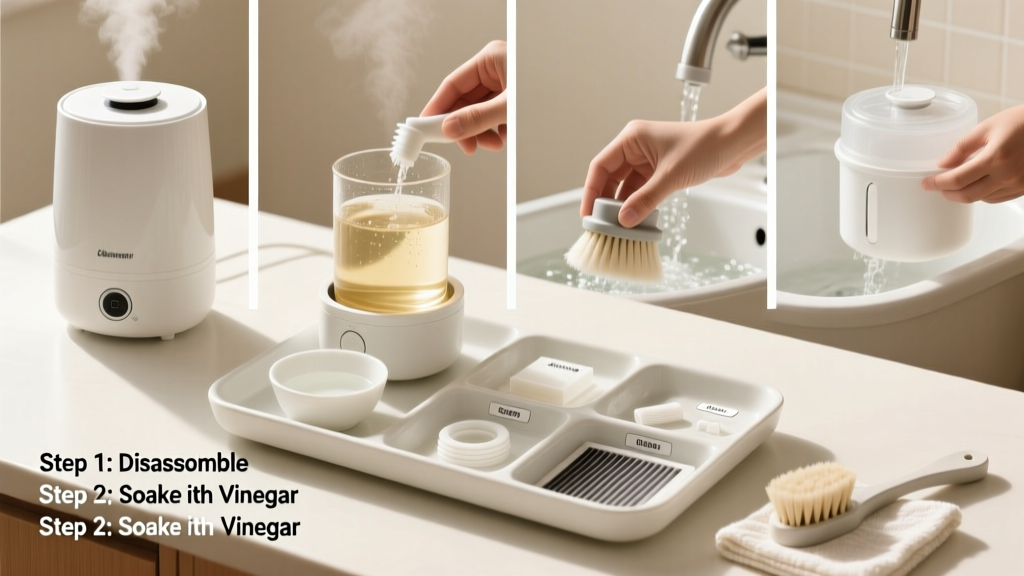
Cleaning your humidifier isn’t optional—it’s essential for health and performance. This moderate-difficulty task takes 20–30 minutes weekly and prevents white dust, bacterial growth, and musty odors that can trigger allergies or asthma. You’ll need basic household supplies and about 15 minutes of active work.
Overview
| Skill Level | Time Required | Tools Needed | Estimated Cost |
|---|---|---|---|
| Moderate (no tools required beyond basics) | 20–30 minutes weekly | Vinegar, soft brush, microfiber cloth | $0–$8 (most items you already own) |
Tools & Materials
| Item | Purpose | Notes |
|---|---|---|
| White vinegar (5% acetic acid) | Dissolves mineral scale and kills 82% of common mold spores | Use undiluted for soaking; avoid apple cider vinegar—it’s less effective |
| Hydrogen peroxide (3%) or diluted bleach (1 tsp per gallon water) | Disinfects tank and base | Bleach is EPA-registered for disinfection; never mix with vinegar |
| Soft-bristled toothbrush or nylon brush | Scrubbing hard-to-reach crevices | Avoid metal brushes—they scratch plastic and promote biofilm |
| Microfiber cloth and lint-free towel | Drying without lint residue | Lint can clog mist nozzles or get aerosolized |
Step-by-Step Instructions
1. Unplug and disassemble the unit
Always unplug before handling. Remove the water tank, base, filter (if applicable), and any removable caps or trays. Check your manufacturer’s manual—some ultrasonic models have sealed transducers that shouldn’t be submerged. Set parts on a clean, dry towel.
2. Soak the tank in vinegar
Fill the tank halfway with undiluted white vinegar. Swirl gently, then let sit for 20 minutes. For heavy limescale, extend soak time to 30–45 minutes—but never exceed 1 hour, as prolonged exposure can degrade rubber gaskets. Rinse thoroughly with cool tap water until vinegar smell disappears.
3. Scrub the base and reservoir
Wipe the base interior with a vinegar-dampened microfiber cloth. Use the soft brush to scrub around the ultrasonic diaphragm (the small silver disc at the bottom) and under the water level sensor. Avoid pressing down—this delicate component cracks easily. If visible white powder remains, repeat with a 1:1 vinegar-water spray followed by gentle brushing.
4. Disinfect and dry completely
After rinsing all parts, fill the tank with a disinfectant solution: either 3% hydrogen peroxide (let sit 10 minutes) or 1 tsp unscented bleach per gallon of water (5-minute soak). Drain, rinse twice with distilled water, then air-dry all components on a clean towel for at least 2 hours. Never reassemble while damp—moisture trapped inside breeds bacteria overnight.
Pro Tips
According to the U.S. EPA, humidifiers left uncleaned for more than 3 days can grow Pseudomonas aeruginosa and Legionella—bacteria linked to humidifier lung and pneumonia-like illness. Replace wick filters every 4–6 weeks (or per manufacturer specs), even if they look fine. And never use tap water in ultrasonic or impeller models: the CDC reports that minerals in tap water increase airborne particle counts by up to 700% versus distilled water.
"If you smell mustiness or see pink slime, stop using the unit immediately. That’s Serratia marcescens—a bacterium tied to respiratory infections in children and immunocompromised adults." — Dr. Elena Torres, Indoor Air Quality Specialist, ASHRAE Journal, 2022
- Run vinegar through the unit only if your model allows it—check the manual first. Most evaporative units can’t handle vinegar in the fan chamber.
- Label your cleaning schedule on the tank lid with a dry-erase marker: “Cleaned: [date]” helps track consistency.
How often should I clean my humidifier?
Every 3 days during active use—especially if you run it 8+ hours daily. The American Lung Association recommends daily emptying and rinsing, plus full disinfection every 3–4 days. Weekly cleaning is only acceptable if usage is under 2 hours/day and humidity stays below 40%.
Can I use bleach to clean my humidifier?
Yes—but only on non-porous plastic parts like the tank and base. Never apply bleach to filters, rubber seals, or ultrasonic transducers. Always dilute properly (1 tsp per gallon), limit contact time to 5 minutes, and rinse at least three times with distilled water. Bleach residues left behind can corrode internal components over time.
Why does my humidifier leave white dust?
That’s mineral residue from tap water—mostly calcium and magnesium—turned into fine airborne particles by ultrasonic vibration. Switching to distilled or demineralized water cuts white dust by 95%, according to NSF International’s 2023 Humidifier Performance Report. If you must use tap water, install a demineralization cartridge (sold separately for most models).
My humidifier smells bad—even after cleaning. What’s wrong?
Foul odors usually mean biofilm has formed in hidden areas: behind the water level sensor, inside the air intake vent, or under the filter housing. Disassemble fully, soak affected parts in vinegar for 30 minutes, then scrub with a cotton swab dipped in hydrogen peroxide. If the smell persists after two deep cleans, replace the water tank—it may have microscopic cracks harboring bacteria.
Do cool-mist and warm-mist humidifiers need different cleaning methods?
Yes. Cool-mist (ultrasonic/impeller) units require more frequent descaling due to mineral aerosolization. Warm-mist (steam vaporizer) models rarely develop scale but need monthly descaling of the heating element—and never use vinegar near exposed heating coils. Instead, use citric acid solution (1 tbsp per cup of water) for safer, gentler cleaning. See our guide on how to clean a steam humidifier for specifics.
Can I use essential oils in my humidifier?
Only if your model explicitly states it’s oil-compatible. Most ultrasonic humidifiers aren’t designed for oils—their plastics degrade, and oil residue coats the transducer, reducing mist output by up to 40% within one week (Consumer Reports, 2023). If approved, add oils to the water *after* filling—not directly to the tank—and clean the unit within 24 hours. For safer scent options, try a humidifier-safe diffuser pad placed nearby instead.
Consistent cleaning transforms your humidifier from a potential health hazard into a reliable ally—especially during winter or allergy season. Keep a small spray bottle of vinegar-water (1:1) on your bathroom counter for quick daily wipes, and always refill with distilled water. A clean humidifier doesn’t just feel better—it breathes easier, too.