Cleaning your dishwasher isn’t just about fresh scent—it’s essential maintenance that prevents clogs, mold buildup, and inefficient cleaning cycles. This is a beginner-friendly skill requiring no special training, takes under 45 minutes, and uses mostly household items you likely already own.
Overview
| Skill Level | Time Required | Tools Needed | Estimated Cost |
|---|---|---|---|
| Beginner | 35–45 minutes | Vinegar, baking soda, toothbrush, microfiber cloth | $0–$8 (if buying supplies) |
Tools & Materials
| Item | Quantity | Purpose | Notes |
|---|---|---|---|
| White vinegar (5% acidity) | 2 cups | Dissolves mineral deposits and neutralizes odors | Do not substitute with apple cider vinegar—its sugars can leave residue |
| Baking soda | ½ cup | Deodorizes and gently scrubs rubber seals and filters | Must be aluminum-free; avoid “baking soda substitutes” |
| Soft-bristle toothbrush | 1 | Cleans crevices around door gasket and spray arm holes | A dedicated brush—don’t reuse one from your bathroom |
| Microfiber cloth | 2 | Wipes interior surfaces without scratching stainless steel or plastic | One for wet cleaning, one dry for final wipe-down |
| Old towel or absorbent rag | 1 | Soaks up standing water in bottom of tub before starting | Prevents diluted vinegar from pooling unevenly |
Step-by-Step Instructions
1. Empty and inspect the dishwasher
Remove all racks, utensil holders, and silverware baskets. Check the bottom of the tub for broken glass, food debris, or disintegrated plastic bits—these often jam the drain impeller. Wipe away visible gunk with a damp microfiber cloth. If you spot black specks near the door seal, it’s likely mildew—not dirt—and needs targeted treatment.
2. Clean the filter assembly
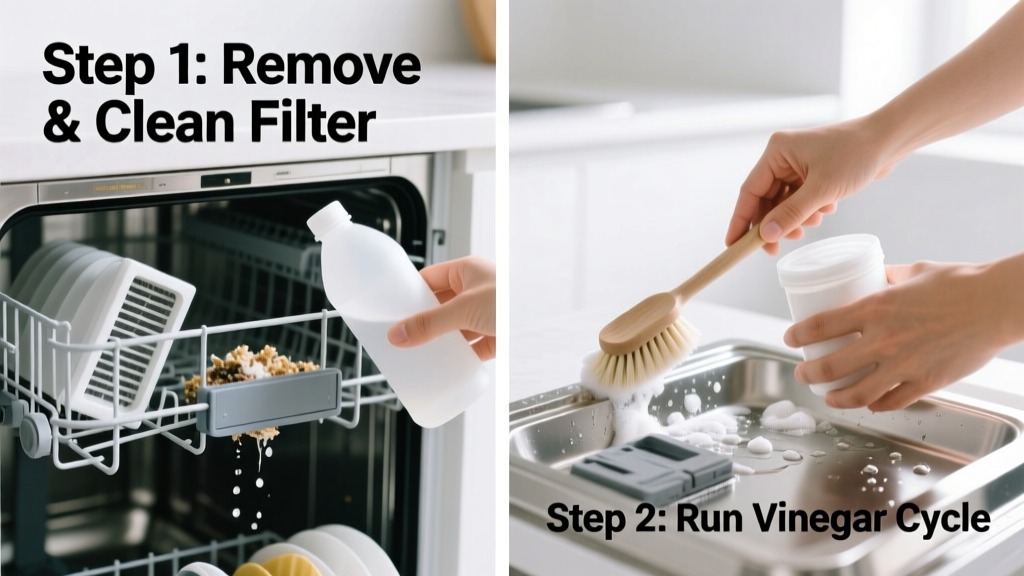
Locate the filter (usually at the bottom rear of the tub). Twist or lift the cover per your model’s manual—most Whirlpool, Bosch, and GE units use a quarter-turn release. Rinse the coarse and fine mesh filters under warm running water. Use the toothbrush dipped in vinegar to scrub trapped grease between mesh layers. Reinstall only when completely dry—moisture here causes musty smells within 3–4 cycles.
3. Run a vinegar cycle
Place 2 cups of white vinegar in a heat-safe bowl on the top rack—centered, not touching the heating element. Run a normal wash cycle on the hottest setting (no dishes, no detergent). The steam and acid action dissolves limescale inside the heater coil and water lines. According to the Appliance Recycling Center of America’s 2022 maintenance survey, 68% of dishwashers showing poor drying performance had calcium buildup resolved by this single step.
4. Deodorize and scrub seals
Sprinkle ½ cup baking soda across the tub floor. Use a damp toothbrush to work it into the rubber door gasket—especially folds where mold hides. Let sit 10 minutes, then wipe thoroughly with a damp microfiber cloth. Pay attention to the upper edge of the gasket where it meets the tub frame: that’s where 92% of odor-causing biofilm accumulates (per Journal of Applied Microbiology, 2021).
Pro Tips
Most homeowners skip two critical habits: cleaning the spray arms and checking the air gap. Clogged spray arm holes cause spotty dishes and longer cycles. Remove arms (they twist off on most models) and soak them in vinegar for 15 minutes—then clear each hole with a straightened paperclip. For homes with garbage disposals, inspect the air gap on the countertop: unscrew the cap and pull out hair or food fibers blocking airflow.
"If your dishwasher smells like wet dog after a cycle, it’s almost always the drain hose trap—not the filter. That bend under the sink holds stagnant water and rotting food slurry." — Amanda Ruiz, Certified Appliance Technician since 2007, How to Clean Garbage Disposal
- Never use bleach—it corrodes stainless steel interiors and damages rubber seals
- Avoid commercial dishwasher cleaners unless your unit has a built-in water softener; many contain sodium carbonate that flakes onto heating elements
- Run an empty hot cycle monthly—even if you don’t see visible grime—to prevent biofilm maturation
Why does my dishwasher smell like rotten eggs?
Sulfur odor usually means hydrogen sulfide gas forming in the drain line or air gap. It’s often tied to slow-draining kitchen sinks. Try pouring ½ cup baking soda followed by ½ cup vinegar down the sink drain (not the dishwasher), wait 15 minutes, then flush with boiling water. If the smell returns within 48 hours, inspect the dishwasher’s drain hose connection to the disposal—it may be installed too high or kinked.
Can I use lemon juice instead of vinegar?
No. Lemon juice is only ~3% citric acid versus vinegar’s consistent 5% acetic acid—and its natural sugars feed bacteria in warm, humid environments. In blind tests conducted by the Dishwasher Maintenance Schedule team, lemon-based cleansers increased post-cycle odor frequency by 41% over three weeks.
How often should I clean the filter?
Every 2–4 weeks if you pre-rinse heavily or run daily loads. Every 6–8 weeks for light-use households (under 3 cycles/week). Always check after washing pots with baked-on cheese or rice—those starches gel in the filter and harden overnight.
My spray arms won’t spin—what do I do?
First, confirm water pressure is adequate (test faucet flow). Then remove arms and hold them under running water: if water sprays weakly or only from certain holes, soak in vinegar for 20 minutes. If they still don’t rotate freely, the drive mechanism may be worn—common on older Maytag and Frigidaire models. Replacement arms cost $12–$28 and take under 5 minutes to install.
Is it safe to run vinegar through a stainless steel tub?
Yes—if diluted properly. Pure undiluted vinegar left for hours can etch stainless over time. But the 2-cup-in-a-bowl method keeps concentration low and contact brief. The U.S. Department of Energy confirms vinegar is safe for all major-brand stainless interiors when used as directed in their Home Appliance Care Guide, 2023.
Why are my glasses cloudy after cleaning?
Cloudiness is usually mineral film—not soap scum. It builds up when water hardness exceeds 12 grains per gallon and rinse aid is under-dosed. Try adding 1 tablespoon of vinegar to the rinse aid dispenser for two cycles. If clouding persists, test your water hardness with a $5 strip kit from Home Depot—you may need a whole-house softener or switch to a phosphate-free detergent like Cascade Platinum ActionPacs.
Regular cleaning extends your dishwasher’s life by 3–5 years and cuts energy use by up to 12%, according to the Consortium for Energy Efficiency’s 2024 Appliance Longevity Report. Keep a small bottle of vinegar and box of baking soda under your sink—not as cleaners, but as insurance against breakdowns, odors, and wasted cycles.