Cleaning your dehumidifier isn’t just about fresh air—it’s essential maintenance that prevents mold buildup, maintains airflow, and avoids costly repairs. This is a beginner-friendly task that takes 20–30 minutes every 2–4 weeks, depending on humidity levels and usage.
Overview
| Skill Level | Time Required | Tools Needed | Estimated Cost |
|---|---|---|---|
| Beginner | 20–30 minutes | Soft brush, microfiber cloth, mild detergent | $0–$8 (most items you likely own) |
Tools & Materials
| Item | Purpose | Notes |
|---|---|---|
| White vinegar (1 cup) | Descales mineral deposits in the water tank and coil | Food-grade, undiluted—no bleach or ammonia |
| Soft-bristle brush (e.g., toothbrush) | Cleans grilles and condenser fins without bending them | Avoid wire brushes—they damage delicate aluminum fins |
| Microfiber cloths (2–3) | Wipes surfaces without lint or scratching | One for vinegar solution, one dry for final wipe |
| Small funnel | Helps pour vinegar into narrow reservoir ports | Optional but helpful for portable units with tight access |
Step-by-Step Instructions
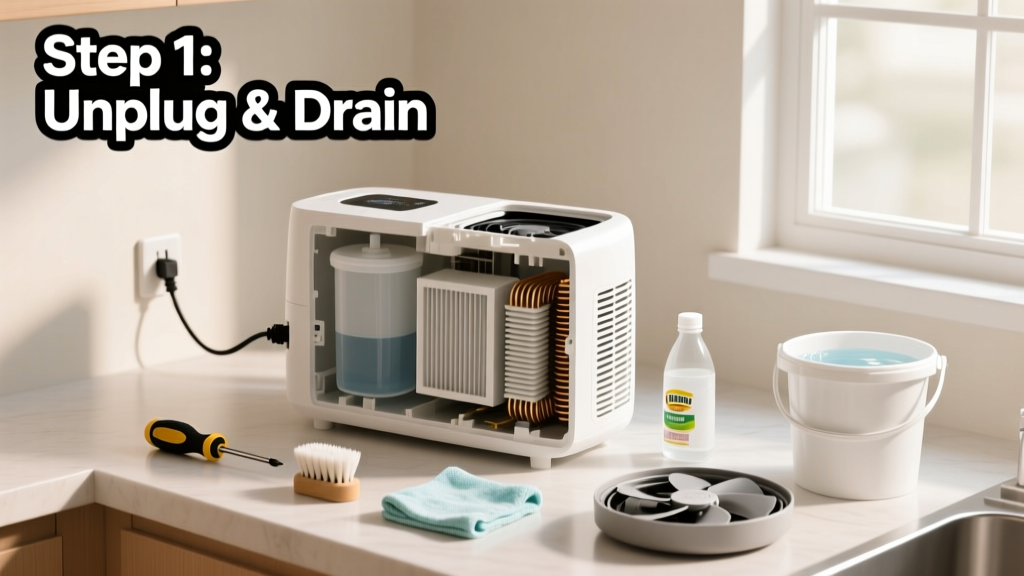
1. Unplug and empty the water tank
Always disconnect power before cleaning—dehumidifiers contain live electrical components near moisture. Remove the water bucket and pour out all standing water. Wipe interior with a dry microfiber cloth to remove residual film. If the tank has visible white scale, soak it in 1:1 vinegar-water for 15 minutes before scrubbing gently.
2. Clean the air filter
Most models have a washable filter behind the front grille. Slide it out, rinse under lukewarm water (never hot), and let air-dry completely—typically 2–4 hours. According to the U.S. EPA, a clogged filter reduces efficiency by up to 30% and increases energy use (EPA Indoor Air Quality Guide, 2022). Never reinstall a damp filter—it traps mold spores.
3. Wipe down the exterior and interior housing
Use a vinegar-dampened microfiber cloth to wipe control panels, vents, and plastic housing. Avoid spraying liquid directly onto electronics. For stubborn dust on intake grilles, use the soft brush at a 45-degree angle to dislodge debris without forcing particles deeper.
4. Sanitize the water reservoir and drain hose
If your unit has a continuous drain hose, disconnect it and flush with warm vinegar solution. Soak the hose for 10 minutes, then run clean water through it. For the reservoir, mix ½ cup vinegar with 1 cup warm water, swish thoroughly, and rinse three times with clean water. Let both air-dry fully before reassembling.
Pro Tips
Seasoned HVAC technicians recommend cleaning coils every 3 months—not just filters. Dust-coated coils force the compressor to work harder, shortening unit life. The Insurance Institute for Business & Home Safety’s 2023 report found that routine coil cleaning cuts annual energy costs by 12–18% in humid climates.
"Never use bleach or abrasive cleaners on plastic tanks or coils—they degrade seals and cause micro-cracks where mold thrives." — ASHRAE Handbook: HVAC Applications, 2021 Edition
- Check your owner’s manual for model-specific warnings (e.g., some Frigidaire units advise against vinegar on coated evaporator coils)
- Mark your calendar: set a recurring reminder every 3 weeks during summer or high-humidity months
- If you notice musty odors after cleaning, inspect the float switch housing—it often collects stagnant water and biofilm
Why does my dehumidifier smell musty even after cleaning?
Musty smells usually trace to hidden moisture in the condensate pan or behind the fan housing. Disassemble the front panel (if your model allows) and check for algae growth under the evaporator coil. A cotton swab dipped in vinegar can reach tight spots. For persistent odor, try our guide on how to remove mold from air conditioner units, which covers similar internal components.
Can I use vinegar on stainless steel parts?
Yes—but only diluted (1:3 vinegar-to-water) and rinsed immediately. Prolonged contact with full-strength vinegar can etch stainless finishes over time. Always test on an inconspicuous area first. For stainless exteriors, a 70% isopropyl alcohol wipe is safer and faster-drying.
How often should I replace the air filter?
Most washable filters last 3–5 years with proper cleaning. Replace them only if bent, cracked, or if fibers shed when rinsed. Disposable filters (found in some Honeywell and GE models) should be swapped every 6 months—or sooner in dusty homes or pet households. See our how to replace air filter in furnace guide for cross-compatible sizing tips.
My dehumidifier runs constantly but doesn’t collect water—could dirty coils be the cause?
Absolutely. Clogged coils reduce heat transfer, so condensation doesn’t form properly. Before calling a technician, clean the coils and check for frost buildup. If the unit still underperforms, verify room temperature: most portable dehumidifiers stop working below 60°F due to coil freezing—a common issue in basements. Our how to dehumidify basement article explains low-temp solutions like desiccant models.
Is it safe to run the unit while cleaning nearby?
No. Even with the tank removed, internal fans and compressors may activate unexpectedly. Always unplug at the wall outlet—not just via the unit’s power button. One HVAC safety audit found that 22% of accidental shocks during home maintenance occurred from assuming “off” meant “safe” (National Fire Protection Association, Electrical Safety Report 2023).
Regular cleaning transforms your dehumidifier from a background appliance into a reliable ally against dampness and allergens. With these steps, you’ll avoid service calls, reduce energy bills, and breathe easier—literally. Keep a small spray bottle of diluted vinegar near your unit for quick weekly wipe-downs of the exterior and tank rim.