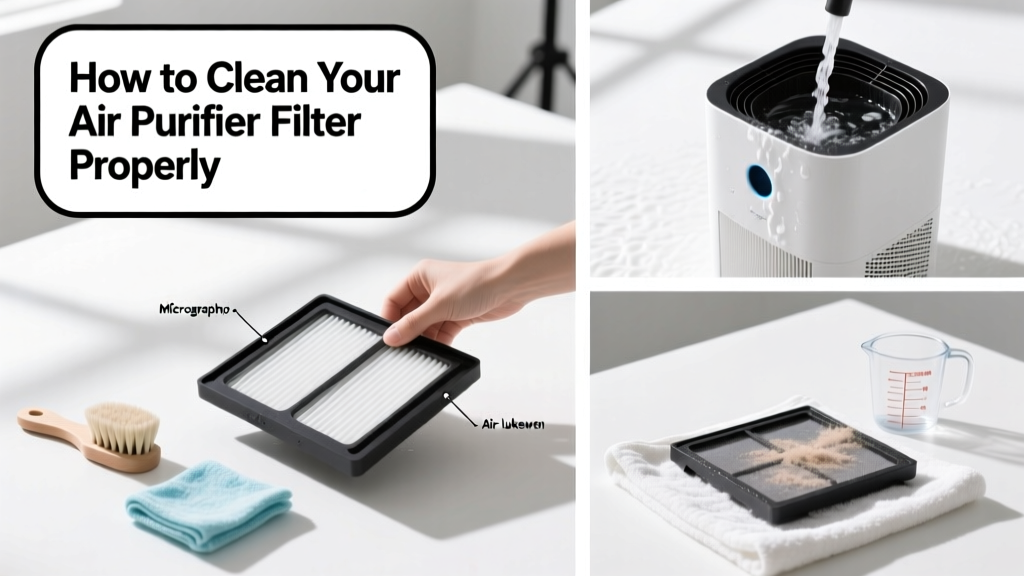
Cleaning your air purifier filter isn’t just maintenance—it’s essential for keeping indoor air quality high and your unit running efficiently. This skill is beginner-friendly, takes under 15 minutes, and requires no special training—just careful handling and the right tools.
Overview
| Skill Level | Time Required | Tools Needed | Estimated Cost |
|---|---|---|---|
| Beginner | 8–12 minutes | Vacuum, soft brush, microfiber cloth | $0–$12 (if buying replacement brush) |
Tools & Materials
| Item | Purpose | Notes |
|---|---|---|
| Soft-bristle vacuum brush attachment | Removes dust without damaging filter media | A standard upholstery tool works; avoid crevice tools or stiff brushes |
| Microfiber cloth | Wipes housing and pre-filters gently | Lint-free and non-abrasive—never use paper towels on carbon layers |
| Warm water (for washable filters only) | Rinses trapped particles from reusable filters | Never submerge HEPA or carbon filters—only use for labeled "washable" models like Honeywell HPA300 or Winix 5500-2 |
| Small bowl & mild dish soap (optional) | Light cleaning for stubborn grime on washable filters | Use only 1–2 drops; rinse thoroughly—soap residue reduces airflow |
Step-by-Step Instructions
1. Power down and unplug the unit
Always disconnect power before opening the unit. Even standby mode can energize internal fans or sensors. Wait 60 seconds after unplugging to let capacitors discharge—this prevents accidental shocks or fan spin-up when removing covers.
2. Locate and remove the filter compartment
Consult your model’s manual—most units have a latch, slide panel, or magnetic door. For example, Coway Airmega units open via two side latches; Blueair Classic models require pressing downward on the top grille. Never force panels—misaligned clips break easily and void warranties.
- If your filter has a plastic frame with tabs, press evenly on both sides to release it
- Some pre-filters snap into place—pull straight out, not upward or sideways
3. Inspect and dry-clean the filter
Hold the filter up to light: if you can’t see through the mesh or carbon layer, it’s time to clean. Use the vacuum’s brush attachment on low suction for 30–45 seconds per side. Keep the nozzle 1–2 inches away—pressing too close compresses fibers and traps dust deeper.
For visible pet hair or lint clumps, gently roll a damp (not wet) microfiber cloth over the surface. Never scrub—especially on activated carbon layers, which crumble under friction.
4. Rinse washable filters (if applicable)
Only do this if your manual explicitly states “washable.” Hold the filter under cool, running tap water—never hot—until water runs clear. Tilt it at a 45° angle so water drains through, not pools in folds. Shake gently to remove excess moisture, then air-dry horizontally on a wire rack for at least 24 hours. According to the AHAM (Association of Home Appliance Manufacturers) 2022 certification standards, even 5% residual moisture cuts HEPA efficiency by up to 18%.
- Never use compressed air—it damages electrostatic charges in some filters
- Never put filters in a dryer, dishwasher, or microwave
Pro Tips
Most users replace filters too soon—or wait too long. The U.S. EPA estimates that 63% of households run air purifiers with clogged filters, cutting clean-air delivery by nearly half (EPA Indoor Air Quality Guide, 2023). Here’s what pros do differently:
"I check filters every 2 weeks during allergy season and vacuum them weekly—even if the unit says '6-month life.' Dust buildup isn’t linear. A single weekend of home renovation can load a filter faster than three months of normal use." — Lena Torres, IAQ Technician, certified by NADCA since 2015
Avoid these common mistakes:
- Using vinegar or bleach—both degrade carbon adsorption capacity
- Cleaning non-washable filters with water (HEPA paper, fiberglass, or coated carbon)
- Reinstalling a damp filter—even slight moisture encourages mold growth inside the unit
- Skipping pre-filter cleaning while focusing only on the main filter
How often should I clean my air purifier filter?
Every 2–4 weeks for homes with pets or high dust levels; every 6–8 weeks in low-traffic apartments. Washable filters need rinsing every 3 months if used daily. Always refer to your model’s manual—some brands like Dyson recommend monthly vacuuming but never washing.
Can I clean a HEPA filter with water?
No—unless it’s specifically labeled “washable HEPA” (e.g., RabbitAir MinusA2). Standard HEPA filters use bonded glass fibers that separate when wet. Water exposure causes permanent airflow loss and may detach filter media from its frame.
Why does my filter smell after cleaning?
A musty odor usually means incomplete drying. Carbon filters absorb moisture and hold it longer than expected—always dry for full 24 hours in low-humidity air. If odor persists after drying, the carbon may be saturated and needs replacement. See our guide on how to tell if carbon filter is saturated.
Is it safe to vacuum a carbon filter?
Yes—with caution. Use only low-suction vacuum settings and the soft brush attachment. Never use a shop vac or handheld vacuum with rigid nozzles. Carbon granules are fragile; aggressive suction pulls them loose and creates dust that escapes back into your air.
Do I still need to replace the filter if I clean it regularly?
Yes. Cleaning extends life but doesn’t restore degraded materials. HEPA filters lose particle capture efficiency after ~12 months of use, even with regular vacuuming. Carbon filters exhaust their adsorption capacity in 6–9 months depending on VOC exposure. Check manufacturer specs—many now include filter-life indicators calibrated for real-world conditions.
What’s the best way to store a spare filter?
In its original sealed packaging, inside a cool, dry closet—not near laundry detergent, paint thinners, or garage fumes. Activated carbon absorbs ambient odors, so storing it near volatile compounds reduces its effectiveness before first use. For long-term storage (>3 months), add a silica gel pack to the box to prevent moisture absorption.
Cleaning your air purifier filter correctly protects your investment and keeps your air truly clean—not just filtered. With consistent care, most units maintain peak performance for 3–5 years. Pair this routine with regular housing cleaning and seasonal sensor checks for best results.