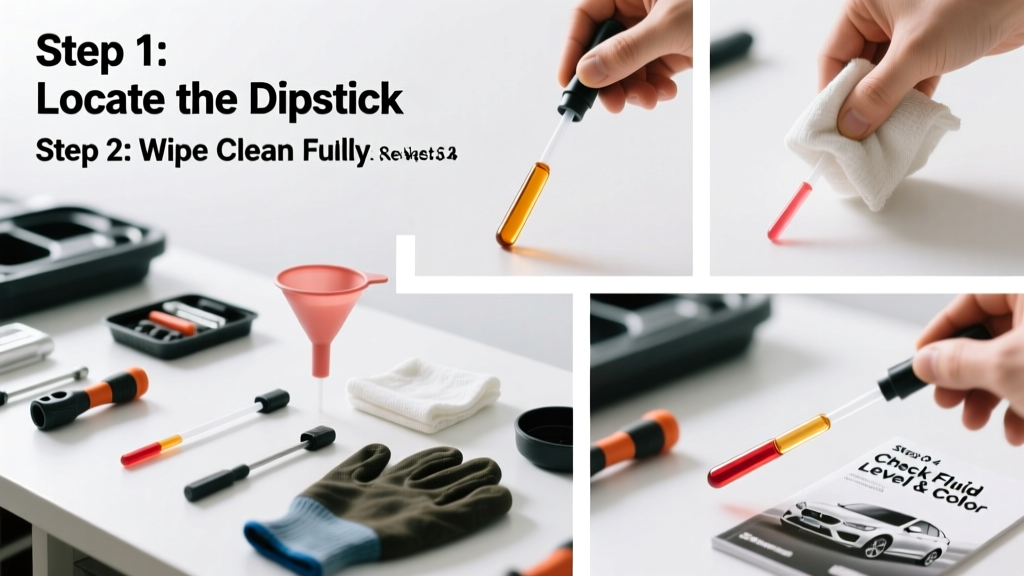
Checking your transmission fluid is a quick, essential maintenance task that helps prevent overheating, slipping gears, and premature transmission failure. It’s a beginner-level skill that takes under 10 minutes once you know where to look and what to watch for.
Overview
| Skill Level | Time Required | Tools Needed | Estimated Cost |
|---|---|---|---|
| Beginner | 7–10 minutes | None (or shop towel) | $0–$5 (if buying fresh fluid) |
Tools & Materials
| Item | Why It’s Used | Notes |
|---|---|---|
| Clean shop towel or lint-free rag | Wipes dipstick cleanly; avoids false low readings from residue | Paper towels can leave fibers—avoid them |
| Owner’s manual | Confirms fluid type, correct operating temperature, and dipstick location | Many newer vehicles (e.g., Toyota Camry 2019+, Honda Civic 2020+) have no dipstick—fluid must be checked via fill plug |
| Transmission fluid (if topping off) | Only add if level is low and color/smell is acceptable | Using the wrong type (e.g., ATF-DX vs. Mercon LV) can damage seals and clutches |
| Funnel with narrow spout (optional) | Prevents spills when adding fluid through the dipstick tube | Use only if your vehicle has a dipstick—never force fluid into a sealed system |
Step-by-Step Instructions
1. Park on level ground and warm up the engine
Start the engine and let it idle for 5–10 minutes—or drive for 10–15 miles—to bring the transmission to normal operating temperature (160–200°F). Never check cold fluid unless your manual explicitly says to. Park on level pavement, set the parking brake, and shift through all gears (P→R→N→D→P), pausing 2 seconds in each before returning to Park.
2. Locate the transmission dipstick
Open the hood and find the dipstick—usually labeled “TRANS” or colored red or yellow. It’s often near the back of the engine bay, close to the firewall. If you don’t see it, consult your owner’s manual: many front-wheel-drive models (like the 2018+ Subaru Impreza) and most CVTs use a check/fill plug instead of a dipstick.
3. Pull, wipe, reinsert, and read the dipstick
With the engine still running and in Park, pull the dipstick straight out. Wipe it completely clean with your shop towel. Fully reinsert it—don’t force it, and ensure it seats fully. Pull it out again and hold it horizontally in good light. Look at both sides of the tip: the fluid should reach between the “Hot Full” and “Hot Add” marks. Don’t rely solely on the lower mark—some manufacturers (like Ford) specify reading only at the upper edge of the crosshatch.
4. Assess color, smell, and texture
Fresh automatic transmission fluid (ATF) is translucent cherry-red and smells slightly sweet. Dark brown or black fluid signals oxidation and clutch material contamination. A burnt smell means internal overheating or slippage. Milky or frothy fluid indicates coolant mixing—likely a failed transmission cooler or cracked radiator. If fluid looks or smells off, do not top off; schedule a professional inspection.
Pro Tips
Transmission fluid doesn’t “wear out” like engine oil—but it degrades due to heat, friction, and contamination. According to the National Institute for Automotive Service Excellence (ASE) 2022 Technician Survey, 68% of premature transmission failures were linked to neglected fluid checks or incorrect fluid type.
"If the dipstick reads 'full' but the fluid is dark and smells burnt, that full level is misleading—the fluid has lost its lubricity and won't protect clutch packs under load." — Chris L., ASE Master Technician with 27 years’ experience at a Ford-certified shop
- Never check fluid with the engine off—most transmissions require pressure and flow to stabilize the level
- Don’t overfill: just ½ quart too much can cause foaming, leading to erratic shifting and air lock in the valve body
- If your car has no dipstick, you’ll need a lift or ramps and a 10mm hex key to access the fill plug—fluid should just begin to weep out when the transmission is at correct temp and level
What does it mean if the fluid level is low?
A consistently low level almost always points to a leak—not evaporation. Common leak sources include the pan gasket, torque converter seal, output shaft seal, or cooler line connections. The U.S. EPA estimates that 14% of household water usage is from leaks—but in cars, even a dime-sized drip per day can drop fluid 1 quart every 2,000 miles.
Can I use any red-colored fluid?
No. Modern transmissions require specific friction modifiers and viscosity grades. Using generic “universal” ATF in a GM 8L90 or Toyota U760E can trigger harsh shifts and TCC shudder within 500 miles. Always match the OEM specification listed in your owner’s manual—or check our guide to transmission fluid types.
My dipstick shows bubbles or foam—what’s wrong?
Foam means air is mixing with the fluid, usually from overfilling or a clogged vent. Less commonly, it’s caused by a failing torque converter seal allowing air ingestion. Either way, stop driving and verify the level first—then inspect the vent cap on the dipstick tube or transmission housing.
Do CVT transmissions need different checking steps?
Yes. Most CVTs (like Nissan’s JF015E or Subaru’s Lineartronic) require the vehicle to be idling in Neutral—not Park—with the brake applied, and fluid checked at precise temperatures (often 104–113°F). Many require a factory scan tool to activate the “check mode.” See our CVT maintenance tips for model-specific procedures.
How often should I check transmission fluid?
Every 3,000 miles—or at every oil change—is ideal for older vehicles. For newer models with “lifetime” fluid, check it annually or every 15,000 miles. Why? Because “lifetime” means “lifetime of the original fill under ideal conditions”—not your real-world stop-and-go traffic, towing, or high-heat desert driving.
Is it safe to add fluid while the engine is running?
Yes—if your vehicle uses a dipstick and the manual permits it (most do). But add slowly: no more than ¼ quart at a time, then recheck. Never pour fluid directly into the dipstick tube without a funnel—splashing onto hot exhaust components is a fire hazard. And always confirm the fluid type matches your spec before opening the bottle.
Checking transmission fluid isn’t glamorous—but it’s one of the highest-impact, lowest-effort things you can do to extend your transmission’s life by 30,000+ miles. Pair this habit with regular inspections of your power steering fluid and coolant levels, and you’ll catch small issues before they become big bills.