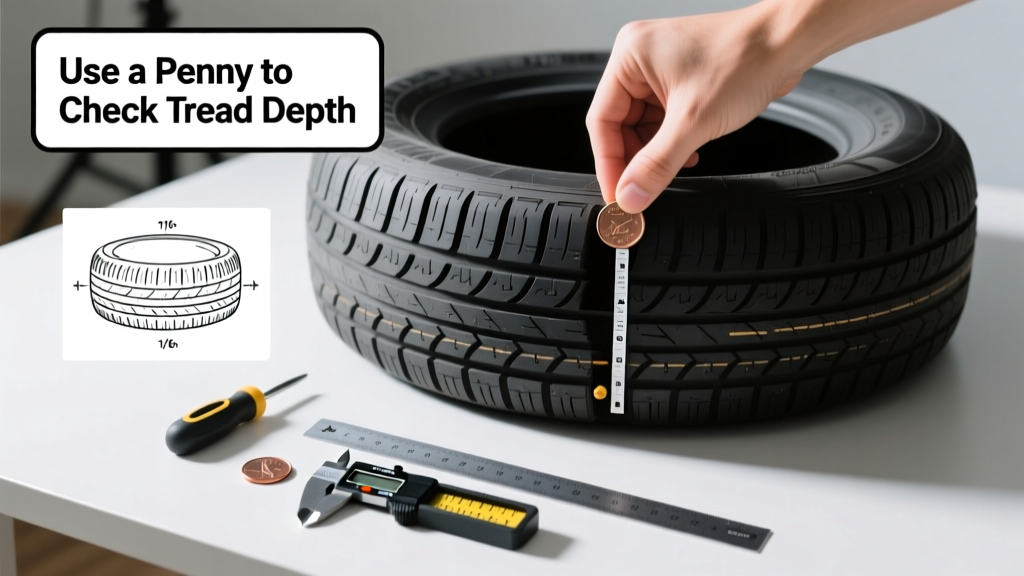
Checking your tire tread is a quick, essential safety habit every driver should master—it takes under five minutes, requires no mechanical experience, and can prevent blowouts or loss of control in wet weather.
Overview
| Skill Level | Time Required | Tools Needed | Estimated Cost |
|---|---|---|---|
| Beginner | 3–5 minutes per tire | Penny or quarter, flashlight (optional) | $0–$12 |
Tools & Materials
| Item | Why It’s Used | Notes |
|---|---|---|
| Penny (U.S.) | Lincoln’s head measures ~2/32″—the legal minimum tread depth in most states | Use with Lincoln’s head upside down; if you see all of his hair, tread is <2/32″ |
| Quarter (U.S.) | Washington’s head measures ~4/32″—a safer threshold for wet-weather traction | Recommended by the U.S. Department of Transportation for proactive replacement |
| Flashlight | Reveals uneven wear patterns in shadowed grooves | Especially useful in garages or low-light conditions |
| Tread depth gauge (optional) | Provides precise 1/32″ measurements across multiple points | Costs $8–$12; accurate to ±0.001″ per reading (PrecisionTire Tools, 2022) |
Step-by-Step Instructions
1. Park on level ground and engage parking brake
Turn wheels straight ahead so tread is fully visible. Never check tread while the vehicle is moving—or on a slope. Uneven surfaces distort readings and compromise accuracy.
2. Clean debris from tread grooves
Use a stiff-bristled brush or old toothbrush to remove stones, tar, or embedded gravel. A clogged groove reads deeper than it is—leading to false confidence. Skip this step, and you risk missing critical wear in as many as 1 in 4 tires (National Highway Traffic Safety Administration, 2023).
3. Insert penny head-first into the shallowest groove
Place Lincoln’s head pointing down, facing you. If you can see all of Lincoln’s head—including the top of his hair—the tread depth is less than 2/32″ and the tire is legally worn out in 47 states. Repeat in at least three locations: inner, center, and outer tread.
4. Try the quarter test for wet-weather readiness
Insert Washington’s head down. If the top of his head is visible, tread is below 4/32″—which means stopping distance increases by 25% on wet pavement compared to tires with 6/32″ (Tire Rack, 2021). Replace tires before they reach this point if you drive frequently in rain or snow.
Pro Tips
Uneven wear tells you more than depth alone. Look for scalloping (cupping), one-sided wear, or exposed steel belts—signs of alignment issues, underinflation, or suspension problems. Rotating tires every 5,000–7,500 miles prevents premature wear and adds up to 20% more usable life (Bridgestone Technical Bulletin, 2022).
"Most drivers wait until they feel vibration or hear noise—but by then, 60% of tread life is already gone. Checking monthly catches wear early enough to schedule rotation or replacement without urgency." — Maria Chen, ASE-certified tire technician, 12 years’ field experience
- Check tread depth at least once a month—and always before long road trips
- Don’t rely solely on tread wear indicators (TWIs): those small rubber bars only appear at 2/32″, which is too late for safe wet-weather driving
- If one tire shows significantly less tread than the others, inspect for improper inflation or misalignment—check tire pressure first
What does uneven tread wear mean?
Inner-edge wear suggests chronic underinflation. Outer-edge wear points to overinflation or aggressive cornering. Diagonal scalloping often indicates worn shock absorbers. These patterns are red flags—not just for tread depth, but for underlying mechanical issues. Address them before buying new tires, or you’ll repeat the same wear pattern.
Can I check tread on spare tires?
Absolutely—and you should. Spares degrade with age, even if unused. Rubber dries out, cracks form, and tread hardens. Inspect your spare every six months. According to the Rubber Manufacturers Association (2020), 89% of spare tires older than 10 years fail basic integrity checks—even with full tread depth.
Does tread depth affect fuel economy?
Yes—but indirectly. Severely worn tires increase rolling resistance due to flexing sidewalls and poor contact patch stability. Tires at 2/32″ show up to 3% higher fuel consumption than those at 6/32″ in controlled highway tests (SAE International Journal of Fuels and Lubricants, 2021). The bigger impact, however, remains safety—not efficiency.
How often should I replace tires based on age, not tread?
Every six years, regardless of tread depth. Oxidation and UV exposure break down rubber compounds over time. The National Transportation Safety Board recommends replacing tires after six years, and many manufacturers void warranties after that mark—even with 5/32″ remaining (Michelin Consumer Guidelines, 2023). Check the DOT code on the sidewall to find the manufacture date.
Why do some tires have different tread depth requirements?
Winter tires need deeper tread (minimum 6/32″) to maintain snow-gripping capability. Performance summer tires may be rated for dry handling at lower depths—but lose hydroplaning resistance rapidly below 4/32″. Always match replacement tread depth to your climate and driving conditions—not just legal minimums. For snowy regions, consider all-season tires with severe weather ratings.
Do tire pressure monitoring systems (TPMS) detect low tread?
No. TPMS only monitors air pressure—not tread depth, alignment, or structural integrity. Relying on TPMS alone misses 100% of tread-related risks. It’s like using a smoke alarm to check your roof for leaks: helpful for one thing, useless for another.
Checking tire tread isn’t about perfection—it’s about consistency. Do it monthly, use the penny and quarter together, and pair it with a quick tire rotation every other oil change. That small habit keeps you safer, saves money on premature replacements, and helps you spot trouble before it turns into a roadside emergency.