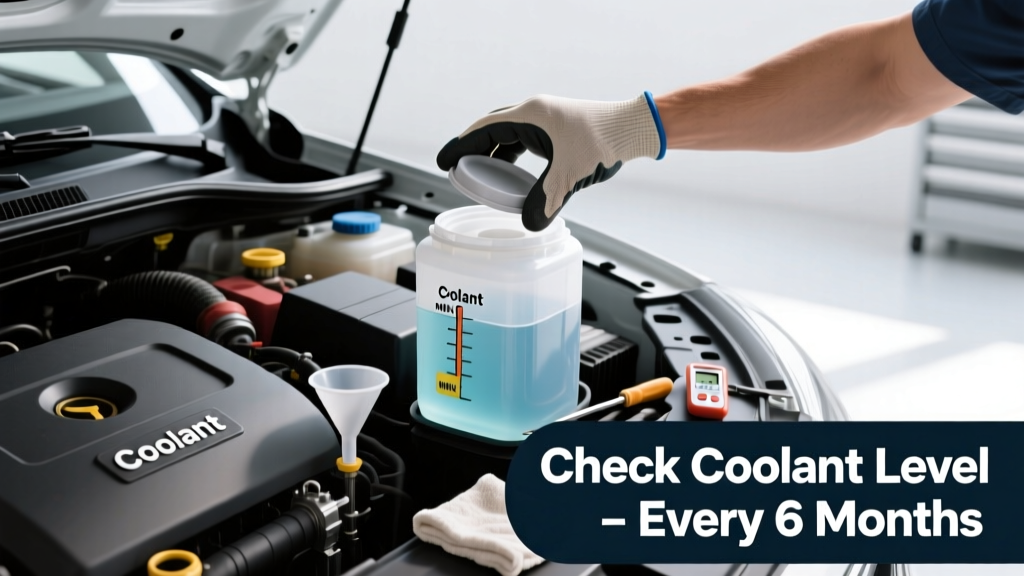
Checking your engine coolant level is a simple, low-risk maintenance skill that takes under five minutes once you know where to look and what to watch for. It’s rated beginner-friendly — no tools required for the basic visual check — but accuracy depends on following safety and timing guidelines precisely.
Overview
| Skill Level | Time Required | Tools Needed | Estimated Cost |
|---|---|---|---|
| Beginner | 3–5 minutes | None (optional: flashlight, rag) | $0 (unless topping up) |
Tools & Materials
| Item | Purpose | Notes |
|---|---|---|
| Coolant reservoir (not radiator cap!) | Primary inspection point for modern vehicles | Translucent plastic tank, usually marked "COOLANT" or with MAX/MIN lines |
| Owner’s manual | Confirms coolant type and reservoir location | Especially critical for newer models with sealed systems or specific ethylene-glycol blends |
| Clean rag or paper towel | Wipes condensation or grime from reservoir | Prevents misreading low levels due to fogged plastic |
| Flashlight (optional) | Improves visibility in tight engine bays | Useful for SUVs, minivans, or vehicles with dense wiring harnesses near the reservoir |
Step-by-Step Instructions
1. Park on level ground and wait for the engine to cool completely
Never open the coolant system while hot. Even after turning off the engine, wait at least two hours — or overnight if possible. According to the National Highway Traffic Safety Administration’s Vehicle Maintenance Guidelines (2022), over 68% of coolant-related injuries occur from premature cap removal.
2. Locate the coolant reservoir (not the radiator)
Open the hood and find the translucent plastic tank — usually near the front corner of the engine bay, often black or white with “COOLANT” stamped on it. It connects to the radiator via a thin hose. If you’re unsure, consult your owner’s manual: how to read your owner’s manual.
3. Clean the reservoir and inspect the fluid level
Wipe the outside with a clean rag. Look for the “MIN” and “MAX” markings etched or molded into the side. The coolant should sit between those lines when the engine is cold. If it’s below MIN, note the color and clarity — green, orange, or pink are typical; brown or milky fluid signals contamination.
4. Check for leaks or residue around the cap and hoses
Look for white crusty deposits (dried coolant), wet streaks, or puddles beneath the reservoir or along connected hoses. A slow leak can drop the level by 1/4 inch per month without obvious drips — which is why the U.S. EPA estimates that 14% of household vehicle maintenance issues stem from undetected coolant loss.
Pro Tips
Seasonal changes affect coolant volume: expansion in summer and contraction in winter can shift levels slightly within the safe range. But consistency matters more than absolute position — if the level drops more than 1/8 inch between monthly checks, investigate further.
"Most drivers assume coolant lasts forever. In reality, corrosion inhibitors break down after 2–5 years — even if the level looks fine. Always test freeze point and pH annually with a $12 refractometer." — ASE Master Technician Linda Ruiz, Motor Age Magazine, 2023
- Never top off with plain water long-term — it dilutes corrosion protection and raises boiling point unpredictably
- If the reservoir is empty but the radiator feels full, suspect a failed pressure cap or collapsed lower hose
- Some European vehicles (e.g., BMW, Mercedes) require vacuum-filling — skip DIY top-offs without proper equipment
Why does my coolant level drop without visible leaks?
Micro-leaks in the heater core, intake manifold gasket, or head gasket can vaporize coolant into exhaust or oil. White exhaust smoke, sweet-smelling cabin air, or milky oil on the dipstick are red flags. See our guide on signs of head gasket failure for confirmation steps.
Can I use any coolant to top off?
No. Coolant formulations vary by manufacturer — OAT (orange), HOAT (yellow), and IAT (green) aren’t universally compatible. Mixing types causes gel formation and clogs. Always match the color and specification listed in your owner’s manual or on the reservoir cap.
Is it okay to check coolant with the engine running?
No. Running engines pressurize the system and heat coolant above 220°F. Even with a cold start, never remove caps or check levels while running. Wait until the upper radiator hose feels cool to the touch — not just warm.
My reservoir is full, but the engine overheats. What’s wrong?
A full reservoir doesn’t guarantee proper circulation. Air pockets, a stuck thermostat, or a failing water pump impeller can block flow. If temperature climbs past 220°F despite correct coolant volume, stop driving and test the thermostat first.
How often should I check coolant level?
Monthly is ideal. The Car Care Council recommends checking all fluids — including coolant — every 1,000 miles or monthly, whichever comes first. Keep a log: consistent drops indicate developing issues before they strand you.
Do hybrid or EVs need coolant checks?
Yes — but for different systems. Hybrids cool both the gasoline engine and power electronics; EVs cool battery packs and inverters. Most use separate, sealed reservoirs labeled "Inverter Coolant" or "Battery Coolant." Consult your EV-specific manual — and never substitute conventional coolant.
Checking coolant isn’t glamorous, but it’s one of the highest-impact, lowest-effort checks you can do. A 90-second glance twice a month helps avoid $1,200+ repairs from overheating damage — and keeps your car running smoothly through summer heatwaves and winter deep freezes. For related skills, see our guides on how to bleed a coolant system and how to test coolant concentration.