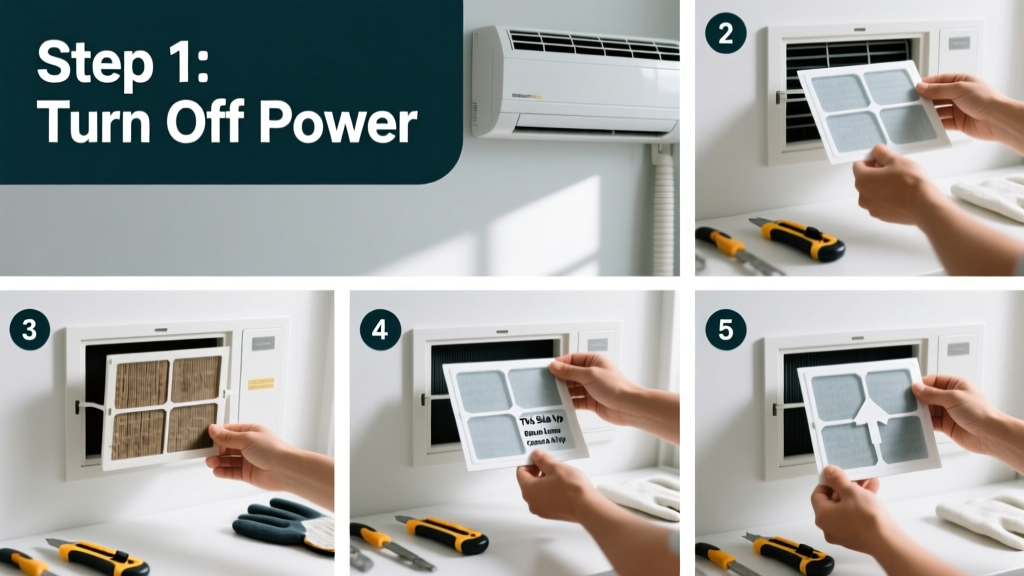
Changing your HVAC air filter is one of the simplest, highest-impact maintenance tasks you can do—no tools or experience required. It’s a beginner-level skill that takes 3–5 minutes and prevents dust buildup, airflow restriction, and premature furnace or AC failure.
Overview
| Skill Level | Time Required | Tools Needed | Estimated Cost |
|---|---|---|---|
| Beginner | 3–5 minutes | None (optional: flashlight, tape measure) | $12–$28 per filter (depends on MERV rating and size) |
Tools & Materials
| Item | Notes |
|---|---|
| Replacement filter (correct size & MERV rating) | Check your old filter’s frame for dimensions (e.g., 16x20x1) and MERV rating (4–13 typical for homes). Avoid oversizing—filters must fit snugly. |
| Flashlight (optional) | Helps spot dust buildup or awkward filter locations in dark return vents or furnace cabinets. |
| Tape measure (optional) | Verify dimensions if label is faded or missing—measure height, width, and depth to the nearest 1/4 inch. |
| Small trash bag | For immediate disposal of the dirty filter—prevents dust redistribution. |
Step-by-Step Instructions
1. Locate your air filter
Most filters sit in the return air duct near your furnace or air handler—or inside a wall, ceiling, or floor return grille. If unsure, follow the cold-air return duct from your thermostat toward the furnace. Some systems have two locations: one at the furnace and another at a central return vent.
2. Turn off the HVAC system
Switch the thermostat to “Off” (not just “Auto”) and, for safety, flip the furnace’s power switch (a small breaker or toggle near the unit) to “Off.” This prevents accidental fan activation while you work.
3. Remove the old filter
Slide the filter straight out—don’t force it. Note the airflow direction arrow on its frame (usually pointing toward the blower/furnace). If the filter is jammed, gently wiggle side-to-side; never pry with a screwdriver—it can damage the slot or housing.
- Tip: Snap a photo of the old filter’s label before discarding—it’s your best reference for size and MERV rating.
- Warning: Don’t run the system without a filter—even briefly. The U.S. EPA estimates that 14% of household water usage is from leaks—but airborne particulate damage from no-filter operation is immediate and cumulative.
4. Insert the new filter
Align the airflow arrow on the new filter with the direction of airflow (toward the blower/furnace). Slide it in fully until it seats evenly—no gaps around the edges. A loose fit lets unfiltered air bypass the media.
- Tip: Use painter’s tape to mark the correct orientation directly on the filter slot if arrows are hard to see.
- Warning: Installing backward reduces efficiency by up to 30% and can cause uneven loading on the blower motor (ASHRAE Handbook, 2022).
Pro Tips
Replace filters every 30–90 days depending on household conditions—not just calendar time. Homes with pets, allergies, or construction activity need monthly changes. Those with no pets and low occupancy may stretch to 90 days—but never exceed manufacturer recommendations.
"A clogged filter forces your system to work 15–20% harder—raising energy bills and cutting equipment lifespan by up to 2 years," says HVAC engineer Lena Torres in the 2023 edition of Residential System Maintenance Best Practices.
Avoid high-MERV filters (13+) unless your system is rated for them. Most standard furnaces max out at MERV 8–11; forcing MERV 13+ restricts airflow and risks heat exchanger cracks or frozen coils.
How often should I change my air filter?
Monthly if you have pets or allergies; every 2 months for average use; quarterly only in low-occupancy, dust-free homes. Check visually each month—if light doesn’t shine through the media, replace it.
Can I wash and reuse my air filter?
Only if it’s explicitly labeled as reusable (typically electrostatic or foam types). Standard fiberglass or pleated filters are disposable. Washing a non-reusable filter degrades the media, creates channels for bypass, and voids warranties.
Why does my new filter look smaller than the slot?
You likely measured incorrectly. Filters are sized by nominal dimensions (e.g., “20x25x1”), but actual size is ~¼ inch smaller (e.g., 19.5x24.5x0.75). Always match the nominal size printed on your old filter—not the physical cavity.
What happens if I install the wrong size filter?
Gaps allow unfiltered air into the system, coating your evaporator coil and blower with dust. Over time, this reduces cooling capacity by up to 15% and increases runtime (according to the Air Conditioning Contractors of America’s 2022 Field Study).
Do I need different filters for heating vs. cooling season?
No—the same filter works year-round. However, you may choose a higher-MERV option during allergy season (spring/fall) and revert to MERV 8 in winter if airflow feels restricted.
Where can I buy replacement filters?
Home improvement stores carry common sizes, but online retailers like our filter size guide help verify specs before ordering. For custom sizes, try local HVAC supply houses—they often stock deeper pleats and higher-MERV options not found at big-box stores. Many brands also offer subscription services with auto-ship reminders.
Once you’ve changed your filter, reset your thermostat and listen for smooth startup—no rattling or delayed fan engagement. Mark your calendar or set a phone reminder for your next change. It’s the easiest $15 you’ll spend all year to keep your home breathing easier and your system running longer. For related help, see our guides on how to clean an evaporator coil and seasonal HVAC maintenance checklist.