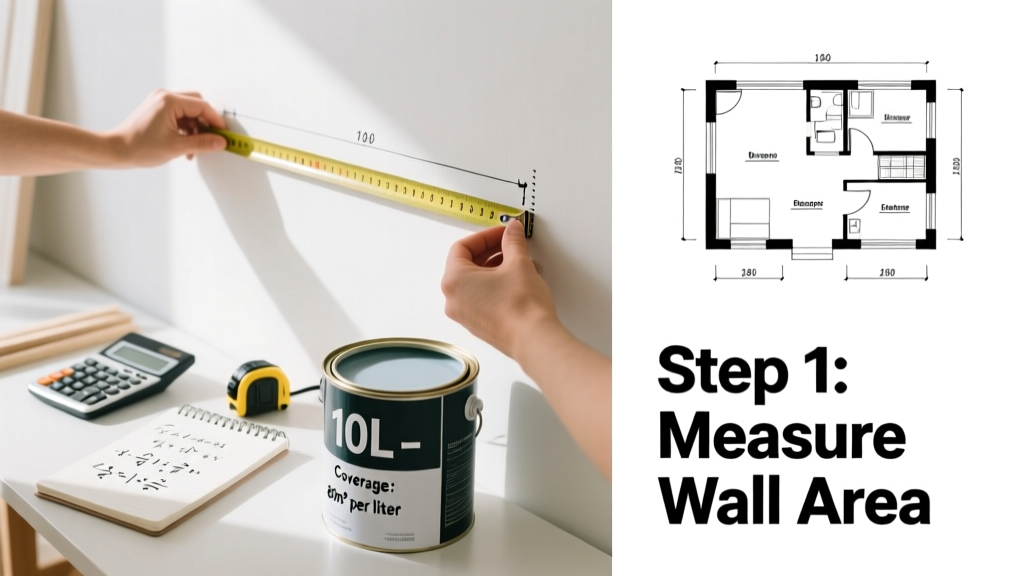
Calculating paint coverage is a foundational skill for any interior or exterior painting project—it’s not guesswork, and it’s not magic. It’s simple math applied to real surfaces, and mastering it saves you time, money, and frustration. Difficulty is low (beginner-friendly), and you’ll need about 15 minutes to measure and calculate before your first trip to the paint store.
Overview
| Skill Level | Time Required | Tools Needed | Estimated Cost |
|---|---|---|---|
| Beginner | 15–20 minutes | Tape measure, calculator, notebook | $0 (uses tools you likely already own) |
Tools & Materials
| Item | Purpose | Notes |
|---|---|---|
| Retractable tape measure (25 ft) | Measuring wall height and length | Laser measures work too—but avoid rounding up measurements by eye |
| Calculator (phone app is fine) | Running square footage and coverage math | Use parentheses: e.g., (12 × 8 × 2) − (3 × 7) for two walls minus a door |
| Notebook or spreadsheet | Recording dimensions and totals | Label each wall (e.g., “North Wall – 12' × 8'”) to prevent duplication |
| Paint can label or manufacturer’s spec sheet | Finding actual coverage per gallon | Standard is 350–400 sq ft/gal—but always verify; chalkboard paint covers only ~200 sq ft/gal (Sherwin-Williams, 2023) |
Step-by-Step Instructions
1. Measure each wall’s height and width
Start at one corner and measure floor-to-ceiling height (don’t assume 8 ft—many homes have 9-ft ceilings). Then measure the full horizontal length of that wall. Repeat for every wall—including those with windows or doors. Record each pair separately.
- Tip: Measure at three points along long walls—floors and ceilings aren’t always level.
- Warning: Don’t skip baseboards or crown molding—they don’t reduce wall area, but trim does require separate paint calculation.
2. Calculate total wall square footage
Multiply height × width for each wall. Add all wall totals together. Then subtract non-paintable areas: standard doors (21 sq ft), windows (15 sq ft average), and built-in cabinets (measure each opening individually).
- Example: Two 12' × 8' walls = 192 sq ft. One 10' × 8' wall = 80 sq ft. One 15' × 8' wall = 120 sq ft. Total = 392 sq ft. Subtract one door (21) and two windows (30) → 341 sq ft.
- Tip: If painting ceiling too, add length × width (e.g., 12' × 15' = 180 sq ft) as a separate line item.
3. Account for coats and surface texture
Most walls need two coats for even coverage. Multiply your net square footage by number of coats (e.g., 341 × 2 = 682 sq ft). Then adjust for surface: raw drywall absorbs more (add 10%); rough stucco or brick may require 20% more paint than smooth walls (U.S. EPA Paint Estimating Guide, 2022).
4. Divide by coverage rate and round up
Check the paint can: premium interior latex typically covers 350–400 sq ft per gallon *per coat*. Divide your adjusted total (e.g., 682) by 375. That’s 1.82 gallons. Always round up to the next full gallon—so buy 2 gallons. For touch-ups or small accent walls, quart sizes (94 sq ft per coat) are cost-effective.
According to the National Association of Home Builders’ 2023 Remodeling Impact Report, 68% of DIYers who miscalculated paint bought at least one extra gallon—and 41% still ran short on the second coat due to unaccounted texture or poor application technique.
Pro Tips
Seasoned painters never rely solely on “one gallon covers 400 sq ft.” Real-world coverage depends on brush/roller quality, application pressure, and substrate porosity. A high-nap roller on textured walls can use 25% more paint than a smooth-surface microfiber roller.
“Measure twice, buy once—but always test coverage on a 2-ft² patch first. If you’re getting 320 sq ft/gal instead of 375, adjust your total before committing to the full job.” — Maria Chen, Lead Painter & Trainer, Painting Contractors Association (2024)
- Common mistake: Forgetting ceiling height varies room-to-room. A basement rec room might be 7 ft tall; upstairs bedrooms often hit 9 ft.
- Common mistake: Including closet interiors in main room calculations—treat walk-in closets as separate zones.
- Pro move: Keep leftover paint in its original can (not poured into jars) with the lid sealed tight—label it with room name and date for future touch-ups.
How do I calculate coverage for stairwell walls?
Stairwells require breaking the wall into segments. Measure height and width of each vertical plane between landings, then add them. Account for angled soffits by measuring their face as a triangle: ½ × base × height. Add all segments, then apply the same 2-coat + texture adjustment rule.
Does primer count toward coverage calculation?
Yes—but separately. Primer coverage is usually lower (250–300 sq ft/gal) and rarely matches topcoat specs. Calculate primer and paint as two independent totals. Never substitute paint for primer on bare drywall or patched areas—the result is uneven sheen and poor adhesion.
What if I’m using spray paint or a paint sprayer?
Sprayers waste 20–40% more material due to overspray (PaintCare Technical Bulletin, 2023). Multiply your net square footage by 1.3 before dividing by coverage rate. Also factor in masking time—you’ll spend 2–3x longer prepping than rolling.
How much extra should I buy for touch-ups?
Aim for 10% over your final calculated amount—but cap it at one extra quart for rooms under 500 sq ft, or one extra gallon for larger spaces. Stores rarely accept opened paint returns, and mismatched batches cause visible seams.
Do dark colors require more coats—and more paint?
Yes. Going from light to dark (e.g., white ceiling to navy) often requires 3 coats. Coverage per coat stays the same, but total square footage multiplies accordingly. Some deep-base paints also have lower spread rates—check the technical data sheet, not just the front label.
Can I use the same calculation for exterior paint?
Only with adjustments. Exterior surfaces weather faster and absorb more. Add 15% for wood siding, 25% for stucco, and 30% for unpainted masonry. Also, account for temperature: below 50°F, most latex paints lose 10–15% effective coverage (American Coatings Association, 2022).
Once you’ve run the numbers, you’ll walk into the paint store confident—not clutching a swatch card and hoping for the best. For related guidance, see our how to cut in like a pro tutorial, or learn how to choose the right roller nap for your surface. And if you’re prepping drywall, don’t skip our how to sand drywall seams guide—it affects how much paint you’ll actually need.