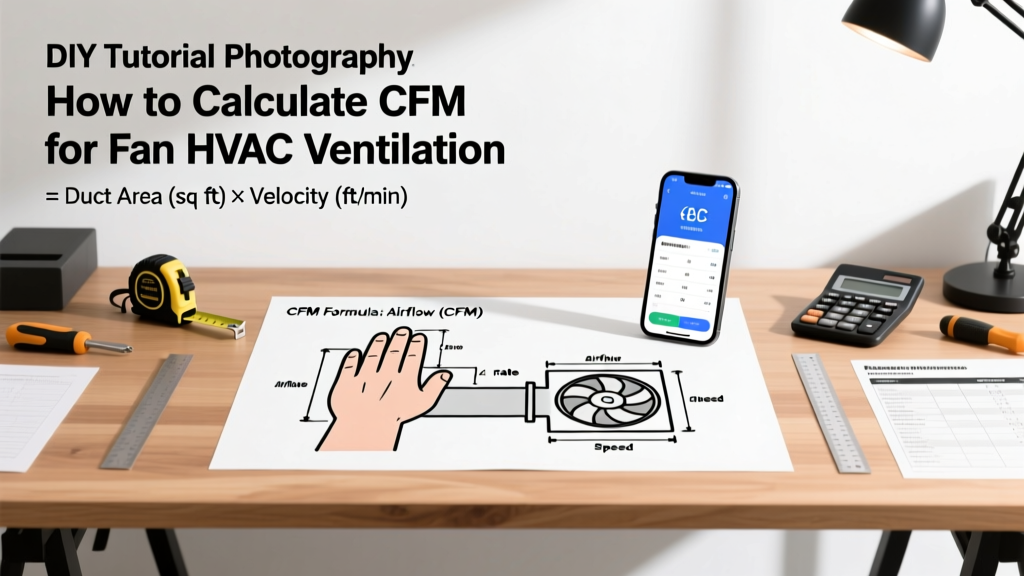
Calculating CFM (cubic feet per minute) for a fan ensures your ventilation system moves enough air to cool, exhaust, or ventilate a space effectively. This is a foundational HVAC skill—moderate difficulty, takes 10–20 minutes once you gather measurements, and requires no special tools beyond a tape measure and calculator.
Overview
| Skill Level | Time Required | Tools Needed | Estimated Cost |
|---|---|---|---|
| Intermediate | 10–20 minutes | Tape measure, calculator, pen & paper | $0 (free if you already own tools) |
Tools & Materials
| Item | Purpose | Notes |
|---|---|---|
| Tape measure (25 ft minimum) | Measure room length, width, height | Laser measures work well for high ceilings or tight spaces |
| Digital calculator or smartphone app | Compute volume × ACH ÷ 60 | Use parentheses to avoid order-of-operations errors |
| ASHRAE Handbook (2023 edition) or online ACH chart | Reference standard air change rates | Free ACH guidelines available at ASHRAE air change rates |
| Duct dimension specs (if applicable) | Verify actual airflow through ducts | Check manufacturer label or stamped duct collar |
Step-by-Step Instructions
1. Measure the room’s interior dimensions
Measure floor length and width in feet, then ceiling height. For irregular rooms, break them into rectangles and sum volumes. Record all three numbers precisely—rounding too early introduces error. If ceiling height varies (e.g., vaulted), use the lowest point for conservative sizing.
2. Calculate room volume in cubic feet
Multiply length × width × height. Example: a 12 ft × 15 ft × 8 ft room = 1,440 ft³. Write this down—it’s your baseline for all subsequent calculations.
3. Determine required Air Changes per Hour (ACH)
Select the appropriate ACH from industry standards: 6 ACH for kitchens, 8–12 for bathrooms, 4–6 for living rooms, 15+ for workshops with fumes. According to the ASHRAE Handbook (2023), residential garages require 6 ACH minimum when attached to homes.
4. Compute CFM using the formula
Apply the standard equation: CFM = (Room Volume × ACH) ÷ 60. Using our example: (1,440 × 8) ÷ 60 = 192 CFM. That’s the minimum rated airflow your fan must deliver at the register—not at the motor.
- Tip: Always add 10–15% margin for duct friction loss if routing air >15 ft or through elbows
- Warning: Never use motor-rated CFM from spec sheets—those are lab values under zero resistance. Real-world performance drops 25–40% with standard ductwork (duct friction loss guide)
Pro Tips
Seasoned HVAC technicians emphasize matching fan capacity to *actual installed conditions*, not just room size. Oversizing causes short cycling and poor humidity control; undersizing leaves stale air and mold risk.
“A bathroom fan rated at 110 CFM on paper may only move 72 CFM after installing 20 ft of flex duct and three elbows. Always derate by 30% unless you’ve pressure-tested the run.” — James L. Rafferty, NATE-certified Master Technician, Contractor Magazine, 2022
Common mistakes include ignoring ceiling insulation (reducing effective volume), forgetting door undercut gaps (which affect net airflow), and using total square footage instead of cubic volume. Also, don’t assume one fan serves multiple rooms—calculate each space individually and size the largest demand.
What’s the difference between static pressure and CFM?
CFM measures airflow volume; static pressure (measured in inches water gauge, or "in. w.g.") measures resistance the fan must overcome. A fan’s CFM rating drops as static pressure rises—so always check the fan’s performance curve chart, not just its “max CFM” label.
Can I use the same CFM calculation for exhaust and supply fans?
Yes—the math is identical. But exhaust fans often need higher CFM due to code-mandated minimums (e.g., IRC Section M1507 requires 50 CFM continuous or 100 CFM intermittent for bathrooms). Supply fans in forced-air systems must match furnace blower capacity and duct design, not just room volume.
How does duct material affect my CFM result?
Rigid metal ducts lose ~0.05 in. w.g. per 100 ft; flexible ducts lose 0.1–0.25 in. w.g. per 100 ft depending on installation quality. Each 90° elbow adds ~15–25 ft equivalent length. These losses reduce delivered CFM—so factor them in before final selection.
Do ceiling fans have CFM ratings—and do they count toward ventilation?
Yes, ceiling fans list CFM (e.g., 5,000–6,500 CFM for 52" models), but they only recirculate air—they don’t exchange indoor/outdoor air. They improve comfort but don’t satisfy mechanical ventilation requirements per building codes like the 2021 IECC.
Why does my newly installed fan feel weak even though CFM matches the calculation?
Three likely culprits: improper duct sealing (leaks rob airflow), a dirty or bent damper, or incorrect termination (e.g., roof cap blocked by snow or bird nests). Test static pressure with a manometer—if it exceeds 0.5 in. w.g., reevaluate duct layout.
Accurate CFM calculation prevents costly callbacks, reduces energy bills, and keeps indoor air healthy. Once you’ve sized your fan, pair it with proper duct sealing and regular filter maintenance—you’ll get consistent performance season after season. For help selecting quiet, ENERGY STAR–rated fans, see our best bathroom fans and kitchen range hood CFM guide.