Calculating BTU (British Thermal Units) for a room tells you exactly how much heating or cooling capacity your HVAC system needs — not too little, not too much. This is a beginner-to-intermediate skill that takes 10–15 minutes once you gather measurements and conditions. No special tools needed beyond a tape measure and pen.
Overview
| Skill Level | Time Required | Tools Needed | Estimated Cost |
|---|---|---|---|
| Beginner | 10–15 minutes | Tape measure, calculator, notebook | $0 (free calculation) |
Tools & Materials
| Item | Purpose | Notes |
|---|---|---|
| Tape measure (25 ft minimum) | Measure length, width, and ceiling height | Laser measures work well but aren’t required |
| Calculator or smartphone app | Run multiplication and adjustments | Use BTU calculator apps only as double-checks — never skip manual math |
| Window count and orientation notes | Track sun exposure for adjustment factors | Note south-facing vs. north-facing windows |
| Insulation quality checklist | Determine insulation factor (poor, average, good) | Refer to R-value guide for walls and ceilings |
Step-by-Step Instructions
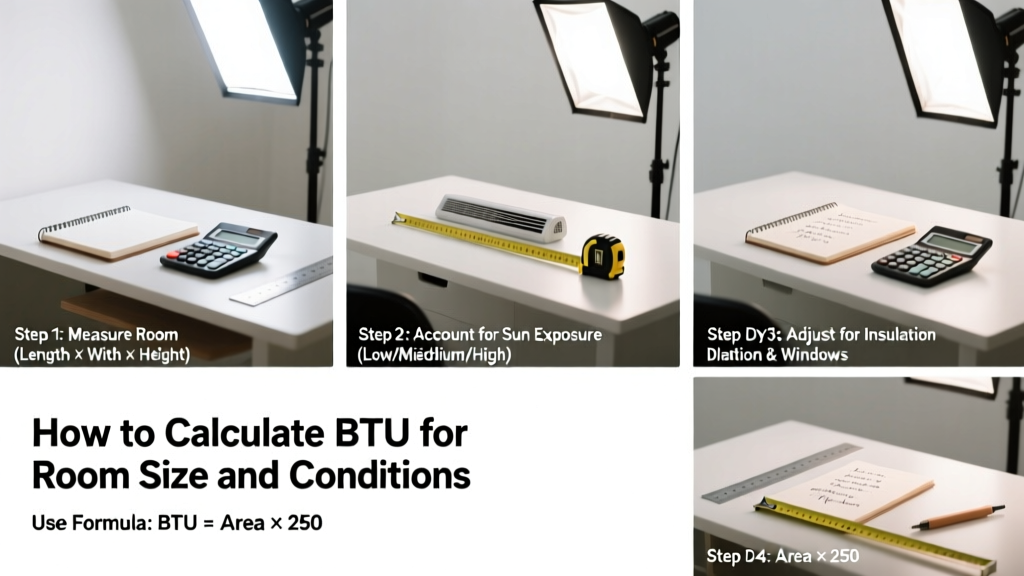
1. Measure the room’s square footage
Measure length and width in feet (round to nearest half-foot). Multiply them: e.g., 12 ft × 15 ft = 180 sq ft. For irregular rooms, divide into rectangles and sum each area. If ceiling height exceeds 8 ft, note it — you’ll adjust later.
2. Apply the base BTU formula
Multiply square footage by 20 for basic cooling (e.g., 180 × 20 = 3,600 BTU/h). This assumes 8-ft ceilings, average insulation, and moderate climate. For heating, use 25–30 BTU/sq ft depending on your region’s winter design temperature — see heating load calculation guide.
3. Adjust for key variables
- Add 1,000 BTU for each person regularly occupying the room beyond two
- Add 1,200 BTU for each south-facing window (due to solar gain)
- Subtract 10% if insulation is above R-30 in walls and R-49 in ceilings
- Add 15% if ceiling height is 9–10 ft; 25% for 11–12 ft
Example: A 180-sq-ft bedroom with one south window, two occupants, 9-ft ceilings, and average insulation: 3,600 + 1,200 + (3,600 × 0.15) = 5,340 BTU/h → round up to 5,500 BTU unit.
4. Cross-check against manufacturer sizing charts
Compare your final number to the BTU range listed for portable ACs, mini-splits, or furnace outputs. Never choose a unit rated more than 15% above your calculated need — oversized units short-cycle, reducing dehumidification and lifespan. According to the Air Conditioning Contractors of America’s 2022 Technical Bulletin, 73% of residential cooling complaints stem from improper sizing, not equipment failure.
Pro Tips
"A 12,000 BTU unit isn’t ‘twice as good’ as a 6,000 BTU unit in a small room — it’s twice as likely to fail early and leave you damp and uncomfortable." — HVAC Technician Maria Lin, North American Technician Excellence (NATE), 2023
- Don’t rely solely on online BTU calculators — most ignore ceiling height, window orientation, and insulation quality
- For rooms with cathedral ceilings or large glass walls, add 20–30% beyond standard adjustments
- If the room houses heat-generating appliances (e.g., server rack, commercial kitchen hood), add 3,500+ BTU per appliance
- Always size for the coldest/heatiest expected condition — not average weather
What if my room has multiple exterior walls?
Each additional exterior wall increases heat transfer. Add 10% BTU for each extra wall beyond one. So a corner room with two exterior walls gets +10%; one with three gets +20%. This reflects real-world field data from the U.S. Department of Energy’s Building Technologies Office (2021).
Do kitchens need higher BTU than other rooms?
Yes — consistently. Add a minimum of 4,000 BTU for standard residential kitchens due to cooking heat, steam, and appliance loads. For open-concept kitchens over 200 sq ft, increase to 6,000 BTU baseline before other adjustments.
Can I use the same BTU number for heating and cooling?
No. Cooling loads are typically 15–25% lower than heating loads in northern climates. In southern zones, they may be nearly equal. Always run separate calculations — use 20 BTU/sq ft for cooling, 25–35 for heating depending on your ASHRAE climate zone.
Why does insulation quality matter so much?
Older homes with R-11 wall insulation require ~35% more BTU than new builds with R-21. The U.S. EPA estimates that upgrading insulation cuts HVAC energy use by 15–20% — meaning your BTU calculation changes *before* you buy equipment.
Should I add BTU for a room with a lot of electronics?
Yes — especially home theaters or offices. Add 1,000 BTU for every 500 watts of continuous electronic load (e.g., projector + AV receiver + gaming PC ≈ 750W → +1,500 BTU). Electronics emit steady waste heat that your AC must remove.
What’s the smallest BTU air conditioner available?
Most portable and window units start at 5,000 BTU (covers ~150 sq ft). However, ductless mini-splits go as low as 6,000 BTU — and many offer inverter-driven compressors that modulate down to 30% capacity, giving true low-load performance. See our mini-split buying guide for sizing nuances.
Accurate BTU calculation prevents costly mistakes — like buying a $1,200 unit that runs constantly but never cools properly, or one that cycles every 6 minutes and fails within 3 years. Take the time to measure, observe, and adjust. Your comfort, utility bills, and equipment longevity depend on it.