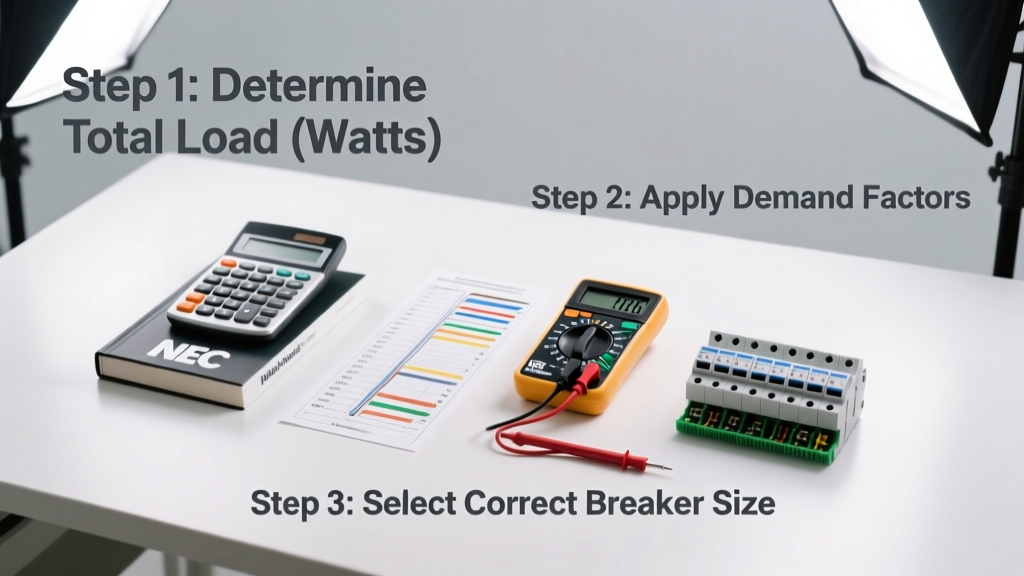
Calculating the correct circuit breaker size is a foundational electrical skill that keeps your home safe and code-compliant. It’s a moderate-difficulty task requiring basic math and familiarity with appliance nameplates—plan for 20–45 minutes per circuit, depending on complexity.
Overview
| Skill Level | Time Required | Tools Needed | Estimated Cost |
|---|---|---|---|
| Intermediate (basic electrical knowledge required) | 20–45 minutes per circuit | Voltmeter, calculator, tape measure, notepad | $0–$15 (most tools commonly owned) |
Tools & Materials
| Item | Purpose | Notes |
|---|---|---|
| Nameplate data from all connected devices | Provides rated amps or watts | Found on labels—never guess; unplug and check each device |
| NEC Article 210.19(A)(1) & 220.5(B) | Official sizing rules | Free online via NFPA.org or NEC Handbook 2023 edition |
| Calculator (scientific or phone app) | Compute continuous vs. non-continuous loads | Must handle decimal multiplication and rounding |
| Circuit diagram or sketch | Map outlets, lighting, and fixed appliances | Hand-drawn is fine—label wire gauge and distance if possible |
Step-by-Step Instructions
1. Identify all connected loads on the circuit
List every device—outlets, lights, HVAC units, kitchen appliances—that will operate simultaneously. For receptacle circuits in bedrooms or living rooms, use the NEC’s default 180 VA per outlet (not per plug): a duplex outlet counts as one 180 VA load. For fixed appliances like a garbage disposal or dishwasher, use the nameplate amp rating.
- Tip: If the nameplate shows watts only, divide by voltage (e.g., 1,200 W ÷ 120 V = 10 A).
- Warning: Never include high-draw intermittent loads like space heaters unless they’re permanently wired and intended for continuous use.
2. Separate continuous and non-continuous loads
A continuous load runs for 3 hours or more—think refrigerators, LED lighting on timers, or sump pumps. Non-continuous loads include most general-use outlets and bathroom fans. Per NEC 210.19(A)(1), continuous loads must be multiplied by 125% before sizing the breaker.
- Example: A 6 A continuous lighting circuit becomes 6 A × 1.25 = 7.5 A minimum.
- Warning: Overlooking this step causes nuisance tripping—even if total amps seem within limit.
3. Sum the adjusted loads
Add the 125%-adjusted continuous loads to the full-rated non-continuous loads. Round up to the next standard breaker size: 15 A, 20 A, 30 A, etc. Do not round down. For example, a calculated load of 19.8 A requires a 20 A breaker—not 15 A.
According to the National Fire Protection Association’s NEC Handbook 2023, “Breaker sizing must protect both the conductor and the equipment—undersizing risks overheating; oversizing defeats overcurrent protection.”
4. Verify conductor ampacity matches the breaker
Check the wire gauge used in the circuit: 14 AWG copper is rated for 15 A max; 12 AWG for 20 A; 10 AWG for 30 A (NEC Table 310.16). If your calculated breaker size exceeds the wire’s ampacity, you must either downsize the breaker or upgrade the wiring—a licensed electrician must handle any rewiring.
Pro Tips
Seasoned electricians emphasize two things: first, always account for future expansion—add 20% headroom if adding outlets or smart devices later. Second, never mix breaker types (e.g., AFCI + GFCI) without verifying compatibility with your panel’s labeling.
“Most residential breaker failures stem not from overload, but from mismatched wire gauge and breaker rating. Always verify both—not just the math.” — Mike R., Master Electrician, IBEW Local 25, 2022
Common mistakes include forgetting the 125% rule for continuous loads, misreading nameplate values (e.g., confusing input vs. output watts), and assuming all kitchen countertop circuits can share one 20 A breaker—NEC 210.11(C)(1) requires at least two dedicated 20 A small-appliance branch circuits.
What’s the difference between breaker size and wire size?
Breaker size limits current to protect the wire. Wire size determines how much current it can safely carry. They must match: a 20 A breaker requires at least 12 AWG copper. Using 14 AWG wire on a 20 A circuit violates NEC 240.4(D) and creates a fire hazard.
Can I use a 15 A breaker on a 20 A circuit if it’s not tripping?
No. A 15 A breaker on a 20 A-rated circuit may prevent overloads—but it also risks frequent nuisance trips and fails to protect downstream devices designed for 20 A operation. More critically, it violates NEC 210.3 and voids UL listing for the entire circuit assembly.
How do I size a breaker for a subpanel?
Calculate total connected load on the subpanel (including 125% for continuous loads), then apply NEC 220.82 for dwelling unit calculations—or use the optional method in 220.83 for existing homes. Feeder conductors and the main breaker must both support the calculated load. For a 60 A subpanel feeding a garage workshop, you’ll likely need 6 AWG THHN copper wire and a 60 A 2-pole breaker.
Does voltage affect breaker sizing?
Not directly—the breaker responds to amperage, not voltage. But voltage affects how many amps a given wattage draws: a 2,400 W heater draws 20 A at 120 V, but only 10 A at 240 V. Always use the actual operating voltage listed on the nameplate when converting watts to amps.
Why did my 30 A breaker trip with only 22 A measured load?
Three likely causes: (1) hidden continuous load not accounted for (e.g., a dehumidifier running 4+ hours), (2) shared neutrals or multi-wire branch circuits causing neutral overloads, or (3) breaker aging—thermal-magnetic breakers lose calibration after ~10,000 operations (Eaton Technical Bulletin TB-101, 2021). Test with a clamp meter over time, not just a snapshot reading.
Do LED lights change breaker sizing calculations?
Yes—but usually in your favor. A 100 W incandescent string equals ~0.83 A at 120 V; an equivalent 12 W LED string is just ~0.1 A. However, don’t assume all “LED-compatible” dimmers or drivers are continuous-load rated—check manufacturer specs. Some LED drivers draw inrush current up to 20× rated amps for milliseconds, which can fatigue older breakers.
Once you’ve sized your breaker correctly, double-check connections at the panel and test under real load conditions—not just theoretical math. If you’re installing a new circuit for a GFCI outlet or upgrading a kitchen circuit, cross-reference your calculation with AFCI requirements. For whole-house load calculations or service upgrades, consult your panel’s label and consider hiring a licensed electrician—especially when working inside the main service panel.