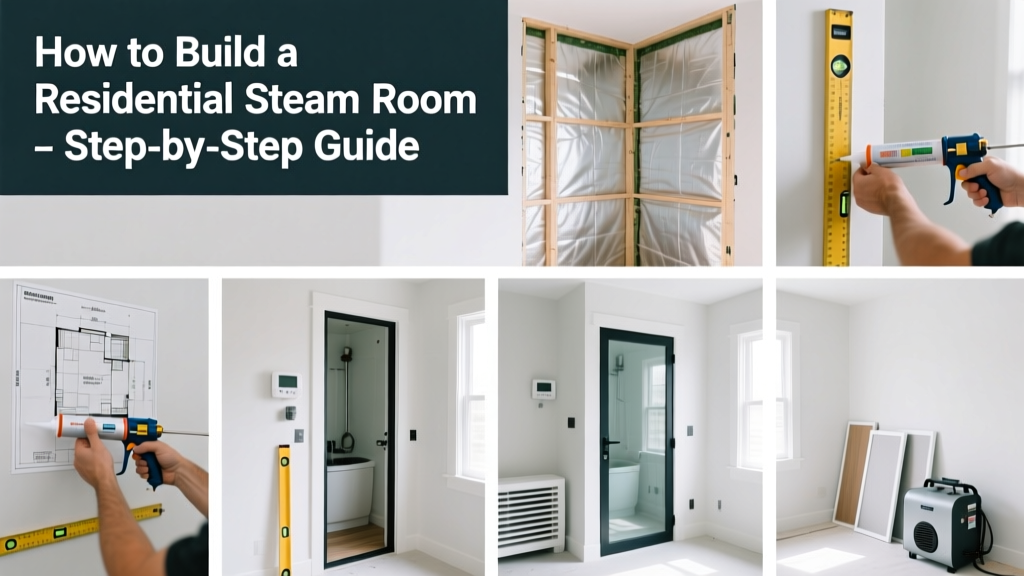
Building a residential steam room is a mid-to-advanced DIY project that transforms a standard bathroom into a spa-grade retreat—provided you follow strict moisture management, electrical, and plumbing codes. Expect 8–12 days of active work (plus 7–10 days for material curing and inspections), and plan for at least intermediate carpentry, tiling, and electrical experience.
Overview
| Category | Details |
|---|---|
| Skill Level | Intermediate to Advanced (requires drywall, tile, and 240V electrical experience) |
| Time Required | 8–12 days active build + 10 days curing/inspection wait |
| Tools Needed | Wet saw, laser level, stud finder, vapor-barrier stapler, torque screwdriver, multimeter |
| Estimated Cost | $4,200–$9,800 (excluding labor; varies by size and generator model) |
Tools & Materials
| Category | Items |
|---|---|
| Framing & Structure | Pressure-treated 2×4 studs (for floor sill plate), 16" OC wall framing, 3/4" CDX plywood subfloor, 1/2" cement board (HardieBacker or Durock) |
| Waterproofing | RedGard liquid membrane (2 gal minimum), Kerdi membrane (Schluter) or NobleSeal CIS, 3M 9080 tape, PVC corner beads |
| Steam System | Steam generator (e.g., Thermasol ProSeries 3kW or Mr. Steam E240), stainless steel steam head (wall- or ceiling-mount), insulated steam line (3/4" copper with 1" fiberglass wrap) |
| Finishes | Non-porous tile (porcelain or glass, ≤ 6" x 6", COF ≥ 0.6), modified thinset (Laticrete 254 Platinum), grout (epoxy or polymer-modified) |
| Electrical & Code | 60A double-pole breaker, 6 AWG THHN wire in conduit, GFCI-protected 240V circuit, UL-listed junction box, licensed electrician sign-off required |
Step-by-Step Instructions
1. Design and Permitting
Sketch your steam room layout to minimum dimensions: 3' x 3' floor area, 7' ceiling height (per ASME A112.19.1-2021). Submit plans to your local building department—including structural, plumbing, and electrical details. Most jurisdictions require permits for steam generators over 2 kW and all associated 240V circuits. According to the International Residential Code (IRC R302.2.2, 2021 edition), steam rooms must be separated from adjacent spaces by fire-rated assemblies if sharing walls with sleeping areas.
2. Frame and Insulate
Build walls using pressure-treated bottom plates anchored to concrete (or use galvanized steel framing on wood subfloors). Space studs 16" on-center. Install R-13 fiberglass batts in walls and R-19 in ceilings—then cover all framing with 1/2" cement board screwed every 6" along edges and 8" in field. Leave 1/8" gaps between sheets. Seal all seams with alkali-resistant mesh tape and thinset before waterproofing.
3. Waterproof the Enclosure
This is non-negotiable—and where most DIY failures occur. Apply two full coats of RedGard to all surfaces (walls, ceiling, curb, bench), overlapping onto the floor by 3". Let dry 24 hours between coats. Then embed Kerdi membrane into unmodified thinset over RedGard, pressing firmly into corners and around penetrations. Seal all seams and corners with Kerdi-Band and thinset. Test with a flood test: plug the drain, fill with 2" of water, and monitor for 48 hours. No drop = pass.
4. Install Steam Generator and Piping
Mount the steam generator on an exterior wall or in an adjacent mechanical closet—never inside the steam room. Maintain ≥ 12" clearance from combustibles and ensure ambient temps stay between 40°F–104°F (per Thermasol’s 2023 Installation Manual). Run insulated 3/4" copper steam line from generator to steam head using a dedicated 1% upward pitch toward the head. Never install valves or tees in the steam line. Connect the generator’s control wiring per manufacturer specs—always using a licensed electrician for final 240V hook-up and load testing.
Pro Tips
Seasoned contractors stress one thing above all: vapor barrier placement. Unlike showers, steam rooms require *dual* barriers—one behind the cement board (polyethylene sheeting taped at seams) and one on top (liquid or sheet membrane). Skipping either invites mold in wall cavities within 18 months.
"We see three failed DIY steam rooms per month in our inspection logs—every one traced to improper vapor sealing or undersized electrical service. If your panel doesn’t have spare 60A capacity, upgrade first." — Mike R., Certified Home Inspector, National Association of Home Inspectors (NAHI), 2024
Avoid these common mistakes:
- Using standard drywall or greenboard—both disintegrate under sustained 110–120°F saturated air
- Installing tile grout joints wider than 1/8"—steam penetrates and condenses behind tile
- Placing the steam head directly above seating—causes scalding and uneven distribution
Always run a 20-minute dry cycle before first use to burn off manufacturing oils from the generator’s heating elements.
Can I convert my existing shower into a steam room?
Yes—if it meets structural and dimensional requirements. You’ll need to remove all existing finishes down to studs, add proper insulation and dual vapor barriers, reinforce the ceiling framing for weight (cement board + tile adds ~5 lbs/sq ft), and verify your electrical panel supports the 60A load. Retrofit costs average 25% higher than new construction due to demolition and hidden repairs.
Do I need special ventilation?
No mechanical exhaust is required during operation—but you do need passive airflow. Install a louvered vent (minimum 48 sq in) near the ceiling on an exterior wall or into an adjacent conditioned space. Per ASHRAE Standard 62.2-2022, this allows gentle air exchange without disrupting steam density. Never use a timer fan—it cools the room too quickly and stresses the generator.
What tile is safest for steam room floors?
Porcelain tiles rated for commercial wet areas (PEI IV or V) with a coefficient of friction (COF) ≥ 0.6 when wet. Avoid natural stone (slate, marble) unless honed and sealed annually—they absorb moisture and become slippery. Glass tile works well on walls but not floors—too smooth and thermally conductive. Stick with 2"–4" square or hexagonal formats for maximum grip.
How often does the steam generator need maintenance?
Descaling every 3–6 months depending on water hardness. Use only manufacturer-approved descaling solution (e.g., Thermasol Scale Away). Check the auto-drain valve monthly and clean the steam head orifice with a soft brush quarterly. Generators with built-in water softeners (like Mr. Steam’s SoftSteam models) extend service intervals to 12 months.
Can I use a smart controller with my steam system?
Yes—most modern generators support Wi-Fi or Bluetooth controls (e.g., Thermasol’s iSteam app or Mr. Steam’s MySteam). Ensure your home’s 2.4 GHz network reaches the generator location, and confirm compatibility before purchase. Note: Smart modules must be installed *outside* the steam enclosure and cannot replace hardwired safety cutoffs.
Is a steam room worth the investment?
In high-cost metro areas (e.g., Seattle, Boston), a properly built steam room adds 3–5% to resale value, per the National Association of Realtors’ 2023 Remodeling Impact Report. More importantly, users report measurable reductions in muscle soreness and respiratory symptoms—especially those with chronic sinusitis or arthritis. Just remember: longevity depends entirely on waterproofing integrity, not tile aesthetics.
Building a steam room rewards meticulous preparation—not speed. Get the vapor barriers right, hire an electrician for the final connection, and never rush the flood test. Once operational, it becomes the most-used wellness feature in your home—far more than that unused treadmill gathering dust in the garage. For related guidance, see our how to tile shower walls and how to install a GFCI outlet.