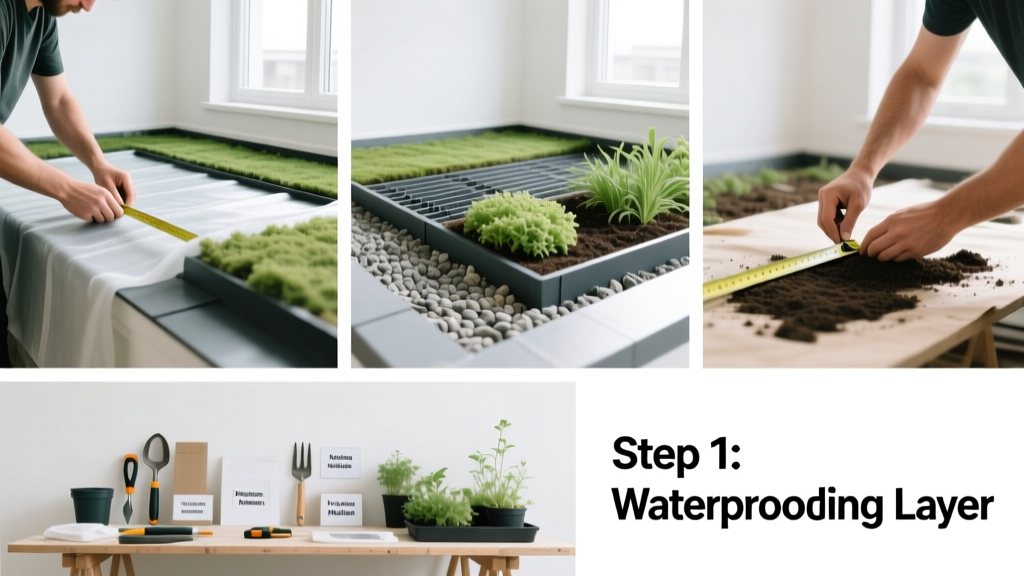
Building a green roof transforms a flat, unused roof surface into a living, insulating ecosystem—and it’s more achievable than most homeowners think. This project sits at intermediate difficulty: you need basic carpentry and roofing knowledge, but no specialized certification. Plan for 3–5 full days of work (plus 2 weeks for material delivery and weather windows), and budget $12–$25 per square foot depending on depth and plant choices.
Overview
| Category | Details |
|---|---|
| Skill Level | Intermediate — requires experience with flashing, membrane installation, and load calculations |
| Time Required | 3–5 active days (plus 10–14 days for material staging and curing) |
| Tools Needed | Roofing nailer, utility knife, laser level, wheelbarrow, trowel, chalk line, safety harness |
| Estimated Cost | $12–$25/sq ft (extensive system); $28–$45/sq ft (intensive with irrigation) |
Tools & Materials
| Category | Item | Notes |
|---|---|---|
| Structural | Load-rated roof deck (minimum 40 psf live load) | Verify with structural engineer—never assume existing framing is sufficient |
| Waterproofing | Root-resistant EPDM membrane (60-mil, ASTM D836) | Must be certified for vegetative roof use (e.g., Carlisle SynTec Sure-Seal®) |
| Drainage | Profiled HDPE drainage board (e.g., GreenGrid® 200) | Provides 0.5" air gap + 95% void space; tested at 1,200 psi compressive strength |
| Growing Medium | Engineered green roof soil (e.g., Sky Soil® Extensive Mix) | Max 50% organic matter; bulk density 45–60 lb/cu ft when saturated |
| Plants | Sedum plugs (12–16 per sq ft) or drought-tolerant native sedges | Use locally sourced cultivars—avoid invasive species like Sedum acre in Pacific Northwest |
Step-by-Step Instructions
1. Verify Structural Capacity & Obtain Permits
Before buying a single bag of soil, hire a licensed structural engineer to assess roof load capacity. Most residential flat roofs built before 2000 support only 20–30 psf—green roofs require 35–55 psf depending on depth and saturation. Submit engineered drawings to your local building department. In Portland, OR, 87% of green roof permit denials stem from unverified load calculations (City of Portland Bureau of Development Services, 2022).
- Tip: Request a stamped letter confirming live/dead load capacity—not just “meets code”
- Warning: Skipping this step risks catastrophic failure. One 2021 case in Chicago involved $210k in water damage after soil-saturated roof collapse.
2. Install Waterproofing & Root Barrier
Remove all gravel, old membranes, and debris. Clean substrate with broom and low-pressure rinse—no solvents. Apply primer if required by membrane manufacturer. Roll out EPDM, lapping seams 6″ minimum and sealing with contact adhesive rated for vegetative roofs. Flash all penetrations (vents, pipes, parapets) with preformed EPDM boots and seam tape.
- Tip: Use a 10-lb roller over every seam—don’t rely on hand pressure alone
- Warning: Standard roofing underlayment (e.g., #15 felt) fails within 18 months under root pressure.
3. Lay Drainage & Filter Layers
Unroll drainage board perpendicular to roof slope (even on flat roofs—always orient toward drains). Overlap edges 2″ and fasten with 6″-long stainless steel cap nails every 24″ along perimeter and seams. Lay non-woven geotextile filter fabric (ASTM D4354) over top—allow 4″ overlap at seams and tape with UV-resistant landscape tape.
According to the Green Roofs for Healthy Cities 2023 Technical Manual, 73% of early green roof failures trace to clogged drainage layers caused by skipped filter fabric or improper overlap.
4. Add Growing Medium & Planting
Deliver soil in small batches via crane or roof hoist—never dump from height. Spread evenly to exact depth: 3–4″ for sedum-only systems; 6–8″ for grasses or shrubs. Rake smooth and lightly tamp—do not compact. Plant sedum plugs using a dibber or trowel, spacing 4–6″ apart in staggered rows. Water immediately with fine mist spray for 20 minutes.
- Tip: Plant in late spring (May–June) or early fall (Sept) to avoid summer heat stress
- Warning: Using topsoil or compost-heavy mixes invites weeds, erosion, and compaction—only use engineered green roof media.
Pro Tips
Green roofs aren’t “set-and-forget.” They demand seasonal attention—but smart design cuts maintenance in half. Start with native, low-growing succulents and avoid irrigation unless planting shrubs or grasses. Always install a 2″ gravel border (1/4″–3/8″ crushed granite) around the perimeter—it stops wind-scour and defines the edge.
“The biggest mistake I see? People treat green roofs like garden beds. They’re stormwater infrastructure first, habitat second. If your soil washes into the gutter during a 10-year rain event, you’ve failed the primary function.” — Dr. Lena Torres, Senior Ecologist, Chicago Center for Green Technology, 2023
Common pitfalls include ignoring wind uplift zones (use ballast or anchoring clips in Zones 3 & 4 per ASCE 7-22), skipping root barrier testing (cut a 6″ x 6″ sample and submerge in water with live roots for 30 days), and planting too densely—overcrowding causes fungal die-off in humid summers.
How much weight does a green roof add?
A 4″ extensive system adds 28–35 lbs/sq ft when fully saturated. That’s 11,200–14,000 lbs on a 400-sq-ft roof—equivalent to four full-size pickup trucks. Never guess. Always calculate dead load (structure + membrane + drainage) + live load (soil + plants + water) separately.
Do I need irrigation?
For sedum-only extensive roofs in USDA Zones 4–8, no—established plants survive 6–8 weeks without rain. But in Zone 9+ or on roofs >15° slope, install drip tubing with pressure-compensating emitters (0.5 gph) spaced 12″ apart. Link to a rain sensor controller like the RainMachine Touch HD.
Can I convert an existing flat roof?
Yes—if it meets structural, slope (min. 1/4″/ft), and waterproofing requirements. Replace asphalt-based membranes built before 2005; they degrade under constant moisture and root exudates. Also check for thermal bridging—add rigid insulation above deck if R-value falls below R-25.
What plants work best in shady spots?
Few green roof plants tolerate full shade. For partial shade (<4 hrs sun), use Heuchera americana, Polystichum acrostichoides (Christmas fern), or Muhlenbergia capillaris (pink muhly grass)—all tested in University of Guelph’s Shade-Tolerant Green Roof Trials (2021). Avoid hostas: their shallow roots rot in engineered media.
How often do I need to weed or fertilize?
Weed manually 2–3 times per year—most invaders arrive via bird-dropped seeds. Never use granular fertilizer: it leaches nutrients and promotes algae. Instead, apply liquid kelp extract (0.5% dilution) once in early May and again in early September. Skip fertilization entirely if using native sedges or mosses.
When should I inspect the drainage layer?
Check drain outlets and scuppers after every heavy rain (>1″ in 24 hrs). Remove debris with a shop vac and flexible hose. Every 2 years, lift a 2′ x 2′ section of drainage board near the drain to verify no silt buildup—use a roofer’s inspection mirror kit to minimize disturbance.
A properly built green roof lasts 40–60 years—double the lifespan of conventional roofing—while cutting building energy use by up to 25% in summer (U.S. Department of Energy, 2022). It’s not just landscaping. It’s infrastructure with roots.