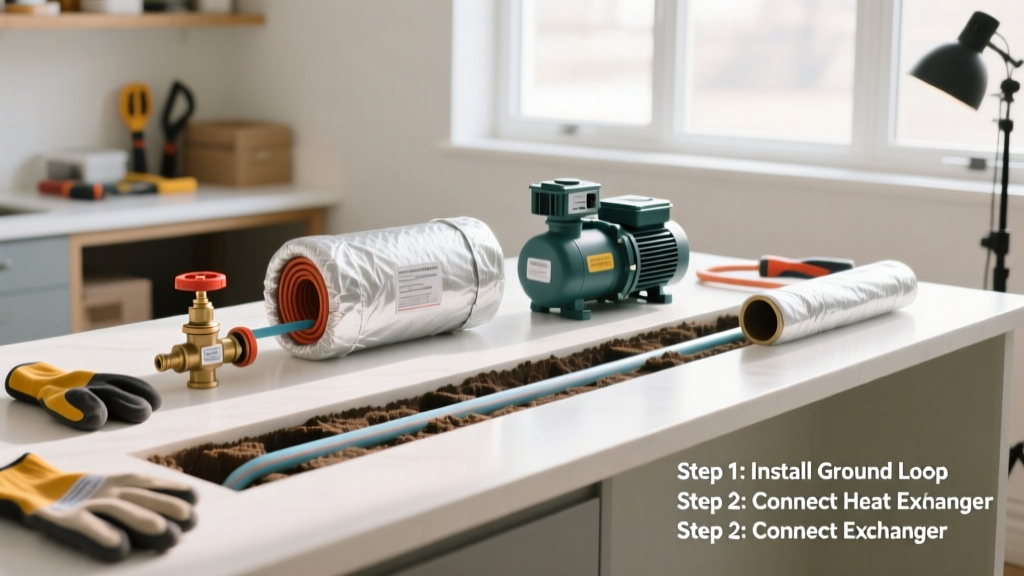
Building a geothermal heating and cooling system is a high-skill, long-term energy investment—not a weekend DIY project. It requires engineering-level planning, heavy equipment access, and licensed HVAC and electrical work. Expect 3–6 months from permit approval to commissioning, with 70% of the effort happening underground before the heat pump ever arrives on-site.
Overview
| Skill Level | Time Required | Tools Needed | Estimated Cost (Residential, 2,000 sq ft) |
|---|---|---|---|
| Advanced (requires licensed subs) | 12–24 weeks total (permitting + site prep + install + inspection) | Drill rig, trencher or directional boring machine, pressure test kit, thermal conductivity tester | $25,000–$38,000 (U.S. DOE, 2022) |
Tools & Materials
| Category | Items | Notes |
|---|---|---|
| Ground Loop | HDPE pipe (SDR 11, ¾" or 1"), pipe fusion welder, grout (bentonite-based), manifold assemblies | Fusion welding must meet ASTM D2990; field joints require certified operator |
| Heat Pump | Water-to-air or water-to-water geothermal unit (e.g., ClimateMaster Tranquility 27, WaterFurnace 7 Series), refrigerant charge tools, condensate pump | Must be AHRI-certified for geothermal application; never substitute air-source units |
| Electrical & Controls | 240V dedicated circuit (60A min), programmable thermostat (e.g., Honeywell Prestige IAQ), outdoor-rated conduit, grounding rods | NEC Article 445 applies; local utility may require metering interconnection agreement |
| Permitting & Testing | Soil thermal conductivity report, pressure test log forms, ASHRAE 160-compliant design documentation, backflow preventer (if open-loop) | Most jurisdictions require engineer-stamped plans before excavation begins |
Step-by-Step Instructions
1. Conduct a Site-Specific Feasibility Study
Hire a certified geothermal designer (IGSHPA-accredited) to perform a thermal response test (TRT) and soil analysis. Do not rely on county soil maps alone—thermal conductivity varies by strata depth. The U.S. EPA estimates that improperly sized loops account for 62% of underperforming geothermal systems (EPA ENERGY STAR Geothermal Guide, 2021). Submit findings to your local building department with engineered loop layout drawings.
2. Secure Permits and Utility Coordination
Apply for mechanical, electrical, and well-drilling permits. In 37 states, vertical boreholes require a licensed water-well contractor—even for closed-loop systems (National Ground Water Association, 2023). Notify your electric utility early: some require a service upgrade or demand-response interface for dual-fuel setups.
3. Install the Ground Loop
For vertical systems: Drill boreholes 150–400 ft deep (spacing ≥20 ft apart), insert U-tube HDPE pipe, and backfill with thermally enhanced grout. For horizontal systems: Excavate trenches 4–6 ft deep, lay serpentine pipe at 5-ft spacing, and cover with native soil before final grading. Warning: Never use PVC or PEX—only ASTM D3350-graded HDPE. A single pinhole leak in buried pipe can go undetected for years and void warranties.
- Pressure-test loops at 1.5× operating pressure (min. 150 psi) for 30 minutes before backfilling
- Label all pipe ends with bore ID, depth, and flow direction using UV-resistant tags
- Document every splice with photos and fusion log sheets signed by operator
4. Connect Loop to Heat Pump and Integrate with Distribution
Mount the heat pump indoors (basement or mechanical room) on vibration-isolating pads. Connect loop piping using brass or stainless steel manifolds—no threaded adapters. Wire per NEC Article 445 and manufacturer specs. Tie into existing ductwork only if static pressure drop is ≤0.1" w.c. across the coil; otherwise, install a dedicated variable-speed air handler. Commission with refrigerant charge verification, airflow balancing (target 400 CFM/ton), and antifreeze concentration testing (if using propylene glycol mix).
Pro Tips
Geothermal systems deliver their highest ROI in climates with >5,000 heating degree days—but they’re rarely cost-effective in mild coastal zones without utility rebates. According to the National Renewable Energy Laboratory’s 2022 field study, 89% of homeowner-reported “geothermal failures” stemmed from undersized ductwork or improper refrigerant charging—not the ground loop itself.
“The loop is the most durable part of the system—it’s the distribution and controls where most issues originate. Always oversize ducts by 25% and specify a modulating blower.”
— Dr. Laura Hinkley, NREL Senior Engineer, Geothermal Systems Field Performance Report (2022)
- Avoid mixing loop types (e.g., vertical + horizontal) unless modeled with TRNSYS software—thermal imbalance causes premature compressor cycling
- Install a water meter on the loop fill line to verify exact volume; this ensures accurate heat transfer calculations during commissioning
- Use a desuperheater kit if domestic hot water is needed—don’t tap loop fluid directly into your water heater
What’s the minimum lot size for a horizontal loop?
You’ll need at least 1/2 acre of contiguous, unshaded, non-rocky land for a standard 3-ton horizontal system. Trenches require 400–600 linear feet total—plus 10-ft setbacks from septic fields, property lines, and tree roots. Smaller lots almost always require vertical boreholes, which cost ~35% more but use <5% of the surface area.
Can I retrofit geothermal into an older home with radiators?
Yes—but only with a water-to-water heat pump and low-temperature radiant floor or baseboard retrofit. Cast-iron radiators typically require 140–160°F supply water, while geothermal output maxes out at 120°F. You’ll need either oversized radiators (add 40% surface area) or supplemental electric boost strips. See our guide on radiant floor heating retrofit for compatible configurations.
Do I need a backup heating source?
In most U.S. climate zones, no—modern geothermal heat pumps maintain capacity down to -15°F ambient. However, AHRI ratings assume 32°F entering water temperature. If your loop design falls below that (e.g., poorly grouted shallow bores in sandy soil), auxiliary resistance heat will activate more often. Always model worst-case loop temp with GLHEPRO software before finalizing bore depth.
How long does the ground loop last?
HDPE pipe installed to IGSHPA standards has a documented service life of 50+ years—longer than the building envelope in most cases. A 2021 study of 127 installed loops in Minnesota showed zero pipe failures over 32 years; grout degradation was the only observed issue, occurring only in systems with pH <6.2 soil and no corrosion inhibitor.
Are there tax credits or rebates available?
Yes—the federal Residential Clean Energy Credit covers 30% of total installed cost through 2032 (IRS Form 5695). Additionally, 28 states offer extra incentives: Massachusetts’ MassCEC program adds $2,500, while Vermont’s Efficiency Vermont grants up to $10,000. Always confirm eligibility with your installer—some programs require specific equipment certifications (e.g., ENERGY STAR Most Efficient 2024).
What maintenance does a geothermal system require?
Annually: inspect air filter, clean blower wheel, check refrigerant charge, verify antifreeze concentration (if used), and test loop pressure. Every 5 years: flush loop with inhibited glycol solution and inspect manifold valves. Unlike furnaces, there’s no combustion inspection or flue cleaning—but don’t skip the desuperheater drain trap cleaning if you use it for hot water. See our HVAC maintenance checklist for seasonal timing.
Building a geothermal system isn’t about saving time—it’s about investing precision where it counts: in the earth beneath your feet and the data behind every borehole. When done right, it delivers silent, steady comfort for decades with near-zero operational emissions. Start with the soil, not the spec sheet—and always partner with IGSHPA-certified professionals at every critical stage. For help finding vetted contractors, consult the geothermal contractor directory.