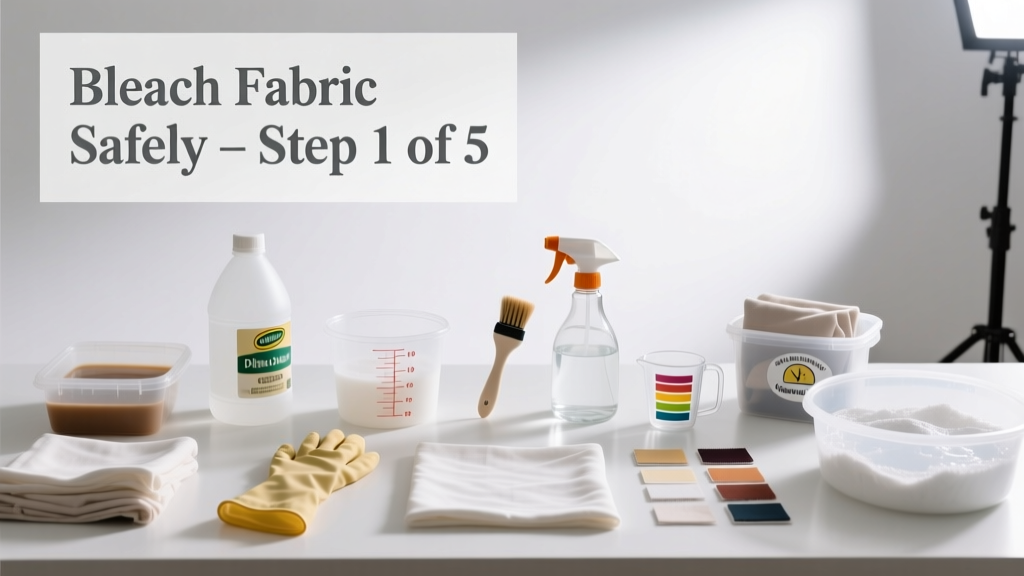
Bleaching fabric is a practical skill for restoring whites, creating vintage effects, or preparing textiles for dyeing—but it’s not just about pouring chlorine onto cloth. Done incorrectly, bleach weakens fibers, causes yellowing, or leaves permanent stains. With moderate difficulty and 20–45 minutes of active time (plus drying), this process rewards careful preparation and attention to fiber content.
Overview
| Skill Level | Time Required | Tools Needed | Estimated Cost |
|---|---|---|---|
| Moderate (requires attention to detail) | 20–45 minutes active + 1–24 hours drying | Gloves, measuring cup, plastic bucket, tongs, ventilation | $3–$12 (most households already own bleach) |
Tools & Materials
| Item | Quantity/Spec | Notes |
|---|---|---|
| Regular household liquid chlorine bleach (6% sodium hypochlorite) | 1 bottle (e.g., Clorox Regular-Bleach®, 2023 formulation) | Avoid “splash-less” or “color-safe” versions—they lack active chlorine for true bleaching |
| Cold or lukewarm water | 1 gallon per treatment batch | Hot water deactivates bleach and accelerates fiber damage |
| Plastic bucket or sink lined with plastic | 1 large container (non-metal) | Never use aluminum, steel, or galvanized containers—bleach corrodes them |
| Rubber gloves & eye protection | 1 pair gloves, optional safety goggles | The U.S. EPA reports 12,000+ bleach-related injuries annually (EPA Safer Choice Program, 2022) |
| White vinegar (optional) | ½ cup | Neutralizes residual bleach after rinsing—critical for cotton towels and linens |
Step-by-Step Instructions
1. Confirm fabric compatibility
Check the care label: Only bleach cotton, linen, rayon, and polyester-cotton blends. Never bleach wool, silk, spandex, mohair, or acetate—they’ll dissolve or yellow instantly. If no label exists, test an inconspicuous seam or hem first: apply 1 drop of diluted bleach (1:10 ratio), wait 1 minute, rinse, and check for strength loss or discoloration.
2. Prepare the bleach solution
Mix precisely: For general whitening, use ¼ cup bleach per 1 gallon cold water. For stubborn stains or dingy whites, increase to ½ cup—but never exceed 1:10 bleach-to-water (5% concentration). According to the American Cleaning Institute’s Bleach Use Guidelines (2021), higher concentrations offer diminishing returns and sharply increase fiber degradation.
3. Soak or spot-treat
For full items (like white t-shirts or pillowcases): fully submerge for 5–8 minutes—no longer. For stains: use a clean cloth soaked in solution and press (don’t rub) for 2–3 minutes. Remove immediately if fabric begins lightening unevenly. Set a timer—you’ll be surprised how fast over-bleaching happens.
4. Rinse thoroughly and neutralize
Rinse under cold running water for at least 3 minutes. Then soak in a vinegar-water solution (½ cup vinegar per gallon water) for 5 minutes to halt chemical action. Skip this step, and residual bleach continues breaking down cellulose fibers—even in the dryer. Spin-dry, then air-dry away from direct sun (UV light worsens yellowing on aged cotton).
Pro Tips
Seasoned textile conservators warn that “bleach is a one-way street”—you can’t undo over-application. Always work in a well-ventilated area, and never mix bleach with ammonia or vinegar *before* application (toxic chloramine gas forms instantly). Keep a log: note fabric type, bleach ratio, soak time, and outcome. You’ll quickly learn that 6 minutes works for your 100% cotton sheets, but 4 minutes is safer for vintage denim.
"Over-bleaching doesn’t make things whiter—it makes them brittle. I’ve seen museum-grade linens snap like dry twigs after a 12-minute soak. Stick to 8 minutes max, even for heavy soil." — Elena Ruiz, Textile Conservator, Winterthur Museum, 2022
- Wash bleach-treated items separately for their first post-bleach cycle—residual chlorine can react with detergent dyes
- Replace your bleach every 6 months; sodium hypochlorite degrades rapidly on the shelf
- For faded black cotton, try how to remove bleach stains instead of re-bleaching
Can I bleach colored fabric?
No—not with chlorine bleach. It removes color unpredictably and damages fibers. For intentional color removal, use a color remover like RIT Color Remover (sodium hydrosulfite), which works on cotton, rayon, and linen without chlorine’s harshness.
Why did my bleached shirt turn yellow?
Yellowing almost always means one of three things: (1) the fabric had optical brighteners that broke down (common in athletic wear), (2) bleach wasn’t fully rinsed and reacted with heat in the dryer, or (3) you used too high a concentration on aged cotton. Try the vinegar soak next time—and skip the dryer.
Is there a safe way to bleach delicate lace?
Generally, no. Most lace contains nylon, polyester, or cotton blends with fragile embroidery. Even diluted bleach attacks thread integrity. Instead, soak in oxygen-based bleach (sodium percarbonate) mixed with warm water for 2–4 hours—gentler and effective for organic soils.
Can I reuse bleach solution?
No. Sodium hypochlorite loses potency within 1–2 hours of dilution, especially in warm or light-exposed conditions. Always prepare fresh solution for each use. Discard leftover mix down the drain with plenty of water.
Does bleach expire?
Yes. Unopened bottles last ~1 year; opened bottles degrade after 6 months. If your bleach smells faint or fails to bubble when mixed with water, replace it. The CDC confirms degraded bleach provides inadequate disinfection—and zero whitening power.
How do I fix uneven bleaching?
You can’t reverse it—but you can mask it. Dip-dye the entire item in a pale indigo or gray fabric dye (how to dye cotton fabric) to create intentional tonal variation. Or repurpose into rag rugs or quilt squares where contrast adds character.
Bleaching fabric isn’t magic—it’s chemistry with consequences. Respect the reaction window, match the method to the fiber, and treat bleach like the powerful tool it is: precise, irreversible, and deeply effective when used with intention. Keep notes, protect your skin and lungs, and remember that sometimes the best bleach job is the one you didn’t rush.