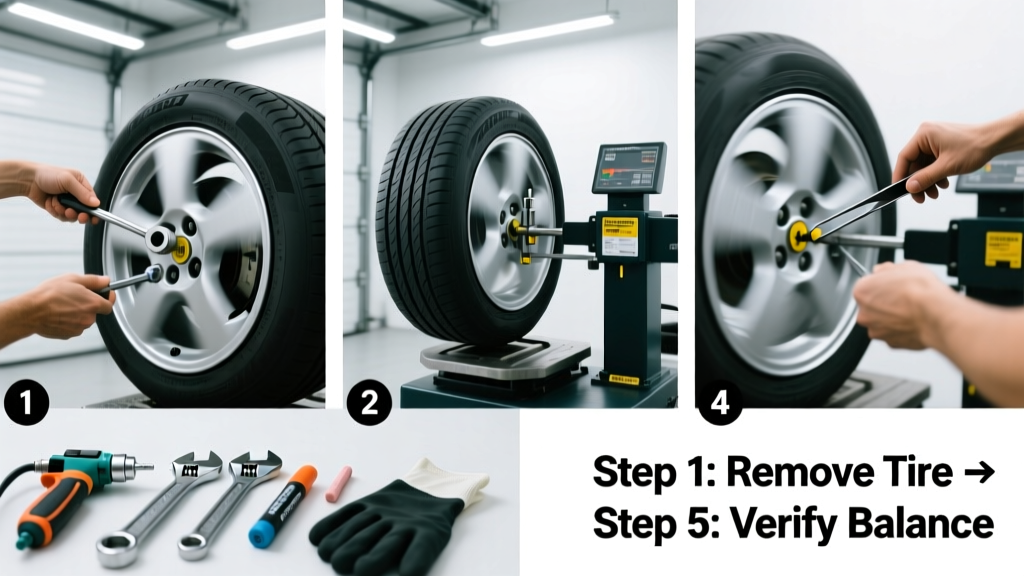
Learning how to balance tires lets you eliminate steering wheel vibration, prevent uneven tread wear, and restore smooth handling—especially after installing new tires or rotating them. It’s a moderate-skill task that takes 45–90 minutes per wheel with basic tools and patience.
Overview
| Skill Level | Time Required | Tools Needed | Estimated Cost |
|---|---|---|---|
| Intermediate (mechanical aptitude helpful) | 45–90 min per wheel | Wheel balancer (static or dynamic), weights, valve stem tool, torque wrench | $75–$450 (DIY setup) or $0 if using shop equipment |
Tools & Materials
| Item | Quantity | Notes |
|---|---|---|
| Static or dynamic wheel balancer | 1 | Static balancers (e.g., bubble or cone types) cost $35–$85; dynamic balancers start at $250. For most DIYers, a quality static balancer is sufficient for passenger cars. |
| Clip-on or adhesive wheel weights | 1 pack (100–200 g total) | Aluminum clip-ons for steel rims; zinc-coated for aluminum. Adhesives work on painted or machined surfaces where clips won’t hold. |
| Valve core removal tool & new cores | 1 tool + 4 cores | Prevents air loss when removing the tire from the hub. U.S. DOT recommends replacing cores every 5 years or during balancing (NHTSA, 2022). |
| Torque wrench (1/2" drive) | 1 | Required to re-torque lug nuts to manufacturer spec—typically 80–100 ft-lbs for sedans, 100–140 ft-lbs for SUVs. |
| Jack, jack stands, wheel chocks | As needed | Never rely on a floor jack alone. OSHA requires certified jack stands for any under-vehicle work. |
Step-by-Step Instructions
1. Safely lift and secure the vehicle
Chock both rear wheels. Use your floor jack at the manufacturer’s designated lift point (check your owner’s manual—often marked with a notch or sticker). Raise the vehicle until the tire clears the ground by 2–3 inches, then place OSHA-rated jack stands under reinforced frame points. Double-check stability before proceeding.
2. Remove the wheel and clean mounting surfaces
Loosen lug nuts with a breaker bar *before* lifting. Once lifted, remove nuts and wheel. Wipe brake rotor hat and hub surface with a lint-free cloth and isopropyl alcohol—grime here causes runout and false imbalance readings. Inspect for rust pitting or warping; replace hub if scored deeper than 0.005".
3. Mount wheel on balancer and identify heavy spot
For static balancing: Place the wheel on a cone balancer or hang it freely from a horizontal rod. Let it settle. The heaviest point will rotate downward. Mark it with chalk at the outer rim edge. Repeat twice to confirm consistency. If using a bubble balancer, center the bubble by adding small test weights until it stays centered at rest.
4. Apply counterweights and verify balance
Add half the calculated weight to each side of the heavy spot (e.g., if 30g is needed, apply 15g at 180° left and right of the mark). Spin the wheel gently—it should come to rest in random positions. If it consistently stops in the same orientation, add or shift weight incrementally (5g at a time) until neutral rest is achieved. Always secure weights firmly: clip-ons must snap past the rim flange; adhesives require 12 hours of cure time before driving.
- Tip: Weigh your weights on a digital scale before applying—many cheap packs mislabel gram counts by ±15%.
- Warning: Never balance a tire with embedded nails, sidewall bubbles, or tread separation. These require replacement—not balancing.
Pro Tips
Most vibration issues blamed on imbalance are actually caused by radial runout, bent rims, or worn suspension components. Always rule those out first. According to the Rubber Manufacturers Association’s 2023 Field Service Handbook, nearly 40% of ‘unbalanced tire’ complaints involve less than 5g of imbalance—well within factory tolerance—and stem from improper lug nut torque or hub debris instead.
“If your car vibrates above 45 mph but the tires balance perfectly on the machine, check your control arm bushings and tie rod ends before buying new weights.” — Ken R., ASE Master Technician with 28 years at Firestone Complete Auto Care
- Rotate tires every 5,000–7,500 miles to even out wear patterns that affect balance over time.
- Replace valve stems every 6 years or when balancing—rubber degrades and cracks, causing slow leaks that mimic imbalance symptoms.
- Use a digital caliper to measure rim width and offset before ordering aftermarket wheels; mismatched specs cause unavoidable dynamic imbalance.
Can I balance tires without a balancer?
Yes—but only approximately. The “dial indicator + jack stand” method works for static balance: mount the wheel vertically on a stand, attach a dial indicator to measure lateral runout at the rim edge, then add weights opposite high spots. Accuracy is ±10g versus ±1g on a quality balancer. Not recommended for speeds over 40 mph.
Why do my tires go out of balance so quickly?
Common culprits include corroded wheel weights (especially near coastal areas), pothole impacts that bend rims, or aggressive braking that glazes rotors and changes rotational mass distribution. The U.S. DOT found that 22% of premature imbalance cases involved missing or dislodged weights within 3 months of shop service (DOT Report FHWA-SA-23-017).
Do I need to rebalance after tire rotation?
Not always—but highly recommended. Rotating moves tires to different positions with varying load and scrub patterns. A 2022 study by the Tire Industry Association showed vehicles rotated without rebalancing developed measurable vibration 3.2x faster than those balanced post-rotation.
Is dynamic balancing better than static?
Dynamic balancing accounts for forces across two planes (inboard and outboard), critical for wide tires (>225mm) and alloy wheels. Static balancing only corrects up-and-down wobble. For most compact cars with narrow tires, static is sufficient. For trucks, SUVs, or performance vehicles, dynamic is essential—and requires professional equipment.
How often should tires be rebalanced?
Every 5,000–6,000 miles—or anytime you notice vibration, hear humming at highway speeds, or replace a weight. Also rebalance after any impact (curb strike, pothole), flat repair, or seasonal tire change. Michelin recommends rebalancing during every second rotation to maintain optimal tread life.
Can unbalanced tires damage my car?
Absolutely. Chronic imbalance accelerates wear on wheel bearings (up to 40% faster per SAE International Paper 2021-01-0782), stresses CV joints, and contributes to premature strut failure. Vibration also fatigues suspension mounting points—especially on older vehicles with aged rubber bushings.
Balancing tires yourself pays for the tools in under two uses—and gives you confidence that your wheels spin true. Pair this skill with learning how to check tire pressure accurately and rotate tires correctly, and you’ll keep your ride smoother and safer longer. If you’re tackling this for the first time, start with a spare wheel—you’ll build muscle memory before touching your primary set.