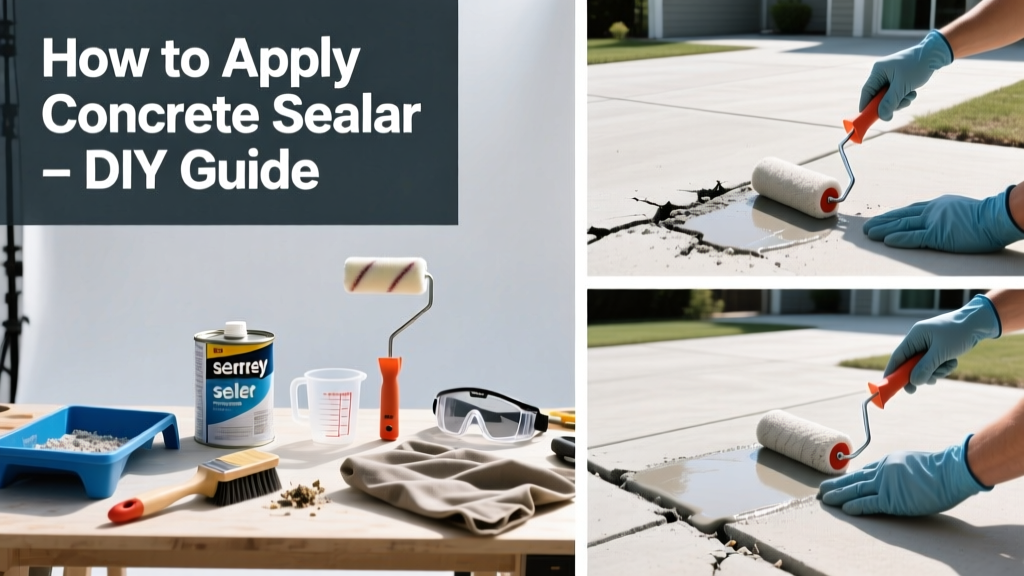
Applying concrete sealer is a mid-skill DIY task that protects surfaces from water, salt, oil, and UV damage—extending life by up to 10 years when done right. Expect 4–6 hours of hands-on work (plus 24–72 hours of dry/cure time), depending on size and weather.
Overview
| Category | Details |
|---|---|
| Skill Level | Intermediate — requires surface prep precision and timing awareness |
| Time Required | 4–6 hours active work; 24–72 hours full cure (varies by sealer type) |
| Tools Needed | Roller kit, sprayer (optional), stiff-bristle broom, squeegee, moisture meter, painter’s tape |
| Estimated Cost | $45–$120 for 5-gallon pail (covers 250–500 sq ft per coat) |
Tools & Materials
| Item | Purpose & Notes |
|---|---|
| Concrete cleaner (acidic or alkaline) | Removes efflorescence, grease, and mineral deposits; choose pH-neutral for stamped concrete |
| Pressure washer (2,500+ PSI) | Essential for rinsing deep-cleaned pores; hold nozzle 12" away to avoid etching |
| Acetone or denatured alcohol | Wipes away invisible oils before sealing—critical for adhesion |
| Water-based acrylic or solvent-based epoxy sealer | Acrylic: breathable, UV-stable, low-VOC; epoxy: high-gloss, chemical-resistant (not for driveways in freeze-thaw zones) |
| 1/4"-nap microfiber roller + extension pole | Prevents streaks and lap marks; never use foam rollers—they trap air bubbles |
| Moisture meter (e.g., Wagner MMC220) | Confirms slab moisture < 4% RH—required before sealing; skipping this causes blisters and delamination |
Step-by-Step Instructions
1. Test for moisture and contaminants
Use a moisture meter on three random spots. If readings exceed 4% RH, delay sealing and investigate drainage or vapor barrier issues. Then, tape off adjacent surfaces (brick, grass, siding) with painter’s tape—sealer stains permanently. Wipe a 2-ft² test area with acetone; if the surface darkens unevenly, grease or curing compound remains.
2. Clean thoroughly—don’t rush this step
Apply concrete cleaner per label directions (usually 1:4 dilution). Let dwell 10 minutes. Scrub stubborn oil spots with a stiff nylon brush—not wire, which embeds metal fragments. Rinse with pressure washer at 2,500 PSI, moving top-to-bottom to avoid streaking. Allow 48 hours of drying in full sun and low humidity (ideally < 85% RH).
- Warning: Never seal damp concrete—even if surface feels dry. Internal moisture will steam out and blister the film.
- Tip: Tape a 12"x12" plastic sheet to the slab overnight. If condensation forms underneath, wait longer.
3. Apply first coat evenly and deliberately
Pour sealer into a paint tray. Load roller fully but wring out excess—no dripping. Work in 3-ft-wide sections, rolling north-to-south, then east-to-west in a "W" pattern. Maintain a wet edge: overlap each pass by 4 inches. For large flat areas (garage floors), use a low-pressure sprayer (e.g., Chapin 20000) followed immediately by back-rolling to eliminate mist drift and ensure film thickness.
4. Apply second coat only if needed—and only after proper recoat window
Check manufacturer specs: most acrylic sealers require 2–4 hours between coats; solvent-based types need 8–12 hours. Never apply a second coat past the “maximum recoat window” (usually 24 hours)—it won’t bond. Use a dry roller to lightly back-roll the second coat, eliminating bubbles and ensuring uniform sheen.
- Warning: Over-application causes hazing, tackiness, or peeling within weeks.
- Tip: Mark start time on your phone—set two alarms: one for recoat window, one for foot-traffic restriction (typically 24 hrs).
Pro Tips
Sealers fail not from poor product choice—but from rushed prep or misread conditions. According to the American Concrete Institute’s Guide to Concrete Floor Coatings (2022), 73% of premature sealer failures trace back to inadequate moisture testing or surface cleaning.
“If you skip the acetone wipe-down, you’re sealing over a layer of invisible oil—like gluing wallpaper to wax paper. It looks fine for three months, then starts lifting at the edges.” — Maria Chen, certified concrete restoration technician with 18 years’ field experience
Avoid these common mistakes: applying in direct sun (causes flash-drying and pinholes), using old sealer (check batch code—most expire 2 years after manufacture), or sealing new concrete before 28-day cure (even if it feels hard, internal hydration isn’t complete).
Can I seal concrete in cold weather?
Only if air and slab temps stay above 50°F for 48 hours before, during, and after application. Below that, acrylics won’t coalesce properly; solvent-based sealers may cloud. The U.S. Department of Transportation advises against sealing between November and March in northern states unless using a cold-weather–formulated product like Armor SX5000.
How long before I can park on my sealed driveway?
Wait minimum 72 hours for light vehicle traffic. Full chemical resistance develops after 7 days. Don’t drive tires across wet sealer—it leaves permanent scuff marks. Place cardboard under jack stands for the first week.
Why did my sealer turn white or chalky?
This is moisture entrapment—either from sealing too soon after rain or high humidity (>85% RH) during application. The water vapor pushes through the film, leaving calcium carbonate deposits. You’ll need to strip with Xylene (for solvent-based) or citrus-based stripper (for acrylic), then retest moisture before reapplying.
Do I need to strip old sealer before reapplying?
Yes—if it’s peeling, hazy, or flaking. But if it’s intact and clean, you can often recoat after light sanding (80-grit) and acetone wipe. Always do an adhesion test: tape a 2" square, rip it off—if sealer lifts, full removal is required.
Which sealer works best for pool decks?
Use a slip-resistant, breathable acrylic with added silica grit (e.g., Foundation Armor AR350). Avoid glossy solvent-based sealers—they become dangerously slick when wet. The National Spa & Pool Institute recommends a coefficient of friction ≥0.60; verify with a pendulum test kit before final walk-on.
How often should I reseal outdoor concrete?
Every 2–3 years for driveways and patios exposed to sun, de-icing salts, or heavy foot traffic. Garages typically last 4–5 years. Check annually: sprinkle water—if it beads strongly, the sealer is still effective; if it soaks in within 10 seconds, it’s time to recoat. For more on maintaining sealed surfaces, see our guide on concrete maintenance schedule and best concrete sealers for cold climates.
Sealing concrete isn’t about making it shiny—it’s about building a durable, invisible shield. Do the prep like your patio’s lifespan depends on it (it does), apply with steady rhythm, and respect the chemistry. You’ll gain years of protection, fewer cracks, and zero surprise repairs down the road.