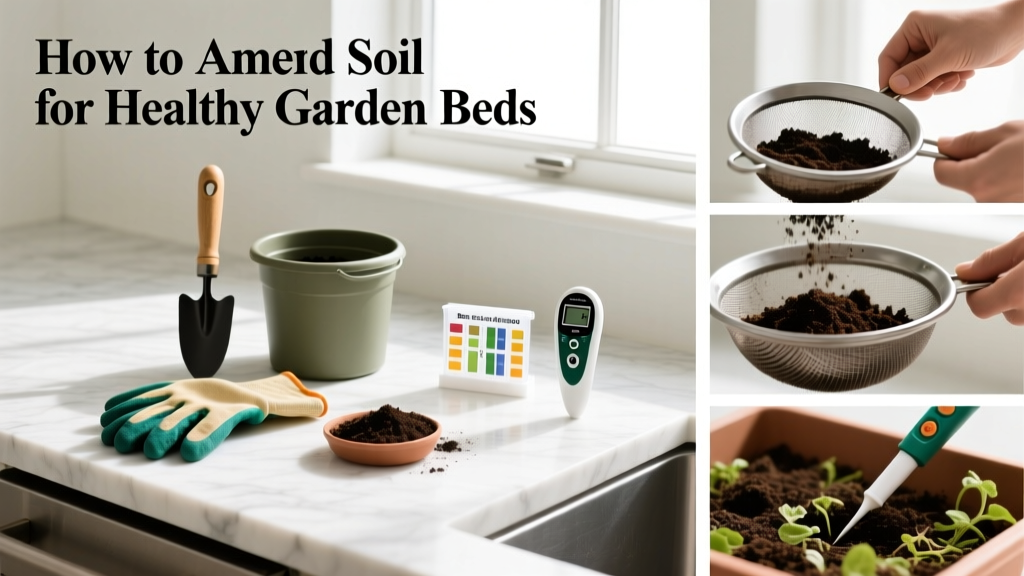
Soil amendment is the intentional addition of organic or mineral materials to improve structure, fertility, water retention, or pH—so your plants thrive instead of just surviving. It’s a foundational gardening skill rated beginner-friendly (no special certification needed), takes 2–4 hours for a 10' × 10' bed, and delivers measurable results within one growing season.
Overview
| Skill Level | Time Required | Tools Needed | Estimated Cost |
|---|---|---|---|
| Beginner | 2–4 hours (per 100 sq ft) | Garden fork, pH test kit, wheelbarrow, gloves | $15–$45 (organic matter + lime/sulfur if needed) |
Tools & Materials
| Item | Quantity (for 100 sq ft) | Notes |
|---|---|---|
| Compost (well-aged, screened) | 2–3 cubic feet | Avoid fresh manure—it can burn roots and harbor pathogens (USDA NRCS, 2022) |
| Worm castings | 1–2 quarts | Rich in beneficial microbes; boosts seedling emergence by up to 30% (Rodale Institute Trial Report, 2021) |
| Elemental sulfur or garden lime | Based on soil test | Use only after lab testing: applying lime without need raises pH and locks up iron |
| Coarse sand (horticultural grade) | 1–2 cubic feet | Only for heavy clay—never use play sand (it creates concrete-like layers) |
Step-by-Step Instructions
1. Test your soil first—don’t guess
Collect 5–7 subsamples from different spots in your bed (6" deep), mix them in a clean bucket, and air-dry overnight. Send to a certified lab (e.g., your state’s Cooperative Extension) or use a $12–$25 digital pH/EC meter. Skip this step, and you risk over-liming acidic blueberry beds—or adding sulfur to already alkaline soils. According to the USDA Natural Resources Conservation Service, 68% of home gardeners who skip testing apply amendments incorrectly.
2. Clear and loosen the surface
Remove weeds, mulch, and debris. Use a garden fork—not a tiller—to penetrate 6–8" deep. Tilling destroys soil aggregates and fungal networks; forking preserves structure while aerating. Work when soil is *moist but not wet*: squeeze a handful—if it forms a tight ball that won’t crumble, wait 2–3 days.
3. Spread amendments evenly
Pour compost in thin, overlapping layers across the surface. Sprinkle worm castings next, then add sulfur or lime *only* if your test confirmed need. Use a rake to distribute everything uniformly before mixing. Never dump amendments in piles—uneven distribution causes patchy growth and nutrient hotspots.
4. Incorporate gently and water in
Fork the amendments into the top 6" using a “lift-and-turn” motion—not a rotary motion—to avoid smearing clay or compacting loam. Rake smooth. Then water slowly with a sprinkler or soaker hose for 30 minutes to settle particles and activate microbes. Avoid overhead watering for 48 hours post-amendment to prevent surface crusting.
Pro Tips
Seasoned growers know timing matters more than volume. Amend in fall for spring planting: earthworms and frost action do half the work over winter. Spring amendments need 2–3 weeks to stabilize before seeding. And never amend sandy soil with sand—add compost instead. Sand in sand = zero improvement.
“The biggest mistake I see? Adding peat moss to alkaline soil. It’s acidic, yes—but it decomposes fast and leaves behind sodium salts that worsen compaction. Compost builds lasting structure; peat just buys time.” — Dr. Lena Torres, Soil Scientist, UC Davis Department of Plant Sciences, 2023
- Test every 2–3 years—even in established beds. Nutrient depletion and pH drift are silent problems.
- Keep records: note date, amendment type, rate applied, and crop response. A simple notebook beats memory every time.
- If you’re planting vegetables, skip synthetic fertilizers for 30 days post-amendment—microbes need time to mineralize nutrients.
Can I amend soil in containers?
Yes—but differently. Mix 1 part compost, 1 part coconut coir (not peat), and 1 part perlite or rice hulls. Skip lime/sulfur unless testing potting mix pH (most commercial mixes are already buffered). Refresh ⅓ of container soil yearly—roots exhaust nutrients faster in confined space.
How much compost is too much?
More than 30% by volume risks nitrogen tie-up as microbes break down excess carbon. Stick to 2–3 inches tilled into top 6" (≈25% volume). For raised beds, layer compost between soil and native fill—never exceed 50% total organic content.
Do I need to retest after amending?
Yes—retest pH and phosphorus 4–6 weeks after incorporation. Nitrogen and potassium levels stabilize faster, but pH shifts take time. If your amended bed still tests below pH 6.0 for tomatoes or above pH 7.5 for azaleas, apply half the original corrective rate—not full dose.
Can I use grass clippings as an amendment?
Fresh clippings alone cause odor, heat, and nitrogen lock-up. But dried, weed-free clippings mixed 1:3 with compost make excellent top-dressing. Never use clippings from lawns treated with herbicides within the last 3 weeks—they persist in soil and stunt broadleaf plants.
What’s the fastest way to improve clay soil?
It’s not gypsum—it’s compost + cover cropping. Gypsum only helps sodic (sodium-rich) soils, not typical clay. Instead, plant daikon radish or cereal rye in fall; their taproots fracture compaction layers. Chop and drop before flowering, then fork in 2 inches of compost. Repeat annually—clay improves measurably in 3 seasons.
Is bagged “garden soil” a good amendment?
No. Most contain peat, synthetic fertilizer, and minimal compost. They’re designed for filling holes—not building soil biology. Use them only as a short-term fix for potted herbs. For beds, invest in local compost: check compost-local-sources for vetted suppliers near you.
Amending soil isn’t about instant perfection—it’s about steady, observable progress. You’ll notice earthworms returning within 10 days, seedlings standing taller by week three, and fewer pests by midseason. Keep a small journal beside your garden gate, and revisit your first amendment notes next fall. You’ll be amazed how quickly your intuition sharpens. For deeper help diagnosing poor plant performance, try our soil-test-interpretation guide—or compare your results with our common-soil-problems-chart.