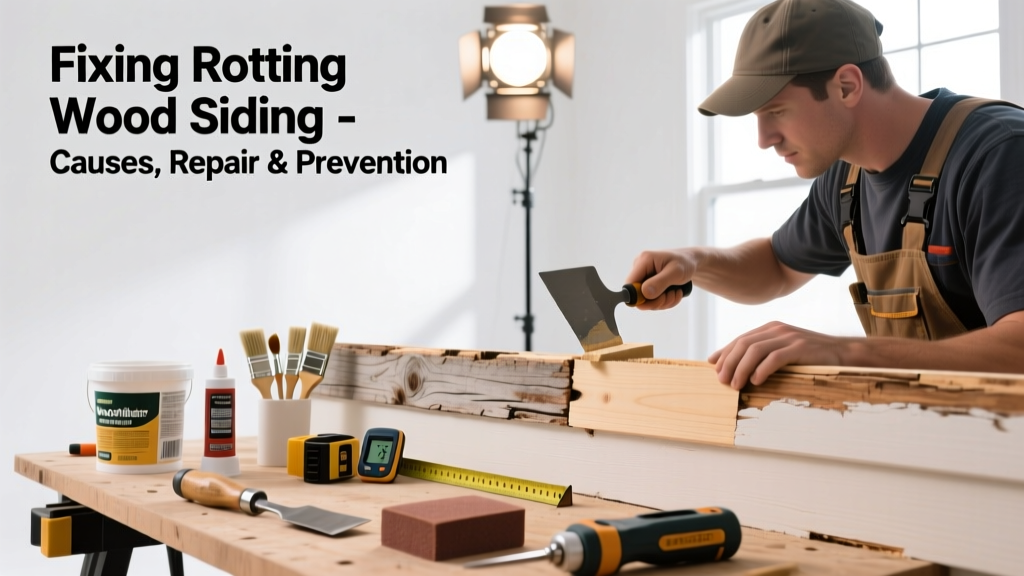
That spongy spot on your cedar clapboard? The paint bubbling near the foundation? That’s not just cosmetic — it’s wood siding actively rotting, and it’s already failing its job as your home’s first weather barrier. Left unchecked, rot spreads fast, inviting moisture deeper into sheathing and framing. This isn’t a ‘wait-and-see’ issue — it’s a structural red flag demanding action.
Quick Diagnosis
Before grabbing tools, confirm what you’re dealing with. Rot rarely appears out of nowhere — it’s always tied to moisture exposure or poor maintenance. Here are the most common root causes:
- Missing or cracked caulk at window/door trim and corner boards
- Clogged or improperly sloped gutters dumping water directly onto siding
- Vine or ivy growth trapping moisture against the wood
- Paint failure (chalky, alligatored, or bare patches) exposing raw wood
- Foundation settling causing gaps between siding and flashing
Tools & Materials Needed
| Item | Purpose | Estimated Cost |
|---|---|---|
| 10-inch reciprocating saw with demolition blade | Cuts through rotted wood cleanly without damaging adjacent boards | $45–$85 |
| 3-in-1 wood filler (e.g., Minwax High-Performance) | Fills small voids after rot removal; sandable and paintable | $12–$18 |
| Exterior-grade primer (oil-based or acrylic bonding) | Seals repaired areas and prevents moisture re-entry | $22–$34 |
| 16d galvanized ring-shank nails | Secure replacement boards with superior holding power in damp conditions | $8–$14 per box |
| Moisture meter (e.g., General Tools MMD4E) | Measures %MC in wood — anything over 20% indicates active decay | $55–$90 |
Step-by-Step Fix
Repair depends on severity. Use these methods in order — start conservative, escalate only if needed:
- Surface-level rot (depth < ¼ inch): Scrape away loose fibers with a 5-in-1 tool, treat with 10% sodium borate solution (e.g., Bora-Care), then fill with exterior wood filler, prime, and repaint.
- Localized board rot (1–3 boards): Cut out damaged sections using a reciprocating saw, leaving clean square edges. Replace with matching cedar or redwood, pre-primed on all six sides, nailed with ring-shank nails every 12 inches.
- Structural rot (sheathing or framing exposed): Remove all compromised siding and inspect underlying OSB or plywood. If sheathing is soft or discolored, cut out and replace full sheets. Flash all seams with self-adhesive membrane (e.g., Grace Ice & Water Shield).
When to Call a Pro
Some situations demand licensed expertise — not because they’re hard, but because missteps risk mold, code violations, or hidden structural compromise. Call a contractor if:
- You find more than 3 consecutive feet of rotted sheathing behind the siding
- Rotted areas extend above the second story — ladder safety and fall protection become critical
- Mold is visible behind the siding (black, fuzzy, or musty-smelling) — requires containment and EPA-certified remediation
- Your home was built before 1978 and lead paint is present — abatement rules apply before sanding or removal
Prevention Tips
Rot doesn’t return overnight — but it does come back predictably without ongoing care. These habits cut recurrence by over 70%, according to the National Association of Home Builders’ 2022 Exterior Maintenance Report:
- Inspect siding twice yearly — spring and fall — focusing on north-facing walls and foundation-level zones
- Keep vegetation trimmed at least 18 inches from walls to ensure airflow and reduce splashback
- Re-caulk all joints and penetrations (windows, vents, pipes) every 3 years — silicone-acrylic hybrids last longest
- Maintain gutters and downspouts; install extended leaders that discharge water at least 5 feet from the foundation
Can I use bleach on this?
No. Household bleach (sodium hypochlorite) kills surface mold but does nothing to stop fungal decay inside the wood. Worse, it degrades lignin — the natural binder holding wood fibers together — accelerating deterioration. Instead, use a borate-based fungicide like Tim-bor or Bora-Care, which penetrates and neutralizes rot fungi at the cellular level.
How deep does rot have to be before I replace the board?
If your moisture meter reads >20% MC *and* a screwdriver sinks in more than ½ inch with light pressure, replacement is mandatory. According to the American Wood Protection Association’s 2021 Field Guide, boards with >30% depth loss lose over 60% of their structural integrity — even if they look intact.
Will painting over rotted wood stop the spread?
Painting over active rot is like putting a bandage on an infected wound. It traps moisture underneath, speeding decay. Always remove all compromised material, treat the sound wood beneath, and allow full drying (minimum 48 hours at <60% RH) before priming.
Is pressure washing safe for wood siding?
Only at low pressure (<500 PSI) and with a wide-angle tip (40°), held no closer than 12 inches from the surface. A study by the Forest Products Laboratory (USDA, 2020) found that pressures above 1,200 PSI splinter grain and force water behind boards — worsening rot long-term.
Can I mix wood species when replacing siding?
You can — but avoid pairing highly resinous woods (like untreated pine) next to cedar or redwood. Resin leaching creates uneven staining and premature finish failure. If mixing, seal all end-grain cuts with copper naphthenate and use identical primer/paint systems across materials.
Do I need to replace all siding if one section is rotting?
Not unless the rot pattern suggests systemic issues — like widespread missing flashing or chronic gutter overflow. Spot-repair is standard practice. But if you find rot in 3+ non-adjacent locations, investigate drainage and ventilation problems first. As contractor Mike Rafferty notes in Exterior Renovation Handbook (2023): “Rot never travels alone — it’s always the symptom of a bigger moisture story.”
“Rot in wood siding isn’t random — it’s always telling you where water has been trapped for months or years. Find the source, not just the spot.” — Sarah Lin, Building Science Consultant, Building Science Corporation, 2022
A properly repaired section of wood siding should last 15–20 years with routine upkeep — longer than many vinyl alternatives when maintained right. Don’t rush the prep work: cleaning, drying, and sealing matter more than the repair itself. For help choosing compatible replacement boards, see our guide on wood siding types comparison. And if you’re weighing full replacement, check our breakdown of cost to replace wood siding versus targeted repair.