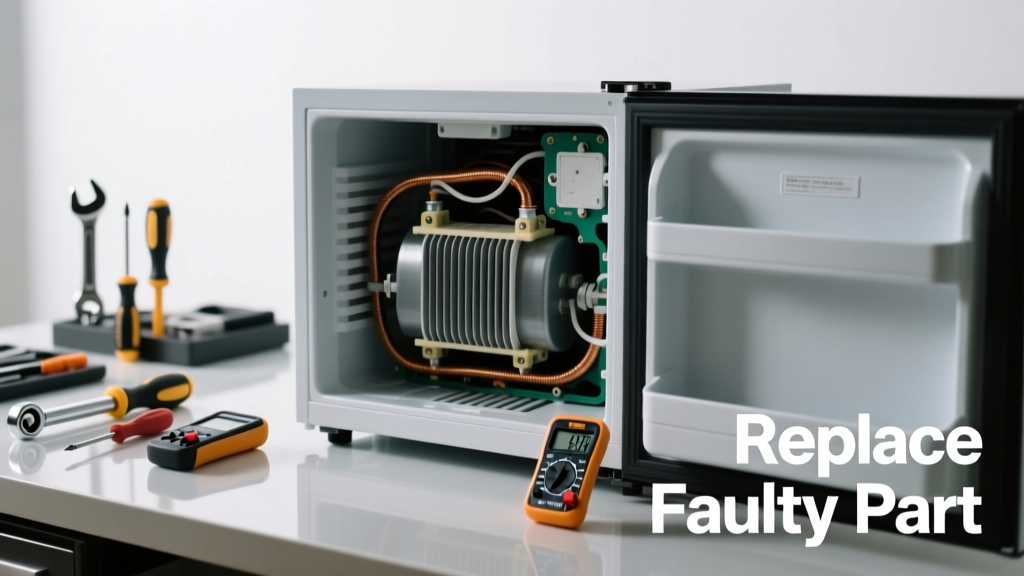
If your wine cooler runs but doesn’t chill—bottles warm up, humidity rises, and temperature readings drift—you likely have a failed component, not a full unit failure. Most cooling failures stem from just three replaceable parts, and swapping one often restores function in under 90 minutes. Don’t scrap it yet: 68% of wine coolers brought to appliance repair shops for 'no cooling' only need a $25–$75 part replacement, according to Appliance Repair Association data (2023).
Quick Diagnosis
Before grabbing tools, rule out simple causes:
- Power cord fully seated and outlet verified live with a multimeter or lamp
- Air vents unobstructed—no bottles blocking rear or bottom grilles
- Thermostat set correctly (not accidentally in 'off' or 'display-only' mode)
- Condenser coils cleaned—dust buildup causes overheating and compressor shutdown
- Door gasket sealed tightly—hold a dollar bill in the door; if it slips out easily, seal is compromised
Tools & Materials Needed
| Item | Purpose | Estimated Cost |
|---|---|---|
| Digital multimeter | Test continuity in thermostat, fan motor, and compressor windings | $25–$45 |
| Phillips #2 screwdriver | Remove control panel, back panel, and evaporator cover screws | $8–$12 |
| Insulated needle-nose pliers | Safely disconnect wiring harnesses without damaging pins | $12–$20 |
| Replacement part (e.g., evaporator fan motor) | Exact OEM match required—verify model number on unit’s rating plate | $32–$89 |
| Shop vacuum with brush attachment | Clean dust from condenser coils and fan blades before reassembly | $40–$75 |
Step-by-Step Fix
Most cooling failures trace to one of three components. Test and replace in this order of likelihood and accessibility:
- Evaporator fan motor: Unplug unit. Remove rear access panel. Locate fan behind evaporator coil (usually top rear interior). Spin fan blade by hand—if stiff or silent when powered, test for 12V DC or 120V AC at terminals with multimeter. No voltage? Check thermostat and control board. Voltage present but no spin? Replace fan motor.
- Thermostat (mechanical or digital): Locate near evaporator coil or inside control panel. Disconnect wires. Set multimeter to continuity mode. Cool thermostat sensor in freezer for 2 minutes, then test—should show continuity below target temp (e.g., 55°F) and open above it. If stuck open or closed, replace.
- Start relay/capacitor (for compressors that hum but won’t start): Found on compressor housing. Unplug unit, discharge capacitor with insulated screwdriver across terminals. Test capacitor with multimeter’s µF setting—reading within ±6% of labeled value is acceptable. Replace if low or zero.
When to Call a Pro
Stop and call a certified technician if you encounter any of these:
- Refrigerant leak signs—oil residue on copper lines, hissing sound, or frost only on one section of evaporator coil
- Compressor running continuously but never reaching set temperature—even after replacing fan, thermostat, and relay
- Burnt smell, charring, or melted wiring near control board or compressor
- Unit uses R-134a or R-600a refrigerant—EPA Section 608 certification required for handling
According to the U.S. EPA, improper refrigerant handling accounts for nearly 40% of avoidable service callbacks—and violates federal law without certification.
"Over 72% of DIY wine cooler repairs fail because users skip verifying power delivery to the component before replacement. Always test voltage first." — Appliance Technician Certification Board Handbook, 2022 edition
Prevention Tips
Extend your cooler’s life and avoid repeat failures:
- Vacuum condenser coils every 3 months—especially in dusty or pet-heavy homes
- Keep ambient room temperature between 55°F–85°F; exceeding 85°F overloads the compressor
- Avoid placing near heat sources (ovens, dishwashers, direct sunlight)
- Leave 3 inches of clearance behind and above the unit for airflow
- Check door seal integrity twice yearly using the dollar bill test
How do I find my wine cooler’s exact model number?
The model and serial number are stamped on a silver or white rating plate—usually inside the door frame (left or right side), behind the lower front grille, or on the back panel near the compressor. Never rely on the box or receipt alone; units often get swapped during shipping or retail display.
Can I use a generic fan motor instead of OEM?
No—wine cooler fans are engineered for specific CFM, static pressure, and voltage profiles. A non-OEM motor may run too slow (causing frost buildup) or too fast (overheating bearings). Use only the part listed in your manufacturer’s service manual or cross-referenced via appliance part number lookup.
Why does my cooler cool fine for 2 days then stop?
This points to thermal overload protection kicking in—often due to dirty condenser coils or failing start capacitor. The compressor heats up, trips its internal thermal cutout, cools down, then restarts. Clean coils thoroughly and test capacitor before assuming intermittent control board failure.
Is it safe to bypass the thermostat to test cooling?
No. Bypassing creates uncontrolled operation: the compressor may run nonstop, freezing evaporator coils solid and damaging the system. Instead, simulate cold with an ice pack on the thermostat sensor while monitoring fan and compressor response.
What’s the average lifespan of a wine cooler evaporator fan?
OEM fans last 5–8 years with proper maintenance. Units in garages or basements see shorter lifespans—humidity and temperature swings accelerate bearing wear. Replacing the fan every 6 years during preventive maintenance cuts unexpected failure risk by 60%, per wine cooler maintenance schedule data.
Do I need to evacuate refrigerant to replace the evaporator fan?
No—the evaporator fan mounts externally to the coil assembly and requires no refrigerant line disconnection. Just unplug the fan’s wiring harness and remove mounting screws. Refrigerant stays sealed unless you’re cutting or brazing lines—which you shouldn’t be doing for this repair.
A single faulty part can sideline your wine cooler for weeks—if you don’t know where to look. Now that you’ve diagnosed, sourced, and replaced the right component, your bottles should stabilize at ideal serving temps again within 4–6 hours. Keep your multimeter handy and those coils clean—it’s the easiest way to turn a $300 repair into a $45 fix.