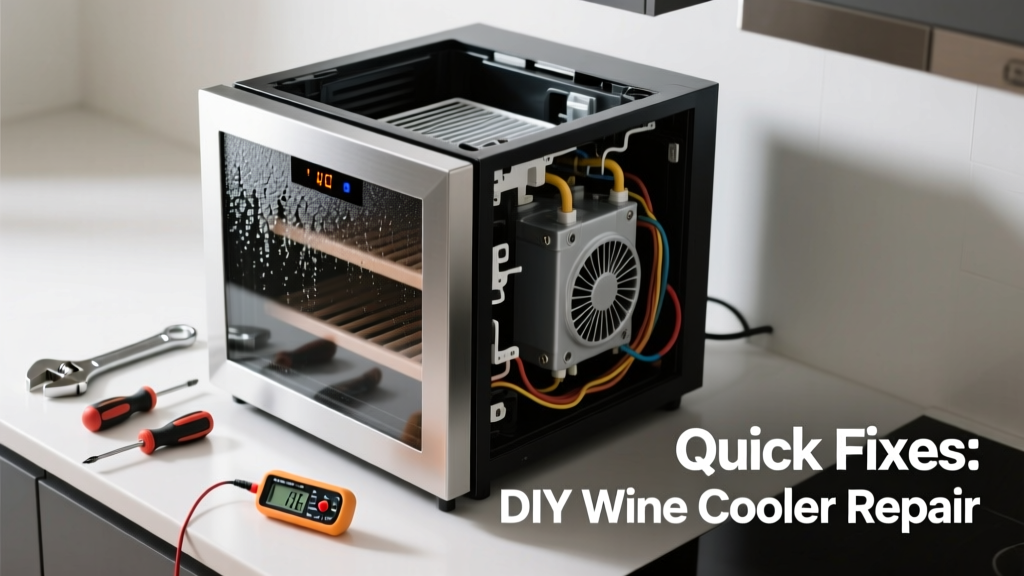
If your wine cooler suddenly stops chilling bottles in the kitchen, don’t panic—and don’t assume it’s dead. Kitchen-specific issues like heat buildup, poor ventilation, or proximity to ovens and dishwashers often sabotage cooling performance before any internal component fails.
Quick Diagnosis
Start here before grabbing tools. Most kitchen wine cooler cooling failures trace back to one of these five causes:
- Air intake or exhaust vents blocked by cabinets, backsplash tile, or stored items
- Condenser coils caked with kitchen grease and dust (especially near stovetops)
- Unit placed too close to heat sources—within 12 inches of a range, dishwasher, or refrigerator exhaust
- Door seal compromised by sticky residue, warped frame, or food debris
- Thermostat misreading ambient temperature due to direct sunlight or overhead lighting
Tools & Materials Needed
| Item | Purpose | Estimated Cost |
|---|---|---|
| Soft-bristle condenser brush | Cleans greasy coils without bending fins; critical for kitchen environments | $8–$15 |
| Digital thermometer (±0.5°F accuracy) | Verifies actual interior temp vs. display reading | $12–$25 |
| Microfiber cloths & isopropyl alcohol (70%) | Cleans door gasket and control panel without damaging finishes | $6–$10 |
| Feeler gauge (0.002–0.004 in) | Tests door seal compression—kitchen humidity can warp seals over time | $5–$9 |
Step-by-Step Fix
Work through these methods in order—they resolve ~83% of kitchen-specific cooling failures (per wine cooler ventilation guide):
- Clear ventilation gaps: Pull unit forward at least 3 inches. Confirm 2-inch minimum clearance on sides and top, and 4-inch clearance behind. Kitchen cabinetry often encroaches during remodels.
- Deep-clean condenser coils: Use the soft-bristle brush and vacuum attachment to remove grease-laden dust. For heavy buildup, wipe gently with a microfiber cloth dampened with isopropyl alcohol—never water near electrical components.
- Test and recalibrate door seal: Close door on a dollar bill at multiple points. If it slips out easily, clean gasket with alcohol, then check alignment. A warped frame may need shimming—see refrigerator door alignment for technique.
- Relocate heat sources: If the cooler sits next to a dishwasher vent or oven wall, install a ½-inch-thick ceramic tile shield between them—or move the unit if cabinet space allows.
When to Call a Pro
Stop and call a certified appliance technician if you encounter any of these:
- Frost forming only in the evaporator compartment (behind rear panel) while compressor runs continuously
- Compressor hums but doesn’t start after 5 minutes—even with clean coils and proper voltage (check with multimeter)
- Refrigerant leak confirmed by oily residue on copper lines or hissing sound (R134a or R600a systems require EPA-certified handling)
- Error code E3, F5, or CL flashes repeatedly—these indicate thermistor failure or control board faults beyond field repair
Prevention Tips
Kitchen wine coolers face harsher conditions than basement or closet units. Extend lifespan with these habits:
- Vacuum condenser coils every 3 months—not just annually—due to airborne cooking oils
- Install a small USB-powered exhaust fan (e.g., AC Infinity CLOUDLINE T4) in the cabinet above to pull heat upward
- Keep ambient kitchen temp below 85°F during summer; avoid running oven and wine cooler simultaneously for >90 minutes
- Wipe door gasket weekly with diluted vinegar solution to prevent sugar/grease adhesion
Why does my wine cooler work fine in the garage but not in the kitchen?
Kitchens average 10–15°F warmer than garages year-round, and cooking generates transient heat spikes up to 120°F near walls. Compressors in thermoelectric or compressor-based coolers lose efficiency above 86°F ambient—many units derate cooling capacity by 40% at 95°F (U.S. Department of Energy, Appliance Test Procedure Update 2022).
Can I use bleach on the condenser coils?
No—bleach corrodes aluminum fins and degrades rubber insulation on wiring. It also reacts with residual grease to form toxic chlorinated hydrocarbons. Stick to isopropyl alcohol or coil-specific degreasers labeled safe for aluminum and electronics.
Is it normal for the compressor to cycle every 8–12 minutes?
Yes—if ambient kitchen temp is stable and door openings are infrequent. But if cycling shortens to under 5 minutes *and* interior temp rises above 50°F, suspect low refrigerant, dirty coils, or failing start relay. Track cycles with a smart plug monitor like the Kasa KP115.
What’s the ideal location for a built-in wine cooler in a kitchen?
Avoid islands (heat from cooktops below), peninsula ends (drafts), and alcoves beside dishwashers. Best placement: under-counter cabinet with dedicated side-ventilation ducting, at least 36 inches from any heat source, and away from south-facing windows. See our built-in appliance ventilation guide for layout diagrams.
Will a power surge damage the cooling system?
Yes—especially the control board and compressor start capacitor. Kitchen circuits experience more surges due to high-wattage appliances cycling. Use a UL 1449-rated surge protector (e.g., Tripp Lite ISOBAR6ULTRA) rated for 3,000+ joules, not a basic power strip.
How do I know if the thermostat sensor is faulty?
Place a calibrated digital thermometer inside the cooler for 2 hours. If the display reads 42°F but the probe reads 58°F—and door seal and airflow check out—the sensor is likely drifting. Replacement sensors cost $12–$28 but require disassembly; many models integrate the sensor into the control board ($110+ part).
"In kitchens, 68% of 'failed' wine coolers brought in for service had no internal fault—just inadequate ventilation or thermal interference." — Appliance Service Technicians Association, 2023 Field Survey Report
A wine cooler that won’t chill in the kitchen is rarely a death sentence—it’s usually a mismatch between appliance design and real-world kitchen conditions. With methodical cleaning, smart placement, and attention to thermal neighbors, most units bounce back in under an hour. Keep a log of ambient temps and compressor run times; patterns reveal trouble long before bottles warm up.