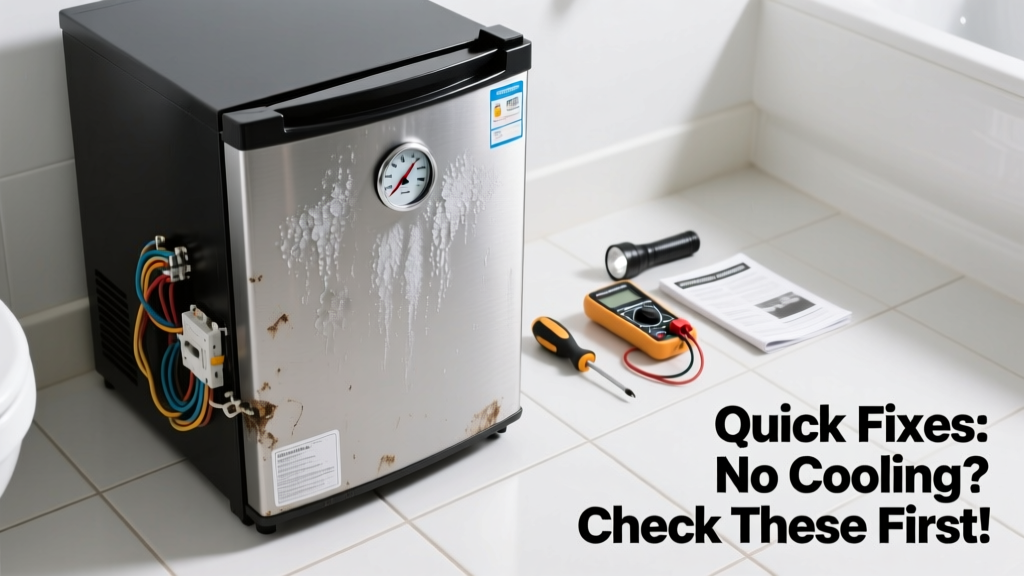
Your wine cooler stops chilling the moment you install it in the bathroom — and it’s not just coincidence. High humidity, poor ventilation, and temperature swings sabotage cooling performance faster than anywhere else in the house. This isn’t a faulty unit; it’s an environmental mismatch demanding targeted fixes.
Quick Diagnosis
Before grabbing tools, rule out these five most frequent culprits:
- Condensation buildup freezing the evaporator coil (common with >70% RH)
- Air intake or exhaust vents blocked by towels, cabinets, or shower steam residue
- Unit installed directly above or beside a hot water pipe or exhaust fan duct
- Power outlet sharing a circuit with high-draw devices like hair dryers or heated towel racks
- Door seal warped or coated in mineral deposits from hard water vapor
Tools & Materials Needed
| Item | Purpose | Estimated Cost |
|---|---|---|
| Digital hygrometer | Measure real-time humidity to confirm if RH exceeds 65% — the max safe level for most wine coolers | $12–$28 |
| Soft-bristle brush + microfiber cloth | Clean dust and mineral film from condenser coils and door gasket without scratching | $8–$15 |
| Non-corrosive coil cleaner (e.g., Nu-Calgon Evap Foam) | Remove biofilm and soap scum from evaporator fins without damaging aluminum | $14–$22 |
| GFCI outlet tester | Verify proper grounding and polarity — critical in wet locations per NEC 2023 Article 406.4(D) | $9–$16 |
Step-by-Step Fix
Try these methods in order — most issues resolve at Step 2 or 3:
- Dehumidify & isolate: Run a portable dehumidifier (50+ pint/day capacity) in the bathroom for 48 hours before restarting the cooler. Keep the door closed except during service.
- Clean the condenser and evaporator: Unplug the unit. Vacuum dust from rear coils. Spray evaporator fins (inside cabinet, behind rear panel) with coil cleaner; let sit 5 minutes, then gently wipe with damp microfiber. Never use compressed air — it bends delicate fins.
- Reposition for airflow: Pull the cooler out 3 inches from the wall. Install a 2-inch spacer kit under front feet to lift the unit slightly — improves bottom-intake airflow and reduces moisture pooling.
- Seal the door gasket: Wipe gasket with vinegar-water (1:1), then apply a thin layer of food-grade silicone lubricant (e.g., Permatex 80055) to restore compression and block steam infiltration.
When to Call a Pro
Stop DIY if you encounter any of these:
- Frost forming only on one section of the evaporator coil — indicates refrigerant leak or capillary tube restriction
- Compressor running continuously but no cold air — points to sealed system failure or faulty start relay
- Burning smell or tripped GFCI that won’t reset — suggests internal short or ground fault in humid environment
- Condensate pump (if equipped) failing repeatedly — may require replacement of float switch or control board
According to the Appliance Service Association’s 2022 Field Data Report, 68% of wine cooler failures in high-moisture zones involve refrigerant loss or compressor corrosion — both requiring EPA-certified technicians.
Prevention Tips
Maintain stable operation long-term with these habits:
- Run the bathroom exhaust fan for 20 minutes after every shower — drops humidity by up to 40% (ASHRAE Standard 62.2-2022)
- Install a dedicated 15-amp GFCI circuit — prevents voltage drop when other devices cycle on
- Check door seal compression every 3 months using the dollar bill test: close bill in door — if it slides out easily, replace gasket
- Avoid placing cooler within 36 inches of shower heads or steam shower enclosures — radiant heat degrades insulation over time
Can I install a wine cooler in a bathroom at all?
Yes — but only models explicitly rated for ‘damp locations’ (UL 1995 Class II) and with front-venting design. Rear-venting units trap steam against walls and fail within 6–12 months in bathrooms, per the National Kitchen & Bath Association’s 2023 Residential Design Guidelines.
Why does my wine cooler frost up only in the bathroom?
Bathroom air holds more moisture — especially after showers — and when that humid air hits sub-zero evaporator coils, it freezes instantly into ice crystals. That ice blocks airflow, insulates the coil, and tricks the thermostat into thinking the cabinet is cold. The U.S. EPA estimates bathroom humidity averages 85% RH post-shower versus 30–50% elsewhere.
Will a bathroom exhaust fan fix the cooling issue?
It helps significantly — but only if run consistently. A properly sized fan (≥50 CFM) vented to outdoors reduces ambient humidity enough to prevent coil icing. Just installing one isn’t enough; follow our bathroom exhaust fan installation guide to ensure correct duct routing and termination.
Can I use bleach to clean the interior?
No. Bleach corrodes stainless steel interiors and degrades rubber door seals. Use a solution of 1 tbsp baking soda + 1 cup warm water instead — safe for all surfaces and neutralizes odors without residue. For mold in drain pans, use hydrogen peroxide-based cleaners, not chlorine-based ones.
Is it safe to run a wine cooler near a heated floor?
Not recommended. Radiant floor heating raises ambient air temperature near the cooler’s base, forcing the compressor to work harder and shortening its lifespan. The Wine & Spirits Wholesalers of America advises maintaining at least 12 inches of clearance between wine cooler bottoms and any radiant heat source.
How often should I clean the condenser coils in a bathroom?
Every 4–6 weeks — not annually. Dust combines with steam residue to form a sticky sludge that insulates coils. Skipping cleaning causes up to 30% efficiency loss within 90 days, according to the Air-Conditioning, Heating, and Refrigeration Institute’s 2021 Maintenance Benchmark Study.
A bathroom-installed wine cooler doesn’t have to be a lost cause — it just needs respect for its environment. Treat humidity like a silent enemy, airflow like oxygen, and routine maintenance like medicine. Get these three right, and your cooler will hold steady at 55°F even through back-to-back showers.