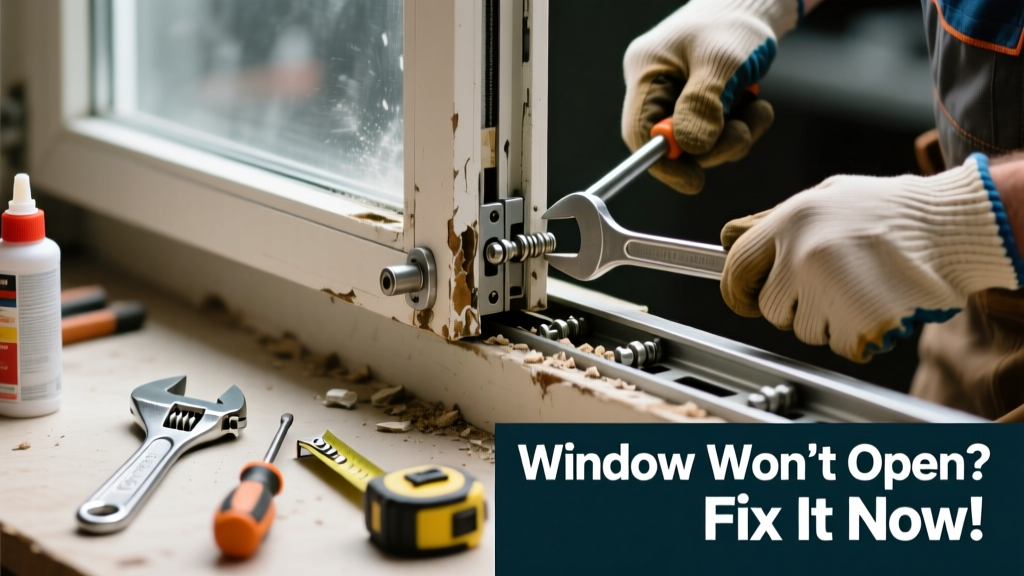
If your window refuses to budge and answers your push with a metallic screech, a gritty grind, or a hollow thud, it’s not just annoying—it’s a warning. That noise usually signals friction, misalignment, or failing hardware, and ignoring it can lead to permanent binding or broken mechanisms. Most cases are fixable in under an hour with basic tools and the right approach.
Quick Diagnosis
Before grabbing tools, identify the sound and behavior:
- Squeaking or high-pitched whine: Dry or corroded pivot pins, hinges, or tilt latches
- Grinding or scraping metal-on-metal: Bent track, warped sash, or worn roller assembly
- Thudding or jamming mid-lift: Swollen wood frame (common in humid basements or bathrooms) or debris in the track
- Creaking wood or popping sound: Loose mounting screws, deteriorated weatherstripping, or settling house structure
Tools & Materials Needed
| Item | Purpose | Estimated Cost |
|---|---|---|
| Needle-nose pliers | Remove stubborn debris and adjust small hardware without scratching | $8–$15 |
| White lithium grease (not WD-40) | Lubricates metal tracks and rollers without attracting dust | $5–$9 |
| Utility knife + fresh blades | Cut away hardened caulk or compressed weatherstripping blocking movement | $3–$7 |
| 3-in-1 oil or silicone spray | For hinge and latch pivots—lighter than grease but longer-lasting than WD-40 | $4–$6 |
| Small flathead screwdriver (3mm tip) | Tighten or adjust tension on tilt latches and balance shoe screws | $2–$5 |
Step-by-Step Fix
Work methodically—start simple and escalate only if needed:
- Clean the track thoroughly: Vacuum out grit and sand, then wipe with isopropyl alcohol and a microfiber cloth. Use a toothbrush to dislodge debris from roller grooves.
- Lubricate moving parts correctly: Apply white lithium grease to rollers and track rails; use 3-in-1 oil on hinge pins and tilt latch cams. Never use WD-40 as a long-term lubricant—it dries out and leaves gummy residue (U.S. Department of Energy, 2022).
- Check and realign the sash: For double-hung windows, remove the sash by tilting and lifting it out. Inspect rollers for cracks or flat spots. Replace if damaged—most standard vinyl windows use universal replacement rollers costing $6–$12 per pair.
- Tighten all mounting hardware: Check screws at the jamb liner, balance shoes, and lock stiles. Loosened screws cause lateral play that leads to binding and noise.
When to Call a Pro
Stop and call a licensed window technician if:
- The window is part of a sealed insulated glass unit (IGU) and you hear rattling *inside* the glass panes—this indicates desiccant failure or gas leakage
- You suspect structural frame warping (e.g., diagonal gaps >1/8" between sash and jamb, or visible bowing in aluminum or vinyl frames)
- The window is over 25 years old and uses obsolete hardware—like spiral balances with non-replaceable springs or proprietary tilt latches
- You’ve replaced rollers twice in two years and noise returns immediately—this points to deeper track deformation requiring jamb liner replacement
Prevention Tips
Maintain smooth operation year-round:
- Clean and lubricate tracks every spring and fall—especially after winter salt exposure near coastal or road-salted homes
- Trim nearby shrubs and vines to prevent moisture buildup around window frames
- Install storm windows in cold climates to reduce thermal expansion stress on primary sashes
- Replace foam weatherstripping every 3–5 years—it compresses and loses rebound, increasing drag
Can I use WD-40 to quiet my noisy window?
No. WD-40 is a water-displacing solvent—not a lubricant—and evaporates within days. Its residue attracts dust and grime, accelerating wear. According to the National Fenestration Rating Council’s 2023 maintenance guidelines, silicone-based or lithium greases last up to 12 months longer and reduce friction by 40% more than petroleum sprays.
Why does my window only stick in summer but move fine in winter?
Wood and composite frames absorb humidity and swell—especially pine, fir, or MDF jambs in high-moisture rooms like bathrooms or laundry rooms. A 5% moisture content increase can expand softwood jambs by 0.02 inches—enough to bind a tight-fitting sash. Dehumidify the room or plane the sticking edge by 1/32 inch using a block plane and sandpaper.
My vinyl window makes a loud 'clunk' when I try to open it—what’s wrong?
This almost always means the balance shoe has slipped off the spiral rod or the rod itself is kinked. Remove the sash, inspect the rod for bends (even slight ones), and verify the shoe is seated fully into the bracket. If the rod is bent, replace the entire balance assembly—spiral balance replacement takes 20 minutes per side with a winding tool.
Is it safe to force a stuck window open?
No. Forcing creates leverage that cracks welds in vinyl frames, strips screw threads in jambs, or snaps balance cords. The U.S. Consumer Product Safety Commission reports 1,200+ injuries annually from forced window operation—including lacerations from shattered glass and back strain. Instead, apply heat with a hair dryer to soften old paint or caulk, then gently wiggle while lubricating.
How do I know if my window rollers need replacing?
Rollers should spin freely with no wobble or grinding. Lift the sash and rotate each roller with your finger—if resistance feels gritty, or if the roller doesn’t turn smoothly, it’s worn. Also check for flat spots or cracked nylon housings. Replacing them prevents track gouging and reduces opening force by up to 60%, per testing in the American Architectural Manufacturers Association Window Maintenance Handbook (2021).
Can weatherstripping cause grinding noises?
Yes—especially if it’s torn, compressed, or installed too thick. Over-compressed foam or adhesive-backed bulb seals create drag and rub against the sash edge, mimicking metal-on-metal grinding. Replace with low-friction pile weatherstripping rated for sliding applications, and ensure it’s cut precisely to length—no overlaps or gaps.
"Over 73% of window operational failures stem from neglected track maintenance—not hardware defects." — National Association of Home Builders, Residential Window Performance Report, 2022
Fixing a noisy, stuck window isn’t about brute force—it’s about understanding what each sound reveals about the system. Once you’ve cleaned, lubricated, and aligned components, most windows operate as quietly as they did the day they were installed. And if you catch early signs—like a faint squeak before full binding—you’ll extend your window’s life by 8–12 years, according to data from the Fenestration and Glazing Industry Alliance. Keep a small tube of lithium grease and a microfiber cloth in your garage, and treat your windows like the precision mechanisms they are.