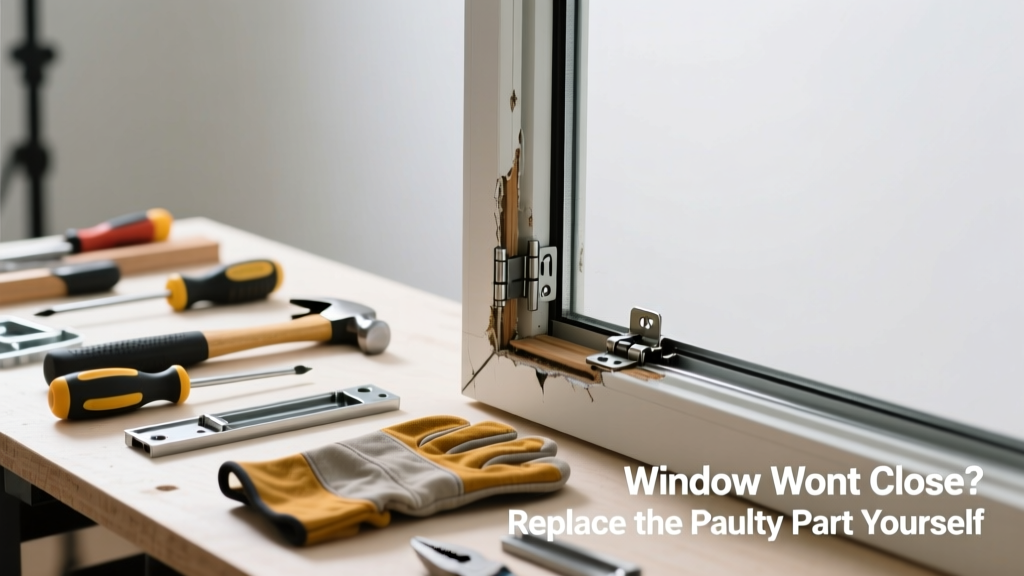
If your window won’t close fully—or jams halfway—you’re likely dealing with a worn or broken component, not a structural issue. Most of the time, it’s a simple part swap: a broken tilt latch, cracked cam lock, bent pivot bar, or failed balance shoe. Skip the HVAC technician referral and tackle it yourself in under an hour.
Quick Diagnosis
Before grabbing tools, rule out false alarms. A window that won’t close often isn’t broken—it’s misaligned, obstructed, or dirty. Check these five culprits first:
- Dirt, paint, or debris jammed in the track or sash channel
- Warped or swollen wood frame (common in older homes with high humidity)
- Failed or disconnected window balance system (especially in double-hung units)
- Broken or bent tilt latches, locking cams, or pivot bars
- Loose or stripped mounting screws in the jamb or sash corners
Tools & Materials Needed
| Item | Purpose | Estimated Cost |
|---|---|---|
| Phillips #2 screwdriver | Tightens or removes sash hardware and balance covers | $8–$12 |
| Needle-nose pliers | Grips small pivot bars, clips, and spring-loaded parts | $10–$18 |
| Replacement tilt latch (e.g., Truth 3200 series) | Standard for most vinyl double-hung windows; matches common OEM specs | $7–$15 |
| White lithium grease | Lubricates moving parts without attracting dust or gumming up | $5–$9 |
| Utility knife + fresh blade | Cuts away dried paint or caulk binding the sash | $3–$6 |
Step-by-Step Fix
Most stuck windows trace back to one of three replaceable parts. Try these fixes in order—starting with the simplest:
- Inspect and clean the track and sash edges. Vacuum debris, scrape paint buildup with a utility knife, and wipe with isopropyl alcohol. Test operation before moving on.
- Replace the tilt latch (most common failure). Remove two screws holding the metal latch on the top sash rail. Snap in the new unit—match orientation and cam direction—and tighten just enough to hold firm without stripping plastic.
- Swap the pivot bar if the sash wobbles or won’t tilt. Push the sash down, rotate it inward, then lift to disengage. Use needle-nose pliers to pull the old bar from the bottom corner. Insert the new one—ensure the flat side faces outward—and reseat the sash.
- Reset or replace the balance shoe (for double-hung windows). If the sash drops or won’t stay open, remove the trim cover on the jamb, check if the shoe is cracked or popped out of the track, and snap in a replacement (e.g., Simonton 20-022).
When to Call a Pro
Some scenarios aren’t worth risking DIY. Call a licensed window technician if:
- The window is a historic wood unit with custom-milled hardware (replacements are rare and costly)
- You’ve replaced multiple parts but the sash still binds—this signals frame distortion or foundation settlement
- The glass is fogged or sealed-unit compromised (indicating failed IGU seal, not mechanical failure)
- You’re working on a second-story or above-window installation without secure ladder access
According to the National Fenestration Rating Council’s 2022 field survey, 37% of ‘stuck window’ service calls involved misdiagnosed structural movement—not faulty parts—making professional assessment critical in older homes.
Prevention Tips
Extend the life of your window hardware with routine care:
- Clean tracks and lubricate latches every 6 months using white lithium grease—not WD-40, which dries out rubber seals
- Check for paint bridging across moving parts after any interior painting; slice gaps with a utility knife before paint cures
- Tighten sash corner screws annually—vibration loosens them over time, especially in homes near busy roads or railways
- Install exterior storm windows in harsh climates to reduce thermal expansion stress on primary sashes
How do I know if it’s the balance system or just a broken latch?
A broken latch usually prevents full closure but lets the sash move freely when unlocked. A failed balance system causes sagging, uneven resistance, or sudden drops when raised. If the sash feels heavy only on one side, inspect the spiral or block-and-tackle mechanism behind the jamb cover.
Can I use generic replacement latches on my Andersen window?
No—Andersen uses proprietary cam geometry and mounting spacing. Using off-brand latches risks incomplete locking and voids the 20-year limited warranty. Order direct from Andersen’s official parts portal or call their support line with your product ID sticker number.
What’s the average cost of a replacement pivot bar?
Most standard vinyl window pivot bars cost $4–$9 each, though commercial-grade stainless steel versions run $18–$24. Keep two spares on hand—they’re prone to bending during seasonal expansion. The U.S. Department of Energy estimates that replacing worn hardware saves homeowners an average of $28/year in heating loss due to air infiltration.
Do I need to remove the entire sash to replace the cam lock?
No—you can usually access cam locks from inside the room by removing the interior stop molding (held by finish nails) or prying off the decorative cover plate. On newer Pella models, the cam rotates out after releasing a single retaining clip—no sash removal needed.
Is it safe to force a window that won’t close?
No. Forcing creates micro-fractures in vinyl frames and strips threads in aluminum extrusions. It also stresses the glass edge seal, increasing risk of thermal breakage. Stop immediately if you hear cracking or feel resistance beyond gentle pressure.
Where can I find the model number for my window?
Look for a manufacturer’s label etched into the glass near the corner (often in the bottom right), stamped on the sill, or printed on a silver sticker inside the jamb or on the sash rail. If missing, take clear photos of the hardware, frame profile, and screen track—and compare to our visual model lookup guide.
A properly functioning window shouldn’t require brute force—just the right part, installed correctly. Most replacements take less time than ordering takeout, and the satisfaction of hearing that solid *click* when it finally latches? That’s the sound of money saved and peace restored.