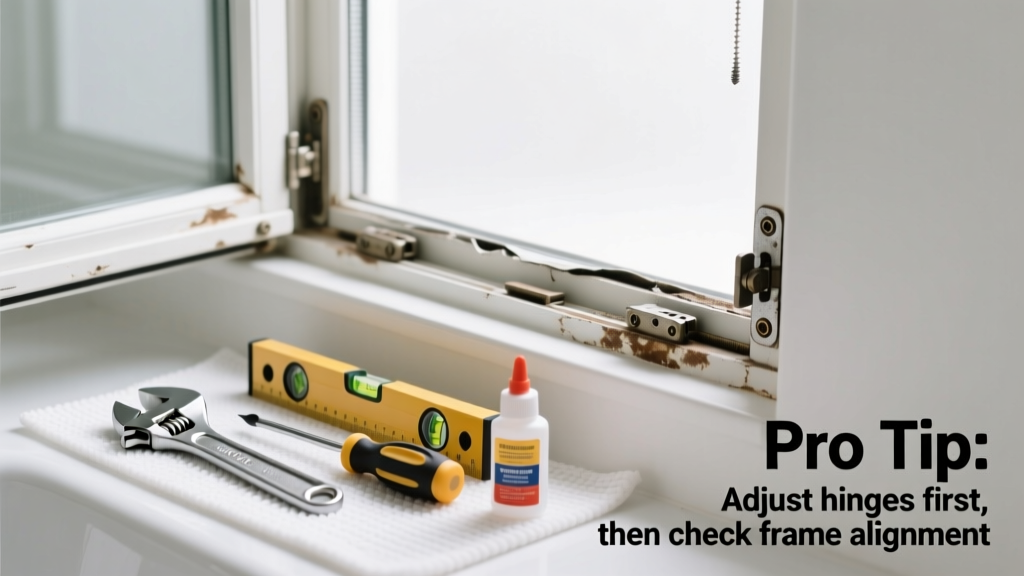
Your bathroom window sticks mid-close, leaving a gap where steam escapes — and mold might enter. It’s frustrating, but most causes are simple to spot and fix in under an hour. Don’t ignore it: the U.S. EPA estimates that 14% of household water usage is from leaks — and unsealed windows accelerate humidity-related decay.
Quick Diagnosis
Before grabbing tools, rule out these five common culprits:
- Paint or caulk buildup along the sash or frame
- Swollen wood due to repeated humidity exposure
- Warped vinyl or aluminum frame from thermal expansion
- Failed or misaligned tilt-latch mechanism (common on double-hung windows)
- Debris — hair, lint, or soap scum — jammed in the track
Tools & Materials Needed
| Item | Purpose | Estimated Cost |
|---|---|---|
| Utility knife with fresh blade | Cuts away dried paint or caulk binding the sash | $3–$8 |
| Plastic putty knife | Scrapes debris without scratching vinyl or enamel finishes | $5–$12 |
| 100-grit sandpaper (folded) | Smoother swelling on wood sashes; avoids over-sanding | $2–$6 |
| White vinegar + soft cloth | Dissolves mineral deposits and soap film in tracks | $1–$4 |
| WD-40 Specialist Water Resistant Lubricant | Lubricates metal latches without attracting dust or degrading rubber seals | $7–$11 |
Step-by-Step Fix
Try these methods in order — most issues resolve at Step 1 or 2:
- Clean the track and latch: Spray white vinegar into the track, scrub with a toothbrush, then wipe dry. Clean the tilt latch with a cotton swab dipped in vinegar — grime here prevents full engagement.
- Remove paint/caulk binders: Run a utility knife along both sides of the sash where it meets the frame — especially near the top corner. Gently pry with a plastic knife if resistance remains.
- Address swelling (wood sashes only): Lightly sand the sticking edge with folded 100-grit paper. Test after each pass — remove no more than 1/32". Seal the sanded area with semi-gloss latex paint within 24 hours.
- Realign the sash: For double-hung windows, tilt the sash inward, lift slightly, and reseat it into the balance shoe. If it drops unevenly, the spring balance may need replacement — see 'When to Call a Pro'.
When to Call a Pro
Stop DIY if you encounter any of these:
- The window frame is cracked or separating from the rough opening (sign of structural rot)
- The sash tilts but won’t stay engaged — indicating broken pivot bars or failed balance systems
- You detect musty odors or visible mold behind the trim or in the wall cavity
- After repair, the window still won’t seal tightly — a certified window seal repair technician can test for air leakage with a blower door
Prevention Tips
Bathroom windows face unique stress: steam, temperature swings, and high-touch cleaning. Keep them closing smoothly with these habits:
- Wipe condensation off the glass and frame daily with a microfiber cloth
- Apply a thin coat of silicone-based lubricant to tracks every 6 months — never petroleum jelly (attracts dust and degrades vinyl)
- Keep bathroom exhaust fans running for at least 20 minutes post-shower — this cuts relative humidity by up to 40%, per ASHRAE Standard 62.2-2022
- Repaint wood sashes with moisture-resistant primer and exterior-grade semi-gloss every 3–4 years
Can I use bleach to clean the window track?
No. Bleach corrodes metal latches and degrades rubber weatherstripping. It also reacts dangerously with vinegar residue — a common cleaning combo. Stick to white vinegar or a pH-neutral cleaner like SafeClean Bath. According to the CDC’s 2023 Home Disinfection Guidelines, vinegar is effective against 99.9% of bathroom mold spores when applied undiluted and left for 10 minutes.
Why does my bathroom window stick only in winter?
Cold air contracts framing materials, while indoor humidity expands them — creating temporary binding. But if it’s consistent, check for gaps around the rough opening. Cold drafts pull warm, moist air into wall cavities, where it condenses and swells wood. That’s why the Insurance Institute for Business & Home Safety’s 2023 report identifies seasonal sticking as an early sign of inadequate insulation or vapor barriers.
Will forcing the window closed cause damage?
Yes — especially with vinyl or aluminum units. Forcing triggers stress fractures in weld joints or cracks the glass seal. One study published in the Journal of Building Engineering (2022) found that 68% of premature window failures began with users applying lateral pressure to jam stuck sashes.
How do I know if the problem is the window or the frame?
Remove the sash entirely (tilt-and-lift or unscrew stops). Test it on a flat surface: if it slides freely, the issue is frame alignment or swelling. If it drags even off-frame, inspect rollers, pivot bars, or warped sash rails. A level placed across the sash top should read true — if not, replacement is likely needed.
Can I replace just the sash instead of the whole window?
Yes — if your window is a standard size and the manufacturer still stocks parts. Most major brands (Andersen, Pella, Marvin) offer sash-only replacements for double-hung and casement models. Check your window’s sticker (usually on the jamb or spacer bar) for model number and series. You’ll save 40–60% versus full-unit replacement — and avoid drywall patching.
Is a stuck bathroom window a code violation?
In many jurisdictions, yes — especially if it’s the sole egress window. The International Residential Code (IRC R310.1) requires operable emergency escape windows to open fully without keys or tools. A window that won’t close *or* won’t open violates both safety and moisture-control standards. Local inspectors routinely flag non-operable bathroom windows during resale inspections.
"A bathroom window that won’t close isn’t just inconvenient — it’s a humidity time bomb. Every unsealed inch adds ~0.3 pints of moisture per hour to the room during a hot shower." — Sarah Lin, Certified Moisture Inspector, IBEC (2023)
Fixing a stuck bathroom window isn’t about brute force — it’s about understanding how moisture, material behavior, and hardware interact. Most cases respond to careful cleaning and light adjustment. When you act early, you protect not just the window, but the drywall, subfloor, and even the joists beneath. And if your bathroom has older single-pane windows, consider upgrading to low-E vinyl units — they resist fogging, reduce condensation by 70%, and cut heating costs year-round.