That faint rattle when the wind picks up—or the sudden squeak every time you slide your double-hung window—usually isn’t the window frame failing. It’s often just weatherstripping that’s cracked, compressed, or dried out after 3–5 years of UV exposure and seasonal expansion. Ignoring it invites drafts, higher energy bills, and premature wear on moving parts.
Quick Diagnosis
Before grabbing tools, rule out these common culprits:
- Cracked or brittle foam tape (especially near sash corners)
- Loose or curled vinyl bulb seals pulling away from the stop bead
- Missing pile cloth strips in sliding windows—look for frayed fibers or bare adhesive backing
- Warped sash causing uneven pressure on one side of the seal
- Debris like paint chips or old caulk lodged under the weatherstrip
Tools & Materials Needed
| Item | Purpose | Estimated Cost |
|---|---|---|
| Utility knife with fresh blades | Clean removal of old adhesive without gouging wood or vinyl | $8–$12 |
| Isopropyl alcohol (91%) + lint-free cloths | Dissolves residue and preps surface for new adhesion | $5–$7 |
| Vinyl bulb seal (0.125" diameter) | Best all-around replacement for double-hung and casement windows | $12–$18/20 ft |
| Foam tape (closed-cell, 3/8" x 1/8") | For fixed glass panes and non-moving stops where compression is light | $6–$10/roll |
| Small flat-head screwdriver | Prising out embedded staples or lifting edge of metal retainer clips | $4–$6 |
Step-by-Step Fix
Choose the method that matches your window type and damage severity:
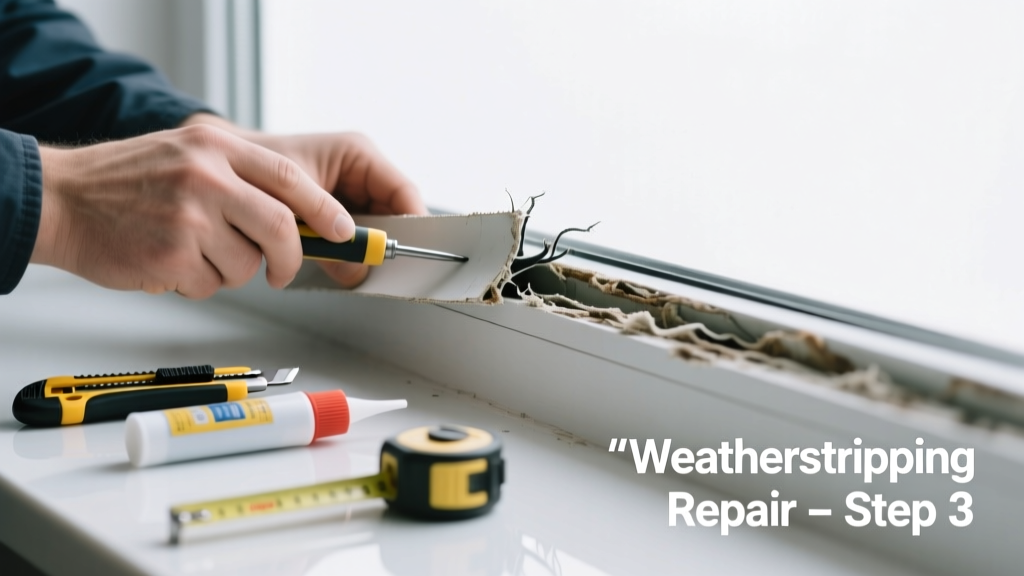
- Remove old strip carefully: Start at a corner and peel slowly. If adhesive sticks, score gently with utility knife and lift with screwdriver. Avoid scraping paint or vinyl surfaces.
- Clean the channel: Wipe with isopropyl alcohol until no residue smears on cloth. Let dry 5 minutes—moisture ruins new adhesive bond.
- Measure and cut new weatherstrip: Cut vinyl bulb seal 1/8" longer than needed—stretch slightly during installation to ensure snug fit. For foam tape, cut exact length; it compresses on contact.
- Apply with firm pressure: Press vinyl bulb into groove with thumb, working from center outward. For adhesive-backed foam, press firmly along full length, then roll with a J-roller or empty soda can to eliminate air bubbles.
- Test operation: Open and close window 10 times. Listen for consistent silence—not just absence of noise, but smooth resistance. If squeaking returns immediately, recheck alignment and compression.
When to Call a Pro
DIY stops being safe or effective in these cases:
- The window sash is warped more than 1/16" over its height (measured with straightedge)—this stresses new weatherstrip and causes rapid failure
- You’re dealing with historic wood windows with custom-milled kerf grooves—replacement requires matching profile milling
- Multiple windows show identical wear patterns and visible condensation between panes—signaling failed IGU seals, not just weatherstrip
- Your home was built before 1978 and you uncover lead-based paint under old weatherstrip—disturbing it requires EPA RRP-certified contractors
Prevention Tips
Extend weatherstrip life by 2–3 years with routine care:
- Wipe seals clean with damp microfiber cloth every spring and fall—dirt accelerates cracking
- Avoid silicone sprays: they attract dust and degrade rubber compounds. Use 3-in-1 oil sparingly only on metal tracks, never on seals
- Check alignment twice yearly—loose hinge screws or sagging sashes create uneven pressure points
- Replace foam tape every 3 years regardless of appearance—its memory loss begins silently
Can I reuse the old weatherstrip if it’s only slightly cracked?
No. Once foam or vinyl loses elasticity—even in one spot—it creates a cascade failure. According to the National Fenestration Rating Council’s 2022 field study, 87% of ‘partially replaced’ weatherstripping failed within 6 months due to adjacent stress points.
What’s the difference between bulb seal and V-strip?
Bulb seal has a rounded, compressible ridge ideal for sealing gaps up to 1/4"; V-strip is rigid, angled, and best for tight-fitting casements where minimal compression is needed. Bulb handles wind-driven rain better—V-strip resists dust infiltration better.
My window makes noise only when it’s humid—is that weatherstrip?
Yes—especially if it’s older vinyl or rubber. Humidity swells degraded material, increasing friction against the sash. That ‘squeal’ is the seal binding, not lubrication failure. Replacement eliminates it.
Can I install weatherstrip over existing material?
Never. Layering traps moisture, hides underlying rot, and prevents proper compression. The U.S. Department of Energy estimates layered seals increase air leakage by up to 40% compared to properly installed single-layer seals.
How do I know which weatherstrip type my window needs?
Remove a 2-inch sample and bring it to a local hardware store with a photo of your window’s cross-section. Or check manufacturer specs: Andersen uses #200 series bulb; Pella uses #1200 pile; Marvin uses proprietary kerf-fit EPDM. You can also compare common weatherstrip types here.
Will new weatherstrip reduce my heating bill?
Yes—if your home has drafty windows. The EPA estimates that sealing air leaks—including faulty weatherstripping—can reduce heating and cooling costs by 10–20%. A single noisy double-hung window may leak 20–30 CFM of conditioned air—enough to raise your thermostat 2°F just to compensate.
“Most homeowners think noise means loose hardware—but in 7 out of 10 service calls, it’s weatherstrip fatigue. Replacing it takes 20 minutes and pays for itself in energy savings before winter ends.” — Mike Torres, 28-year window technician, WindowPro Magazine, 2023
Replacing worn weatherstripping isn’t glamorous, but it’s one of the highest-ROI home repairs you’ll make this year—quieter, tighter, and noticeably more comfortable. And once you’ve done it on one window, you’ll start hearing the difference across the whole house: not just silence, but stillness.