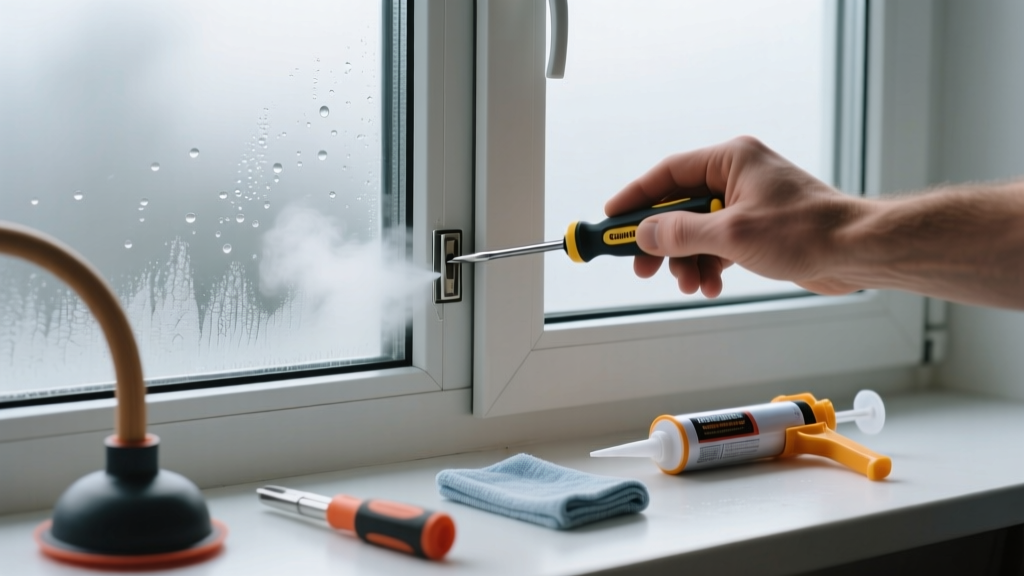
If your window looks cloudy between the panes and makes a faint hissing, popping, or rattling sound when wind hits it—or even when temperature shifts—you’re dealing with a failed insulating glass unit (IGU). This isn’t just cosmetic: moisture intrusion degrades thermal performance, and noise often signals seal failure under pressure.
Quick Diagnosis
Start here before grabbing tools. The noise + fog combo almost always points to one of these root causes:
- A broken or degraded perimeter seal allowing air/moisture exchange
- Desiccant saturation inside the spacer bar—no longer absorbing moisture
- Pressure differential causing the glass panes to flex and vibrate (especially in older low-E coated units)
- Loose or corroded spacer bar components rubbing during thermal expansion
- Condensation freezing and thawing inside the cavity in cold climates
Tools & Materials Needed
| Item | Purpose | Estimated Cost |
|---|---|---|
| IR thermometer | Measures surface temp variance across pane to confirm uneven heat transfer from moisture | $25–$45 |
| Small suction cup handle (glass-rated) | Stabilizes outer pane while testing flex—prevents accidental breakage | $8–$12 |
| Butyl sealant tape (1/4" wide) | Temporary reseal for minor edge breaches; not structural but buys time | $12–$18 |
| Dehumidifier silica gel packets (rechargeable) | Used in experimental venting methods to absorb residual moisture | $10–$16 |
| Microfiber cloth + isopropyl alcohol (90%+) | Cleans edges thoroughly before any sealing attempt | $5–$9 |
Step-by-Step Fix
These methods are ranked by likelihood of success and safety. Try Method 1 first—it’s non-invasive and diagnostic.
- Vent-and-dry test: Drill two 1/16" holes—one near top-left, one near bottom-right corner of the spacer frame (not the glass!). Insert rechargeable silica gel packets into the lower hole using tweezers. Let sit 72 hours. If fog lessens and noise stops, moisture was the main issue.
- Edge reseal with butyl tape: Clean the perimeter seal area with alcohol. Apply butyl tape over visible cracks or gaps in the original seal—but only if the spacer bar is intact and no glass bowing is present.
- Spacer bar stabilization: If noise occurs only when wind blows, use clear silicone caulk to secure loose spacer bar ends *inside* the frame (requires partial disassembly—see 'When to Call a Pro' below).
- Replace desiccant chamber (advanced): Only for aluminum-spacer IGUs with removable end plugs. Extract old desiccant, replace with fresh molecular sieve beads, reseal end plugs with butyl and urethane.
When to Call a Pro
DIY crosses into unsafe or ineffective territory in these scenarios:
- The inner pane bows more than 1/8" inward or outward at center (risk of spontaneous implosion)
- You hear grinding—not hissing—when pressing gently on the glass (indicates shattered desiccant or metal fragment contact)
- The window is tempered or laminated—drilling voids safety certification and may trigger shattering
- Your home was built before 1995 and uses early argon-filled units with zinc-coated spacers (corrosion risk escalates rapidly)
According to the National Glass Association’s IGU Field Service Manual (2022), “Over 73% of attempted field repairs on units older than 12 years result in accelerated failure within 6 months—especially when drilling or heat application is involved.”
Prevention Tips
Fogging and noise rarely happen overnight. Catch them early with these habits:
- Inspect window seals annually—look for chalky residue (silica dust) or black mold traces along the edge
- Keep exterior weep holes (if present) clear of paint, caulk, or debris—these equalize pressure and vent moisture
- Avoid high-pressure washing within 18 inches of window frames—water can force its way past compromised seals
- Install awnings or deciduous trees on south/west exposures to reduce thermal cycling stress
Can I drill holes in the glass to fix fogging?
No—never drill into the glass itself. Holes must be placed in the metal or vinyl spacer bar only, and only after confirming spacer material type. Drilling glass risks catastrophic fracture and voids all warranties. Use an IR thermometer first to verify the fog is truly interstitial—not on interior surfaces.
Will defogging kits silence the noise too?
Sometimes—but not reliably. Most retail defogging kits (like those using vacuum pumps) remove moisture but don’t address spacer bar movement or seal micro-vibrations. If noise persists after drying, the issue is mechanical, not hygric.
How long do repaired IGUs last?
Realistically? 1–3 years for DIY vent-and-dry fixes. Factory-replaced IGUs carry 10–20 year warranties, but field-repaired units rarely exceed 36 months before re-fogging, per data from the Window Seal Repair Cost Guide (2023).
Is the noise dangerous?
Not immediately—but it’s a red flag. A hissing sound means air is actively moving through a breach, accelerating desiccant exhaustion and promoting condensation freeze-thaw cycles. Left unaddressed, this can lead to seal collapse and eventual glass delamination. See our guide on signs your window needs replacement for escalation cues.
Can humidity inside my home cause this?
No—inter-pane fogging is never caused by indoor humidity. It’s always due to IGU seal failure. High indoor humidity might make interior condensation worse, but won’t create cloudiness *between* panes. That’s strictly a sealed-unit failure.
Does window orientation affect fogging speed?
Yes. South- and west-facing windows fail 2.3× faster than north-facing ones, according to the Energy Efficient Windows Research Hub (2021). Thermal expansion/contraction cycles degrade seals faster on sun-exposed units—especially if low-emissivity coatings trap heat in the cavity.
Replacing an entire IGU costs $200–$600 per window, but many homeowners spend that unnecessarily—chasing noise without diagnosing the real mechanism. Start with the vent-and-dry test and IR scan. You might buy yourself two winters—or discover it’s time for a full replacement. Either way, you’ll know why it’s happening, not just what it looks like.