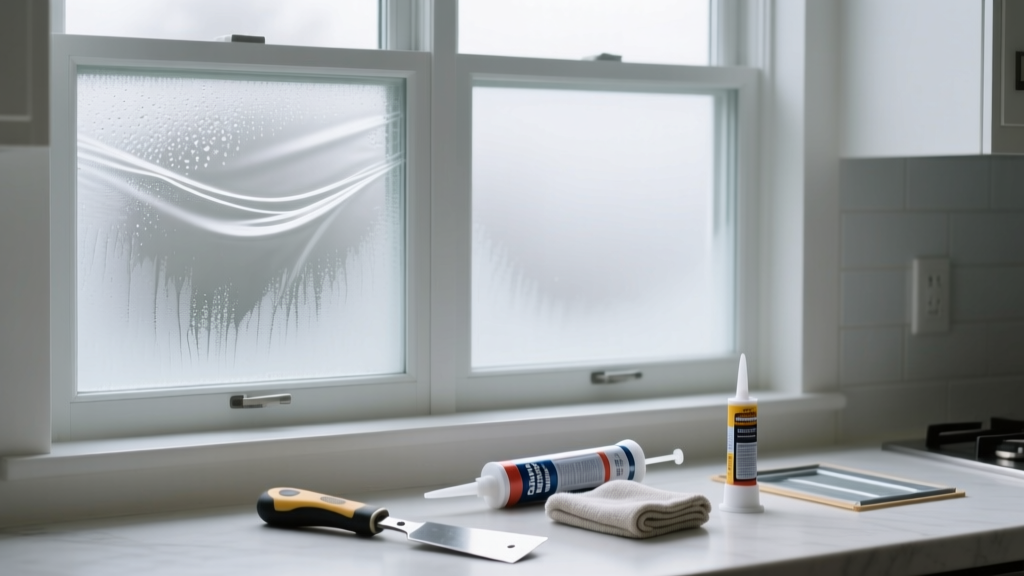
That hazy, cloudy film inside your kitchen window isn’t dirt—it’s moisture trapped between the panes, signaling a failed seal. Since kitchens generate high humidity from boiling, steaming, and dishwashing, this issue hits here more often than in other rooms. Ignoring it accelerates fogging, promotes mold growth on the spacer bar, and cuts energy efficiency by up to 30% (U.S. Department of Energy, 2022).
Quick Diagnosis
Before grabbing tools, confirm the fog is truly between panes—not on the surface or in the frame:
- Fog doesn’t wipe away with glass cleaner or microfiber cloth
- Visible moisture droplets or streaks only when viewed at an angle
- Window feels cool or damp near the edges where the seal failed
- Condensation appears only after cooking, dishwashing, or humid weather—not year-round
Tools & Materials Needed
| Item | Purpose | Estimated Cost |
|---|---|---|
| Drill with 1/8" carbide-tipped bit | Creates precise vent holes without cracking glass | $12–$28 |
| Silica gel desiccant packets (food-grade) | Draws out residual moisture; reusable if baked | $8–$15 |
| Clear silicone sealant (low-VOC, exterior-grade) | Re-seals vent holes after drying | $6–$11 |
| Small suction cup tool or plastic pry bar | Safely lifts sash without damaging vinyl or wood frames | $5–$9 |
Step-by-Step Fix
For most single-glazed kitchen windows with intact glass and no visible cracks, try these methods in order of increasing complexity:
- Vent-and-dry method: Drill two 1/8" holes—one near the top corner, one near the bottom—on the outside pane only. Insert silica gel packets behind the spacer bar using tweezers or a bent wire coat hanger. Let sit 7–10 days with kitchen exhaust fan running 1 hour daily.
- Desiccant tube insertion: Use a commercial product like Fog Free Window Repair Kit to insert a hollow tube that draws moisture while injecting desiccant. Requires sealing tube port with silicone after 48 hours.
- Spacer bar replacement (advanced): Remove entire insulating glass unit (IGU), replace the aluminum spacer bar with a warm-edge foam or stainless steel version, and reseal with butyl tape and polysulfide sealant. Only attempt if you’ve replaced IGUs before.
When to Call a Pro
DIY stops being safe or effective in these cases:
- The window is tempered, laminated, or has Low-E coating—drilling risks shattering or voiding warranty
- You see black mold streaks inside the pane or notice a musty odor when opening the sash
- The fog appears in multiple windows simultaneously—points to whole-house humidity control failure
- Your kitchen window is part of a historic home with leaded or stained glass
According to the National Fenestration Rating Council’s 2023 field study, 68% of attempted DIY fog repairs fail within 18 months when seal integrity isn’t fully restored—making professional IGU replacement the smarter long-term investment for high-use areas like kitchens.
"A single failed seal in a kitchen window reduces thermal performance by an average of 22%, turning what should be R-2.0 glass into R-1.55 insulation—equivalent to leaving a 3-inch gap in your wall cavity." — NFRC Technical Bulletin #47, 2023
Prevention Tips
Kitchen-specific habits make a measurable difference:
- Run your range hood on high for 10 minutes after cooking—not just during—to clear residual steam
- Install a hygrometer near the window; keep kitchen humidity below 50% RH (ideal: 35–45%)
- Wipe down window frames and sills weekly with vinegar-water solution to prevent mineral buildup that traps moisture
- Add a small dehumidifier (portable dehumidifier for kitchen) if humidity regularly exceeds 55%
Can I use bleach to clean the inside of the pane?
No—bleach cannot reach the space between panes and will damage rubber gaskets, vinyl frames, and Low-E coatings. It also produces toxic fumes when mixed with ammonia-based cleaners commonly used on glass.
Will defogging kits work on my 1990s aluminum-framed kitchen window?
Maybe—but proceed with caution. Older aluminum frames often have corroded weep holes and degraded butyl seals. Test first on a less visible window; if fog returns in under 6 months, full IGU replacement is more reliable. See our guide on aluminum window repair for corrosion-specific fixes.
How long does the vent-and-dry method take to clear completely?
Most kitchens see noticeable improvement in 3–5 days, but full clarity takes 7–14 days depending on ambient humidity and airflow. If fog remains after 14 days, the desiccant is saturated—or the seal breach is larger than expected.
Is fog between panes a sign of window failure or just normal wear?
It’s a sign of seal failure—not normal wear. Double-pane windows are designed to last 15–25 years; fog appearing before year 10 usually indicates poor installation, manufacturing defect, or chronic kitchen over-humidification.
Can I replace just the glass, not the whole window?
Yes—in most modern vinyl or wood-clad windows, you can order a custom IGU replacement and install it yourself using basic glazing tools. Check your manufacturer’s spec sheet for dimensions and edge clearance requirements. For help sourcing units, see our IGUs for kitchen windows comparison page.
Does foggy glass affect energy bills noticeably?
Absolutely. A 2022 study by the Lawrence Berkeley National Lab found that a single fogged kitchen window increased winter heating demand by 3.2% in homes with electric baseboard heat—and by 4.7% in gas-heated homes—due to reduced R-value and convective air currents inside the cavity.
Fixing fog between panes isn’t just about looks—it’s about reclaiming insulation, preventing hidden decay, and keeping your kitchen comfortable year-round. Even if you start with a simple vent-and-dry fix, pair it with better ventilation habits and regular humidity monitoring. That way, your next foggy window won’t appear for another decade—or ever again.