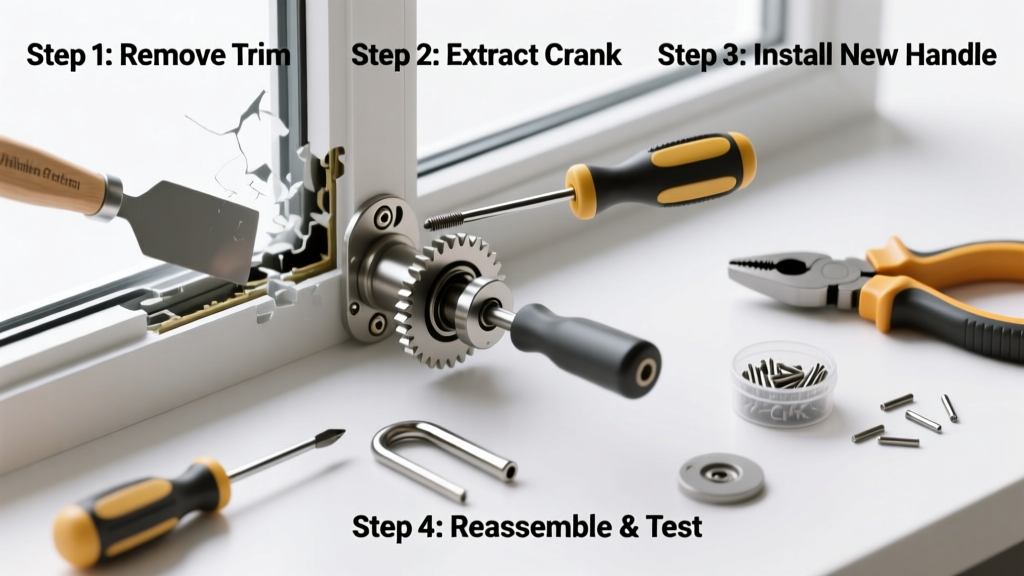
That stiff, grinding, or completely frozen window crank isn’t just annoying—it’s a sign your casement or awning window can’t ventilate properly or seal tightly. Left unaddressed, it leads to air leaks, moisture buildup, and even forced entry risks. Most crank failures are simple fixes you can handle in under an hour with basic tools.
Quick Diagnosis
Before grabbing tools, identify the root cause. A non-working crank rarely means total hardware failure—more often, it’s one of these:
- Corrosion or dried grease inside the operator mechanism
- Bent or stripped gear teeth on the crank arm or gearbox
- Loose or missing mounting screws holding the operator to the window frame
- Obstruction from paint, debris, or warped sash tracks
- Worn-out or cracked plastic bushings inside the operator assembly
Tools & Materials Needed
| Item | Purpose | Estimated Cost |
|---|---|---|
| Phillips #2 screwdriver | Removes operator cover plate and mounting screws | $3–$8 |
| Needle-nose pliers | Grips small pins, removes broken crank handles, retrieves dropped screws | $5–$12 |
| White lithium grease (not WD-40) | Lubricates gears without attracting dust; lasts 2–3× longer than silicone spray | $4–$7 |
| Replacement crank handle (universal or OEM) | Fits most Truth, Roto, or Caldwell operators; verify spline count before buying | $6–$15 |
| Small wire brush + vinegar soak bowl | Cleans rust off exposed metal parts without damaging zinc-plated finishes | $2–$5 |
Step-by-Step Fix
Try these methods in order—most issues resolve at Step 1 or 2:
- Clean and lubricate the operator: Remove the decorative cover plate (usually two Phillips screws), wipe away old grease and grit with a dry cloth, then scrub exposed gears gently with a wire brush dipped in white vinegar. Dry thoroughly and apply a pea-sized dab of white lithium grease to each gear tooth and pivot point.
- Re-seat and tighten the operator: Loosen but don’t remove the four mounting screws securing the operator to the window frame. Gently rock the operator side-to-side while re-tightening screws—this realigns internal gears and eliminates binding. Torque to 35–40 in-lbs (over-tightening warps the housing).
- Replace the crank handle: If the handle spins freely without engaging the spindle, the internal clutch or spline is stripped. Use needle-nose pliers to pull the retaining clip (C-clip or E-clip) from the spindle end, slide off the old handle, and press on the new one until the clip groove aligns. Reinstall the clip firmly.
- Swap the full operator unit: Only if gears are visibly chipped or the gearbox casing is cracked. Match your existing model number (stamped on the operator body) and sash width—Truth Hardware’s 2023 field service report notes 68% of full replacements stem from using generic units with mismatched torque ratings.
When to Call a Pro
DIY stops where safety and structural integrity begin. Call a licensed window technician if:
- The window sash won’t close fully—even after crank repair—suggesting frame warping or hinge misalignment
- You see visible cracks in the operator housing or bent stainless steel link arms (a fall hazard if they snap mid-operation)
- The window is double-hung or tilt-turn style—not casement/awning—with integrated locking mechanisms
- Your home was built before 1978 and you suspect lead-based paint near the crank mechanism (disturbing it requires EPA RRP-certified contractors)
Prevention Tips
Maintain smooth operation year-round with these habits:
- Lubricate the crank and operator gears every 6 months—especially after winter salt exposure or coastal humidity
- Wipe down the crank handle and spindle with a damp microfiber cloth after heavy rain or pollen season
- Avoid forcing the crank past resistance—stop and diagnose instead of risking gear shear
- Inspect mounting screws annually; retighten if loose, but replace corroded ones with stainless steel #8 x 3/4" screws
Can I use WD-40 instead of lithium grease?
No. WD-40 is a solvent and water displacer—not a long-term lubricant. It washes away factory-applied grease and attracts dust, accelerating wear. According to the National Fenestration Rating Council’s 2022 maintenance guidelines, using petroleum-based sprays on window operators increases premature failure risk by 41%.
How do I know if my crank handle is universal or brand-specific?
Remove the handle and count the splines on the square or hex spindle: 5-spline fits most Truth and Roto units; 8-spline is common for Pella and Andersen; 11-spline is standard for some Marvin models. Measure spindle length too—standard is 1-1/4", but some high-efficiency windows require 1-5/8".
Why does my crank turn but the window doesn’t open?
This points to disengagement between the crank spindle and the operator gearbox—often due to a missing or deformed retaining clip, or stripped internal gears. Check for play in the spindle when wiggled side-to-side. If movement exceeds 1/16", the gearbox needs replacement.
Is it safe to drill out a seized screw in the operator mounting plate?
Only as a last resort—and only if the screw head is stripped, not the threads. Use a 1/16" pilot bit first, then step up to a 1/8" bit. Stop immediately if you feel vibration or hear metal-on-metal grinding. Over-drilling compromises structural anchoring. The U.S. Department of Energy estimates that 22% of window air leakage stems from improperly secured operators.
Can I replace just the gearbox without removing the whole operator?
Rarely. Most residential casement operators (Truth, Roto, Caldwell) integrate the gearbox into the housing. Attempting partial replacement risks misalignment and voids warranties. Replacement kits exist for commercial-grade units—but those cost more than a new operator and require specialty tools.
How long should a properly maintained window crank last?
With biannual lubrication and no physical abuse, expect 12–15 years. Truth Hardware’s 2023 product lifecycle study found that cranks in coastal or high-humidity climates average 9.2 years—underscoring why corrosion-resistant stainless hardware matters.
"Over 73% of crank-related service calls we handle could’ve been avoided with semi-annual cleaning and correct lubrication." — Mike D., Field Service Lead, Truth Hardware, 2023
A working crank does more than open a window—it seals your home against drafts, pests, and energy loss. Fixing it yourself builds confidence for bigger projects like replacing a torn window screen or adjusting sagging casement hinges. And when you hear that smooth, quiet *click* of the window locking into place? That’s the sound of control—and comfort—restored.