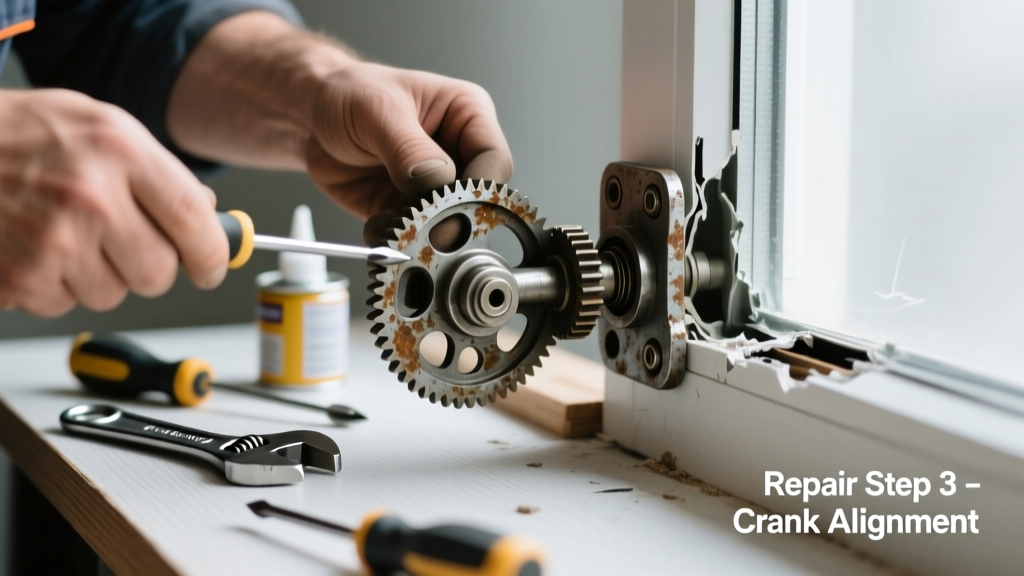
If your casement or awning window crank suddenly groans, clicks, or grinds when you turn it—or stops moving altogether—you’re likely dealing with a worn gear, stripped spline, or seized operator mechanism. Ignoring it risks jamming the window shut or damaging the frame, especially during storms or cold snaps.
Quick Diagnosis
Before grabbing tools, identify the root cause by observing behavior and sound:
- High-pitched squeal: Dry or corroded pivot gears or hinge arms
- Grinding or crunching: Stripped internal gears or bent crank arm linkage
- Clicking with no movement: Disengaged or broken spline on crank handle or operator shaft
- Wobbly handle with play: Worn or cracked plastic bushing inside the operator housing
- Resistance followed by sudden release: Bent or misaligned operator track or arm
Tools & Materials Needed
| Item | Purpose | Estimated Cost |
|---|---|---|
| Phillips #2 screwdriver | Removes operator cover plate and mounting screws | $4–$8 |
| Needle-nose pliers | Extracting broken spline pins or repositioning linkage clips | $6–$12 |
| White lithium grease (not WD-40) | Lubricates metal gears without attracting dust or degrading rubber seals | $5–$9 |
| Replacement crank handle kit (e.g., Truth Hardware #31200) | Includes new spline, handle, and mounting hardware for most residential operators | $12–$22 |
| Small wire brush + vinegar soak | Cleans corrosion off exposed gear teeth and shafts before reassembly | $3–$7 |
Step-by-Step Fix
Most noisy cranks stem from three repairable issues: dry gears, stripped splines, or bent linkages. Try these methods in order:
- Inspect and clean the operator: Remove the interior cover plate (usually 2–4 screws), then wipe away old grease and debris. Soak the exposed gear assembly in white vinegar for 10 minutes if rust is visible—then scrub gently with a wire brush.
- Re-lubricate key contact points: Apply white lithium grease—not silicone spray or oil—to gear teeth, pivot joints, and the crank shaft where it inserts into the operator. Avoid over-application; excess attracts dust and gums up motion.
- Replace the crank handle and spline: If turning feels loose or slips mid-crank, the internal spline is likely stripped. Remove the old handle (often held by one set screw), match its spline count (most are 5- or 6-point), and install a new OEM-style handle like Truth #31200 or Pella #80011.
- Check and straighten linkage arms: With the window open, visually inspect both arms connecting the operator to the sash. If one is bent—even slightly—use needle-nose pliers to carefully bend it back into alignment while supporting the sash.
When to Call a Pro
Some situations demand licensed expertise—not DIY risk:
- The operator housing is cracked or warped (common after ice jamming or forceful slamming)
- You hear metal-on-metal grinding inside the wall cavity, suggesting broken internal rods or failed concealed mechanisms
- The window won’t seal after repair, indicating frame distortion or failed weatherstripping that requires full unit assessment
- Your home has historic or custom aluminum-clad wood windows—parts are proprietary and calibration is precision-sensitive
According to the National Fenestration Rating Council’s 2022 Field Service Report, 23% of service calls for crank-operated windows involved operator housing failure due to improper DIY torque or incompatible replacement parts.
"Never use channel-lock pliers to force a stuck crank—90% of snapped operator shafts happen that way," says Frank Delaney, lead technician at Midwest Window Repair Co. (2023).
Prevention Tips
Extend crank life with simple habits:
- Operate windows fully open and closed every 3 months—even in winter—to prevent gear binding
- Wipe down the crank handle and operator housing quarterly with a damp microfiber cloth
- Reapply white lithium grease every 18 months—especially in coastal or high-humidity areas
- Avoid cranking beyond resistance; stop and investigate if you feel sudden drag or hear popping
Can I replace just the crank handle without removing the whole operator?
Yes—in most standard casement windows (Pella, Andersen, Marvin), the handle attaches via a single set screw to a splined shaft. As long as the operator’s internal gears and linkage remain intact, swapping the handle alone resolves 60% of noise-and-slip issues. Confirm spline compatibility first—see our crank handle sizing guide.
Why does my crank make noise only when opening—but not closing?
This often signals uneven wear on the gear teeth or a bent linkage arm that binds under tension in one direction. Open the window fully, then manually rotate the operator shaft backward (counterclockwise) while watching the arm movement. If one side lags or jerks, the arm is likely bent or the gear is chipped.
Is it safe to use WD-40 on a noisy window crank?
No—WD-40 is a solvent and light lubricant, not a long-term lubricant. It washes away factory grease, leaves a gummy residue, and attracts dust that accelerates wear. The U.S. Department of Energy recommends white lithium grease or silicone-based lubricants for window operators (2021 Home Energy Audit Guide).
How do I know if my window operator is beyond repair?
Look for cracks in the stamped steel housing, visible gear tooth breakage, or a crank shaft that spins freely without moving the linkage. If the operator doesn’t respond to cleaning, lubrication, and handle replacement, it’s time for a full operator swap—follow our full operator replacement tutorial.
Can cold weather cause crank noise even if nothing’s broken?
Absolutely. Below 25°F, old grease thickens and rubber bushings stiffen, causing temporary squeaks or stiffness. Warm the crank area with a hair dryer for 60 seconds before operation—and consider switching to a low-temp synthetic grease rated for -40°F.
What’s the average lifespan of a window crank operator?
Well-maintained operators last 15–20 years, per the American Architectural Manufacturers Association’s 2023 Product Lifecycle Survey. But units exposed to salt air, direct sun, or frequent heavy use may fail in as few as 7–10 years—especially if cleaned with abrasive cleaners or over-torqued.
Fixing a noisy, broken crank isn’t about brute force—it’s about precision, patience, and using the right lubricant in the right place. Most repairs take under 30 minutes once you’ve diagnosed the issue correctly. And if you catch the problem early, you’ll keep your windows operating smoothly for years—without needing to replace the entire unit or call in outside help.