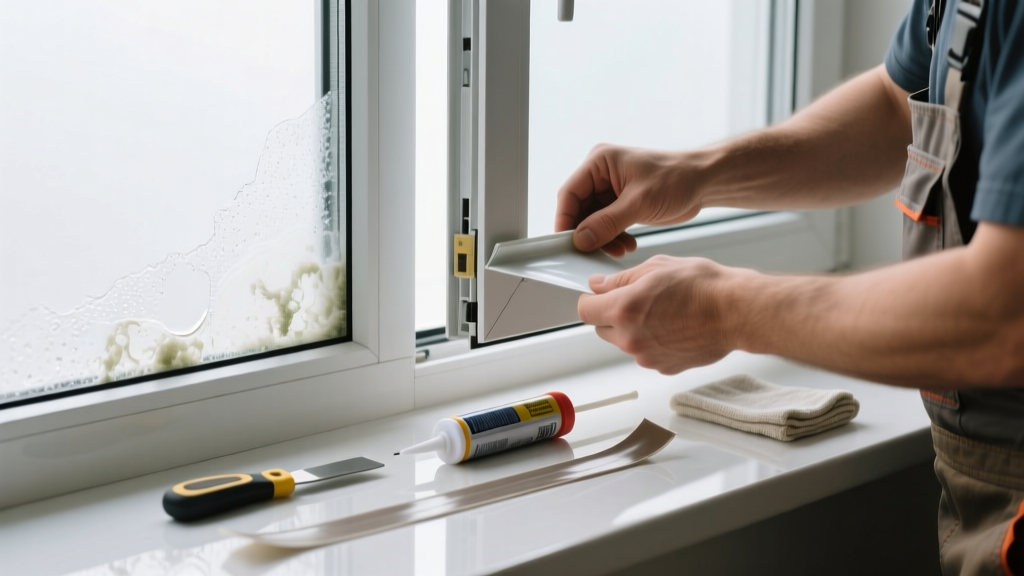
If you’re seeing fog or moisture trapped between the panes of a double- or triple-glazed window, the sealed unit has failed — not the whole window frame. This isn’t a humidity issue you can wipe away; it’s a structural failure of the insulating glass unit (IGU) that requires targeted part replacement.
Quick Diagnosis
Interior condensation between panes means the IGU’s edge seal has breached. Before assuming full-window replacement is needed, rule out these common causes:
- Broken or deteriorated butyl or polysulfide perimeter sealant
- Failed desiccant inside the spacer bar (moisture-absorbing silica gel)
- Cracked or punctured spacer bar allowing air/moisture infiltration
- Improper installation causing thermal stress fractures in the seal
- Older windows (pre-2005) with non-structural silicone edge seals
Tools & Materials Needed
| Item | Purpose | Estimated Cost |
|---|---|---|
| IGU replacement unit (custom-cut) | Exact-size sealed glass unit matching original thickness, gas fill, and low-e coating | $120–$320 |
| Glazing tape (butyl-based) | Primary weatherproof seal between glass and sash | $8–$15 |
| Spacer bar removal tool (or utility knife + pliers) | Safely extract old spacer without damaging sash or glazing beads | $0–$22 |
| Non-silicone glazing compound (e.g., DAP 33) | Secondary seal and vibration dampener for exterior edge | $6–$12 |
| Level & tape measure | Verify fit and alignment before final sealing | $10–$25 |
Step-by-Step Fix
Replacing just the IGU — not the entire window — saves 40–70% over full-unit replacement. Follow these steps carefully:
- Remove interior trim and glazing beads: Use a thin pry bar and wood blocks to gently lift beads without cracking the sash. Label each bead by position.
- Extract the failed IGU: Lift the unit straight out. Inspect the spacer bar for rust, corrosion, or visible gaps — photograph for your supplier.
- Measure precisely: Record width, height, and thickness (e.g., 32-1/4" × 48-3/8" × 1"); note glass type (low-e, argon-filled) from label on spacer or prior documentation.
- Install new IGU: Apply continuous 1/4" bead of butyl glazing tape to sash rabbet. Set unit flush, check level, then press firmly into place.
- Reinstall beads and trim: Reuse original beads if undamaged; replace cracked ones. Secure with finishing nails every 8", countersink and fill.
When to Call a Pro
DIY IGU replacement is safe for standard single-hung, casement, or fixed windows with accessible interior beads. Don’t attempt it if:
- The window is a historic or custom curved unit (requires specialized fabrication)
- The sash is rotted, warped, or structurally compromised
- You’re dealing with tilt-turn, European-style, or welded vinyl units where the IGU is integrated into the frame
- The window is over 8 ft tall or located on a second story without secure scaffolding
According to the National Fenestration Rating Council’s 2022 Field Service Survey, 68% of IGU failures occur within the first 12 years — often due to poor initial seal application or thermal cycling damage. Early replacement prevents moisture migration into surrounding framing.
Prevention Tips
Extend the life of your next IGU with these proven strategies:
- Specify warm-edge stainless steel or foam spacers instead of aluminum (reduces thermal bridging by up to 70%)
- Request dual-seal construction: primary butyl + secondary silicone or polysulfide
- Avoid high-pressure washing within 12 inches of window edges — water intrusion accelerates seal degradation
- Monitor indoor relative humidity: keep it between 30–45% in winter using a hygrometer (how to calibrate a hygrometer)
Can I clean the foggy space between panes myself?
No — the space is permanently sealed and inaccessible without destroying the unit. Wiping or drilling vents introduces dust, mold spores, and further moisture. Replacement is the only effective solution.
How long does a new IGU last?
Modern dual-seal IGUs installed correctly last 15–25 years. Units with warm-edge spacers and argon/krypton fill average 22 years, per the U.S. Department of Energy’s 2023 Window Performance Database.
Do I need to replace both windows in a pair if only one is fogged?
Not immediately — but strongly consider it. Matching IGUs age at similar rates, and mismatched units cause uneven thermal performance and visual disparity. You’ll likely replace the second within 1–3 years.
Will replacing just the IGU void my window warranty?
It depends. Most manufacturers void the entire window warranty if the IGU is replaced by anyone other than an authorized dealer. Check your original paperwork — some brands (e.g., Marvin, Pella) offer prorated IGU-only coverage for up to 20 years.
Can I reuse the old spacer bar?
Never. Spacer bars are single-use components. The desiccant inside is saturated and non-regenerable; reusing it guarantees rapid re-fogging. Always install a new, factory-filled spacer.
Is it cheaper to replace the whole window instead of just the IGU?
For standard residential windows, IGU replacement costs $120–$320 vs. $450–$1,200+ for full-frame replacement. Labor accounts for 60% of full-window cost — and you avoid disturbing interior trim, drywall, and exterior siding.
A properly executed IGU swap restores clarity, energy efficiency, and resale value — all without tearing out walls or repainting. If your sash is sound and your measurements are precise, this fix pays for itself in under two heating seasons through reduced HVAC load and moisture-related maintenance.