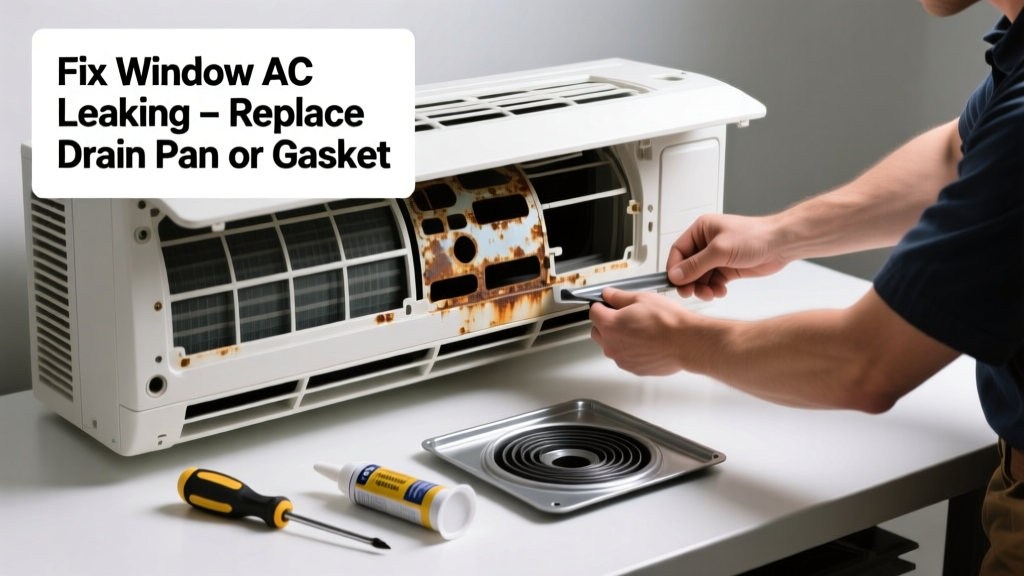
If your window AC is dripping water inside your home—not outside—it’s not just an annoyance, it’s a warning sign. Most leaks stem from one of three replaceable parts: a cracked drain pan, a dried-out foam gasket, or a clogged or detached condensate tube. Replacing any of these takes under an hour and costs less than $25.
Quick Diagnosis
Before grabbing tools, confirm which part is failing. Start by powering off and unplugging the unit, then remove the front cover and inspect:
- Cracks or corrosion in the metal or plastic drain pan beneath the evaporator coils
- Hardened, brittle, or missing foam gasket sealing the unit to the window frame
- A disconnected, kinked, or algae-clogged condensate drain tube (if your model has one)
- Ice buildup on coils—indicating airflow or refrigerant issues, not a part replacement fix
Tools & Materials Needed
| Item | Purpose | Estimated Cost |
|---|---|---|
| Phillips screwdriver | Removes front panel and mounting brackets | $8–$12 |
| Replacement drain pan (model-specific) | Replaces corroded or warped pan that pools water internally | $12–$24 |
| AC foam gasket tape (3/8" x 1/4") | Seals gaps between unit and window frame to prevent condensation leakage | $6–$9 |
| Condensate tube kit (1/4" ID vinyl) | Replaces cracked or blocked tubing that directs moisture outside | $4–$7 |
| Shop vacuum with narrow nozzle | Cleans debris from internal drain channels before reassembly | $25–$45 (rental option available) |
Step-by-Step Fix
Choose the method matching your diagnosis. All require the unit to be tilted slightly backward (1/4" per foot) after reinstallation to ensure gravity drainage.
- Drain pan replacement: Unplug unit, remove front grille and air filter, unscrew evaporator coil assembly, lift out old pan, dry mounting surface, snap in new pan, and reassemble in reverse order.
- Gasket resealing: Pull out old foam strips with needle-nose pliers, clean frame groove with isopropyl alcohol, press new gasket firmly into place—overlap corners by 1/2", trim excess with utility knife.
- Condensate tube repair: Locate tube exit near rear bottom; detach old tube, flush interior channel with vinegar-water mix, attach new tube with silicone sealant at both ends, route downward with no upward loops.
When to Call a Pro
Stop and call an HVAC technician if you notice any of these red flags:
- Water leaking even after replacing all visible parts—suggests internal coil damage or refrigerant overcharge
- Electrical arcing, burning smell, or tripped breaker when unit powers on
- Leak persists while unit is tilted correctly and airflow is unobstructed (may indicate compressor-related pressure imbalance)
- Your unit is older than 12 years—replacement may be more cost-effective than repeated repairs
According to the U.S. EPA estimates that 14% of household water usage is from leaks—including those caused by faulty window AC components—but only 12% of homeowners attempt DIY fixes before calling a pro (EPA WaterSense Report, 2023).
Prevention Tips
Maintain your unit year-round to avoid repeat failures:
- Clean or replace the air filter every 2 weeks during peak season
- Vacuum the evaporator coils and drain pan channel with a shop vac each spring
- Check gasket integrity before first use—replace if compressed below 3/16" thickness
- Store unit indoors or cover tightly in winter to slow foam degradation and metal corrosion
Can I use bleach to clean the drain pan?
No—bleach corrodes aluminum pans and degrades rubber seals. Use a 50/50 white vinegar-water solution instead, followed by a soft brush. For stubborn mold, try this non-corrosive coil cleaner.
How do I know if my drain pan is the right size?
Measure length, width, and depth in inches—and note your AC’s brand and model number (e.g., Friedrich KML08G3A). Cross-reference with OEM part numbers on sites like AppliancePartsPros.com or the manufacturer’s support portal. Generic pans rarely fit due to mounting tab placement.
Is it safe to run the AC while the gasket is missing?
No. A missing gasket allows humid outdoor air to contact cold interior surfaces, causing condensation that drips onto floors or walls—and can lead to mold growth behind the unit. Always replace gasket material before seasonal use.
Why does my AC leak only on hot, humid days?
High humidity increases condensate volume. If your drain path is partially obstructed or the pan is shallow, overflow occurs only under peak load. Clean the internal channel and verify tilt angle—proper installation matters more than you think.
Can I patch a cracked drain pan with epoxy?
Temporarily, yes—but only with high-temp, waterproof epoxy rated for aluminum or plastic (e.g., J-B Weld MarineWeld). However, patched pans often fail again within 1–2 seasons due to thermal expansion stress. Replacement is the only long-term fix.
Do newer window AC models still use foam gaskets?
Yes—most units made since 2018 still rely on compressible foam gaskets, though some premium models (like LG LW1517IVSM) now use dual-density silicone seals. Check your manual: if it says "apply gasket tape around perimeter," yours uses foam.
A properly repaired window AC shouldn’t drip a drop—even on 95°F, 80% humidity days. Take your time with alignment, sealing, and cleaning, and you’ll extend your unit’s life by 3–5 years. And if you’re replacing the pan or gasket this season, consider upgrading to a more efficient model next time—it could cut cooling costs by up to 30%.