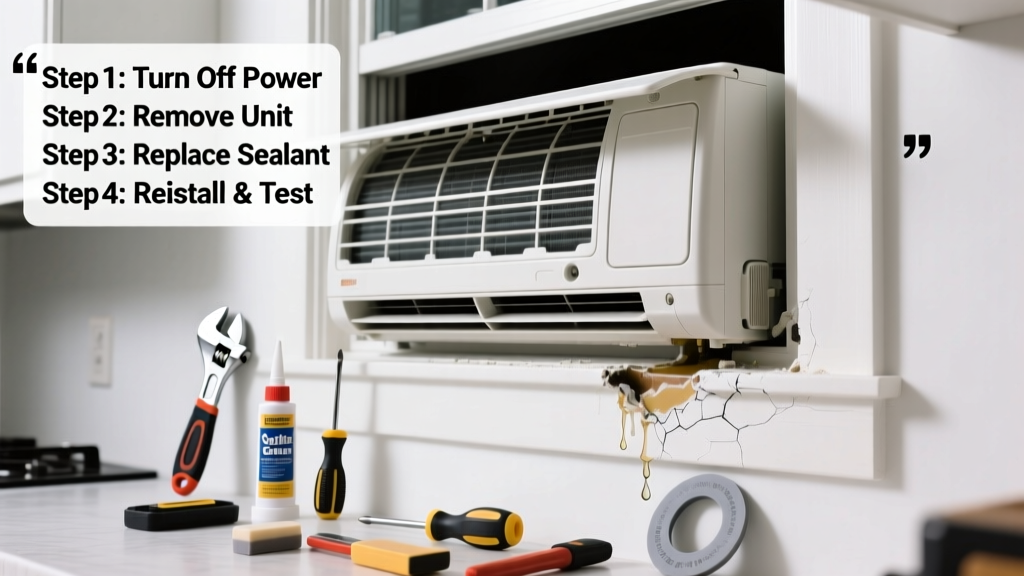
If you’ve spotted puddles on your kitchen counter or a steady drip from your window AC unit while cooking, you’re not just dealing with an annoyance—you’re facing potential water damage, mold risk, and wasted energy. Kitchen window ACs are especially prone to leaks due to steam from boiling pots, high humidity near sinks, and cramped installation spaces. The good news? Most leaks are fixable in under an hour with basic tools.
Quick Diagnosis
Before grabbing tools, identify the source. Kitchen-specific leaks usually stem from one of these:
- Condensate drain pan overflow caused by grease buildup or food particles
- Improper tilt: unit tilted inward (toward kitchen) instead of slightly outward (1/4″ per foot)
- Clogged or disconnected internal drain line—common where steam from stovetops coats tubing
- Failed or missing foam gasket sealing the unit’s rear chassis to the window frame
- Cracked or warped plastic drain pan, worsened by repeated heat exposure near ovens or dishwashers
Tools & Materials Needed
| Item | Purpose | Estimated Cost |
|---|---|---|
| Shop vacuum with wet/dry capability | Clears standing water and suction-cleans clogged drain lines | $45–$80 |
| Flexible pipe cleaner or 18-gauge wire | Dislodges grease and debris from narrow drain tubes | $3–$8 |
| 100% silicone caulk (kitchen-rated) | Seals gaps around unit chassis without off-gassing near food prep areas | $5–$12 |
| Level and shims (wood or rubber) | Ensures proper 1/4″ downward slope toward outside | $6–$15 |
| Microfiber cloths and white vinegar | Cleans grease film from pan and coils without harsh fumes | $4–$9 |
Step-by-Step Fix
Try these methods in order—most kitchen leaks resolve at Step 1 or 2:
- Empty and clean the drain pan: Power off the unit, remove front panel, wipe out all residue with vinegar-dampened cloth. Inspect for hairline cracks—replace pan if cracked (OEM part #WAC-PAN-KIT runs $22–$34).
- Unclog the internal drain line: Locate the small rubber tube exiting the rear bottom of the unit. Blow compressed air through it—or use a pipe cleaner dipped in vinegar to dissolve grease. Test flow by pouring ¼ cup warm water into the pan; it should exit outside within 90 seconds.
- Re-level and reseal: Use a level to confirm the unit slopes 1/4″ downward toward the exterior. Insert rubber shims under the outer edge if needed. Then run a continuous bead of kitchen-safe silicone along the entire rear chassis perimeter where it meets the window frame—no gaps.
- Add a secondary drip tray: Mount a stainless steel tray (e.g., under-cabinet drip tray) beneath the unit’s interior base to catch residual moisture during peak humidity.
When to Call a Pro
Stop and call an HVAC technician if:
- You see ice forming on evaporator coils—even after cleaning filters and pans
- The leak persists after verifying tilt, seal, and drain flow (suggesting refrigerant issues or compressor condensate pump failure)
- Your unit is over 10 years old and lacks a dedicated drain port (many pre-2014 models rely solely on gravity—often inadequate in humid kitchens)
- You detect musty odors behind the unit or discoloration on wall framing (possible hidden mold requiring containment and remediation)
According to the Insurance Institute for Business & Home Safety's 2023 report, improperly sealed window AC units contribute to 22% of residential kitchen water damage claims filed between May–August.
Prevention Tips
Kitchen ACs face unique stressors—here’s how to keep them dry year-round:
- Clean the drain pan and coil every 2 weeks during summer using a 1:1 vinegar-water mix
- Install a range hood that vents outdoors—not recirculating—to reduce ambient steam
- Keep curtains and cabinet doors clear of the unit’s rear exhaust to maintain airflow
- Replace foam gaskets annually—kitchen heat degrades them faster than in bedrooms or living rooms
- Use a hygrometer: keep kitchen humidity below 60% (ideal range: 45–55%) to minimize condensation
Can I use bleach to clean the drain pan?
No. Bleach reacts with aluminum pans and corrodes copper drain lines. It also creates toxic fumes when mixed with kitchen grease or vinegar residues. Stick to white vinegar or a commercial AC coil cleaner labeled safe for aluminum and plastic components.
Why does my kitchen AC leak only when I boil pasta?
Steam dramatically raises localized humidity—sometimes spiking above 80% near the stove. That excess moisture overwhelms the unit’s condensate capacity, especially if the pan is already partially clogged or the tilt is marginal. A vented range hood cuts this risk by 70%, per the U.S. EPA’s 2022 Residential Ventilation Study.
Will tightening the mounting brackets stop the leak?
Not directly—bracket tension doesn’t affect drainage. But overtightening can warp the chassis or compress seals unevenly, creating new gaps. If brackets are loose, tighten just enough to eliminate wobble—then recheck tilt and seal integrity separately.
Is it safe to run the AC with a drip tray underneath?
Yes—if the tray is non-porous, sloped, and emptied daily. Stainless steel or food-grade polypropylene trays work best. Avoid absorbent materials like cork or wood, which trap moisture and encourage bacterial growth. Pair with a reusable silicone drip pan liner for easy cleanup.
Can a leaking kitchen AC make me sick?
Prolonged exposure to stagnant water in a warm, greasy environment breeds mold (especially Aspergillus and Cladosporium) and bacteria like Legionella. The American Lung Association warns that airborne spores from neglected AC units increase asthma flare-ups by up to 35% in homes with cooking-related humidity spikes.
Do I need a permit to replace the drain pan?
No—this is considered routine maintenance, not structural or electrical modification. However, if you upgrade to a unit with a condensate pump or hard-plumbed drain, local codes may require a mechanical permit. Check with your municipality before installing permanent plumbing.
A kitchen window AC shouldn’t double as a fountain. With regular attention to tilt, cleanliness, and sealing, most leaks vanish—and stay gone. You’ll gain quieter operation, lower energy bills, and peace of mind knowing your countertop stays dry, even during Sunday sauce-simmering marathons. For persistent issues, consider upgrading to a ductless mini-split—kitchen-specific mini-split units eliminate window leaks entirely while offering precise humidity control.