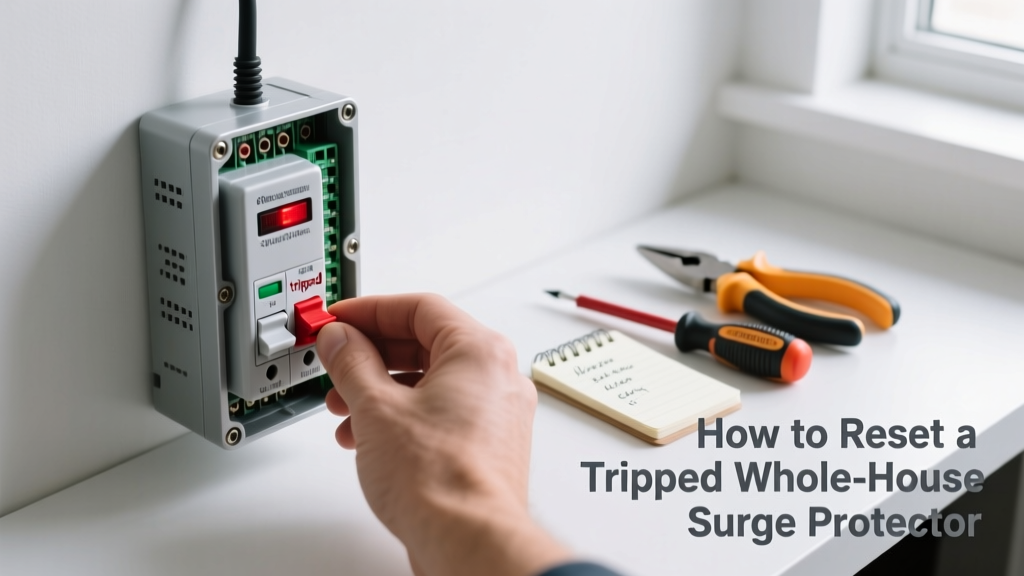
Your lights flicker, outlets go dead, and your HVAC stops mid-cycle — but your main breaker is fine. Chances are, your whole-house surge protector tripped. Unlike a standard breaker, this device silently sacrifices itself to shield your electronics from voltage spikes — and it won’t reset until you know why it failed.
Quick Diagnosis
Before resetting, rule out the real cause. A tripped surge protector rarely fails without reason. Check these first:
- A nearby lightning strike or utility grid switching event (check neighborhood reports or weather logs)
- A recent major appliance failure (e.g., AC compressor short, well pump motor burnout)
- Visible damage: charring, melted plastic, or burning odor near the panel or SPD unit
- Repeated tripping within 48 hours — signals an ongoing overvoltage or grounding issue
- Age: Most whole-house SPDs last 3–5 years; units older than 2019 may have exhausted their joule rating
Tools & Materials Needed
| Item | Purpose | Estimated Cost |
|---|---|---|
| Non-contact voltage tester | Verifies power is off at the SPD before handling | $12–$25 |
| Insulated screwdriver (VDE-rated) | Safely accesses SPD terminals without shock risk | $18–$32 |
| Clamp meter (optional but recommended) | Detects abnormal neutral-to-ground voltage or stray current | $65–$140 |
| Replacement SPD module (if needed) | Matches your panel brand (Siemens, Square D, Eaton) and voltage rating | $85–$220 |
Step-by-Step Fix
Follow this sequence — skipping steps risks re-tripping or equipment damage:
- Shut off main power: Flip the main breaker to OFF. Confirm no voltage at SPD line terminals using your non-contact tester.
- Inspect the SPD status indicator: Most units have LED windows (green = OK, red = failed). If red or blank, the MOVs are likely degraded — not just tripped.
- Reset only if indicator shows green or yellow: Press the reset button firmly (some require holding 3 seconds). If it pops back immediately, stop — there’s an active fault.
- Check grounding continuity: Use a multimeter to test resistance between SPD ground lug and your panel’s ground bar (<1 ohm required per NEC 250.53). Loose or corroded grounds cause false trips.
- Verify neutral integrity: Measure voltage between neutral and ground at the SPD location. Anything above 2 VAC suggests a loose neutral — a fire hazard requiring immediate pro attention.
When to Call a Pro
Don’t touch the panel if any of these apply:
- You measure >2 VAC between neutral and ground at the SPD terminal block
- The SPD smells burnt or shows discoloration on its housing or busbar connections
- Your home has aluminum wiring or a Federal Pacific or Zinsco panel (known fire risks during SPD servicing)
- You lack a valid electrical license and the SPD is hardwired (not plug-in) — most jurisdictions require licensed work for service-panel modifications
"Over 70% of whole-house SPD failures occur due to undetected neutral faults or undersized grounding conductors — not lightning," says Mike Holt, NECA-certified trainer and author of Electrical Grounding & Bonding (2022 edition).
Prevention Tips
Extend your SPD’s life and avoid repeat trips:
- Install a dedicated 20A circuit for the SPD — never share with other loads
- Test SPD status LEDs monthly; log readings in a maintenance journal
- Add point-of-use protectors (UL 1449 Type 3) at sensitive electronics — they absorb residual surges the whole-house unit can’t catch
- Hire an electrician to verify ground rod resistance annually (should be ≤25 ohms per IEEE 142)
Can I reset the surge protector without turning off the main breaker?
No. Whole-house SPDs connect directly to live service conductors. Attempting reset or inspection with power on risks arc flash, severe shock, or fatal electrocution. The NEC requires de-energizing the entire panel before accessing SPD terminals.
Why does my surge protector trip but my breakers stay on?
Because SPDs respond to voltage — not current. Breakers trip on over-amperage (e.g., short circuits); SPDs react to over-voltage events (like lightning-induced transients) that don’t draw enough current to flip a breaker but can fry microchips. That’s why they’re installed upstream of your main breaker.
How long do whole-house surge protectors last?
Most last 3–5 years under normal conditions, but lifespan drops sharply with frequent surges. According to the UL 1449 5th Edition testing standard, SPDs must indicate end-of-life when 10% of their rated energy absorption remains — usually signaled by a red LED or mechanical flag.
Do I need both a whole-house and outlet surge protector?
Yes. UL and the National Fire Protection Association (NFPA 70E) recommend layered protection: whole-house units handle >90% of surge energy (up to 50kA), while point-of-use devices clamp residual spikes down to safe levels for computers and smart appliances. Relying on just one leaves gaps.
Will insurance cover damage if my SPD tripped but wasn’t replaced?
Usually not. Most homeowner policies exclude damage from ‘failure to maintain protective devices.’ State Farm’s 2023 Homeowners Claims Handbook explicitly lists SPD replacement as a preventive maintenance duty — similar to changing HVAC filters. Document your SPD checks and replacements annually.
Can a tripped surge protector cause other breakers to trip?
Rarely — but yes, if the SPD’s internal MOVs short-circuit instead of clamping, it creates a low-resistance path to ground. This can overload the circuit feeding it, causing its dedicated breaker to trip. That’s why SPDs always require their own dedicated breaker sized per manufacturer specs (usually 20A–30A).
Tripping isn’t failure — it’s the device doing its job. But treating it like a nuisance breaker resets the stage for bigger problems. Treat each trip as a diagnostic clue, not a reset button. If your SPD trips more than once a year, schedule a whole-home surge audit — including grounding system verification and neutral integrity testing. For deeper electrical health checks, see our guide on how to test home grounding system or signs of bad electrical panel.