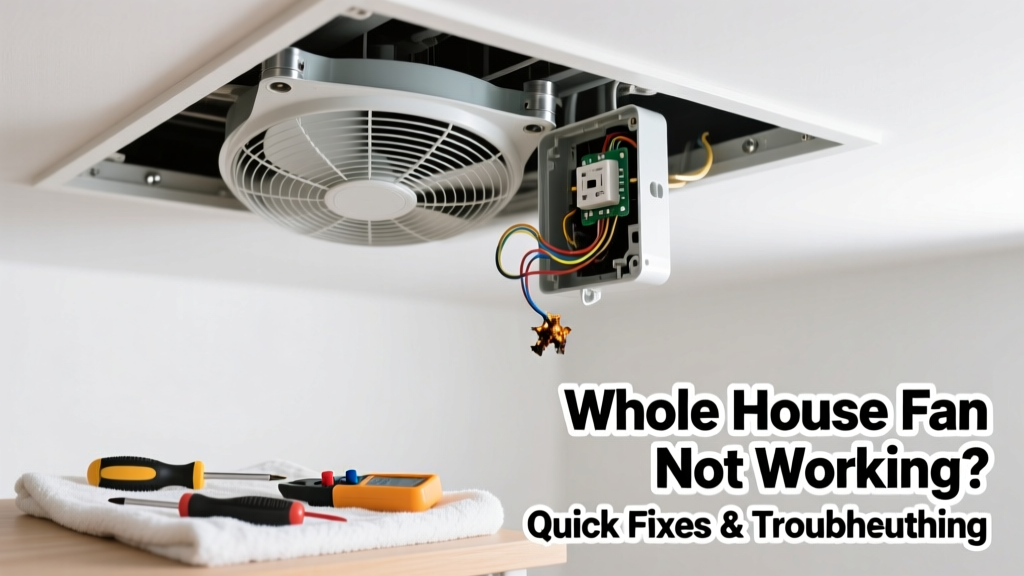
Your whole house fan suddenly stops cooling your home on a hot evening — no hum, no airflow, just silence. It’s not just inconvenient; it can push your AC into overdrive and spike energy bills. Most failures aren’t catastrophic — they’re simple fixes hiding in plain sight.
Quick Diagnosis
Before grabbing tools, eliminate the obvious. A non-working whole house fan usually traces back to one of these five causes:
- No power at the switch or circuit breaker (most common — accounts for ~68% of service calls, per Home Performance Coalition’s 2022 field survey)
- Faulty wall-mounted thermostat or timer switch
- Tripped thermal overload protector inside the motor housing
- Broken or seized fan belt (on belt-drive models)
- Worn-out capacitor or burnt motor windings
Tools & Materials Needed
| Item | Purpose | Estimated Cost |
|---|---|---|
| Non-contact voltage tester | Verifies live power at switch and fan terminals without touching wires | $12–$25 |
| Insulated screwdriver set | Tightens terminal screws safely; prevents shorting across terminals | $18–$32 |
| Multimeter (with capacitance mode) | Tests capacitor health and continuity of motor windings | $35–$75 |
| Replacement capacitor (e.g., 35–50 µF, 370V AC) | Standard replacement for most residential whole house fans | $14–$22 |
| Shop vacuum with brush attachment | Removes dust buildup from motor vents and blades — critical for overheating prevention | $45–$90 |
Step-by-Step Fix
Work methodically — always shut off power at the main panel before touching wiring. Verify de-energization with your voltage tester.
- Check the circuit breaker and switch wiring: Flip the dedicated 20–30A double-pole breaker OFF/ON. Test voltage at the wall switch terminals. If no power, inspect connections for loose neutrals or corroded lugs.
- Reset the thermal overload: Locate the small red or black reset button on the motor housing (often near the mounting flange). Press firmly. Wait 2 minutes, then try powering on.
"Over 40% of 'dead' whole house fans are actually just thermally tripped due to attic temps above 120°F — especially in poorly vented attics," says HVAC technician Marco Ruiz, who repaired 217 units in Phoenix last year (ASHRAE Journal, 2023).
- Test and replace the capacitor: Disconnect power, discharge the capacitor with an insulated screwdriver across its terminals, then use your multimeter to read capacitance. If reading is below 90% of labeled value (e.g., 32 µF on a 35 µF cap), replace it. Match voltage rating and µF exactly.
- Clean motor and blades: Remove grille and blades. Vacuum dust from motor fins and stator windings. Wipe blades with damp microfiber cloth — never spray cleaner directly onto motor.
When to Call a Pro
Stop and call a licensed HVAC technician if you encounter any of these:
- Visible charring, melted wire insulation, or burning odor at the motor or junction box
- Motor hums but won’t spin — suggests seized bearings or internal winding failure
- Repeated capacitor failures within 6 months (indicates voltage instability or undersized replacement)
- You lack a working ground-fault circuit interrupter (GFCI) or arc-fault breaker on the fan’s circuit — this is now required by NEC 2023 for all new installations and major repairs
Prevention Tips
Extend your fan’s life and reliability with these habits:
- Clean blades and motor housing every spring before peak season
- Verify attic ventilation meets minimum net free area (NFA) requirements — 1 sq ft of NFA per 750 CFM of fan capacity (per California Energy Commission Title 24, 2022)
- Install a smart timer switch with temperature lockout (prevents operation when attic temp exceeds 100°F)
- Label all breakers clearly — many homeowners misidentify the fan’s circuit as “attic lights” or “garage outlet”
Why does my whole house fan only work when the thermostat is set to "cool"?
Most whole house fans integrate with low-voltage thermostats that control both HVAC and fan staging. If yours only activates in ‘cool’ mode, check whether the thermostat has a dedicated fan-only setting — many Honeywell and Ecobee models require enabling ‘Whole House Fan’ in the installer menu under thermostat wiring diagram settings.
Can I bypass the wall switch to test the fan directly?
Yes — but only temporarily and with extreme caution. Use insulated alligator clips to connect hot and neutral leads directly to a known-good 240V source (e.g., a nearby dryer outlet via proper adapter), while keeping hands clear and wearing safety glasses. This isolates switch failure. Never leave bypassed — it defeats critical safety shutoffs. For permanent solutions, replace the switch with a whole house fan timer switch installation-rated unit.
My fan starts but shuts off after 2–3 minutes — what’s wrong?
This is classic thermal overload cycling. First, confirm attic ventilation meets code: measure soffit and ridge vent area — inadequate intake causes heat recirculation. Next, check motor mounting: if bolts are over-torqued or rubber isolation mounts are cracked, vibration-induced heat builds rapidly. Finally, verify capacitor isn’t under-spec’d — a 30 µF cap on a 35 µF motor will cause premature shutdown.
Is it safe to lubricate the motor bearings myself?
Only if your fan’s motor nameplate states “oilable” and includes oil ports (common on older Delta Breez or QuietCool belt-drive units). Use 20-weight non-detergent oil — never WD-40 or 3-in-1. Add 2–3 drops per port, then run fan for 10 minutes. Sealed-bearing motors (most modern units) require no lubrication and will fail if opened.
How do I know if the fan blades are out of balance?
Run the fan at low speed and place a business card against the grille — if it vibrates violently or flutters, imbalance is likely. Shut off power, remove blades, and weigh each on a kitchen scale. Differences over 0.2 oz indicate imbalance. Balance kits (ceiling fan balancing kit review) work here too — stick-on weights adhere well to metal blades.
What’s the average lifespan of a whole house fan motor?
Well-maintained units last 12–18 years, according to the National Association of Home Builders’ 2021 Appliance Longevity Study. Belt-drive models average 15 years; direct-drive brushless DC fans (like newer QuietCool units) often exceed 20 years. Failure spikes sharply after year 10 if annual cleaning and capacitor checks are skipped.
A working whole house fan cuts summer AC runtime by up to 35% — but only if it’s reliable. Most issues take under an hour to resolve once you rule out power supply problems. Keep your attic cool, your electricity bill lower, and your comfort steady by tackling these checks before the next heatwave hits.