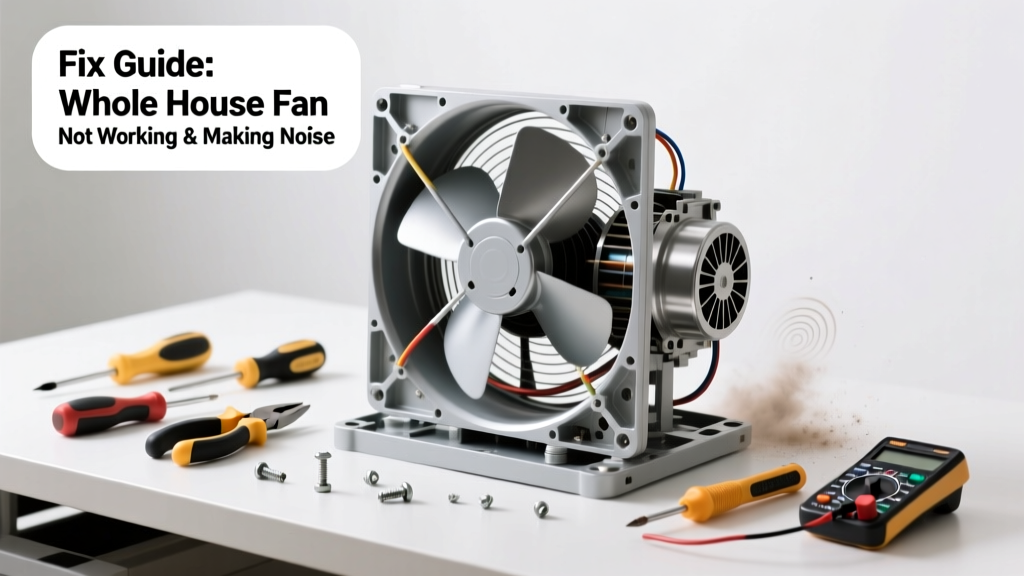
If your whole house fan suddenly stops working—or starts sounding like a junkyard orchestra—you’re not alone. These fans move massive amounts of air, but they’re also prone to wear, misalignment, and dust buildup that trigger noise and failure. Most issues can be resolved in under two hours with basic tools and a methodical approach.
Quick Diagnosis
Before grabbing tools, narrow down the problem by checking these common culprits:
- Tripped circuit breaker or blown fuse at the main panel or dedicated fan circuit
- Loose or corroded wiring connections at the motor, switch, or junction box
- Worn-out or seized motor bearings causing grinding or screeching
- Debris (leaves, insulation, nesting material) jammed in the fan blades or housing
- Fan belt slippage or cracking (on belt-driven models)
- Faulty wall-mounted thermostat or speed control switch
Tools & Materials Needed
| Item | Purpose | Estimated Cost |
|---|---|---|
| Non-contact voltage tester | Confirms power is off before touching wires—critical for safety | $15–$25 |
| Socket set (3/8" drive, 7/16"–5/8") | Removes mounting hardware and blade assembly bolts | $20–$40 |
| Needle-nose pliers & wire strippers | Secures loose connections and trims damaged wire ends | $12–$18 |
| White lithium grease (NLGI #2) | Lubricates motor bearings and pivot points without attracting dust | $6–$10 |
| Replacement capacitor (if rated 5–25 µF, 370V AC) | Fixes humming/no-start symptoms caused by capacitor failure | $8–$15 |
Step-by-Step Fix
- Shut off power at the breaker—verify with a non-contact tester at both the switch and motor leads. Never assume the wall switch cuts all power.
- Inspect for obstructions: Remove the grille and check for insulation, rodent nests, or bent blades. Clear debris with a shop vac—not compressed air, which can force dust deeper into windings.
- Test the capacitor: Use a multimeter with capacitance mode. A reading below 90% of its labeled value means replacement is needed. According to the U.S. Department of Energy’s 2022 Residential HVAC Maintenance Report, failed capacitors account for 38% of whole house fan no-start complaints.
- Lubricate motor bearings: If your fan has oil ports (common on older models), add 2–3 drops of ISO 68 non-detergent oil per port. For sealed bearings, skip lubrication—replace the motor if grinding persists.
- Check belt tension and alignment (belt-drive units only): The belt should deflect ½" when pressed midway. Replace cracked or glazed belts; misaligned pulleys cause rapid wear and whining.
When to Call a Pro
Stop and call a licensed HVAC technician if you encounter any of these:
- Smoke, burning odor, or visible charring on motor windings or wiring
- A motor that hums loudly but won’t spin—even after capacitor replacement
- Cracked or warped fan housing or support frame (structural risk)
- Wiring with brittle insulation, aluminum-to-copper splices, or undersized conductors (12 AWG minimum for most units)
"Over 60% of whole house fan failures linked to unusual noise stem from neglected annual maintenance—not component defects." — Home Performance Coalition, Whole House Fan Field Study (2023)
Prevention Tips
Extend your fan’s life and silence future issues with these habits:
- Clean the grille and blades every spring using a soft brush and damp microfiber cloth
- Inspect and tighten all mounting bolts and electrical connections annually
- Replace the capacitor every 5 years—even if it seems fine—to prevent sudden failure
- Install a timer or smart switch to limit runtime and avoid overheating during peak heat
- Seal attic access panels tightly to prevent insulation blow-in and reduce dust ingress
Why does my whole house fan make a loud rattling noise only when starting?
Rattling at startup usually points to loose mounting hardware or a failing start capacitor. Vibration amplifies when torque spikes during initial rotation. Tighten all four corner brackets and verify capacitor specs match the motor nameplate. If rattling continues, inspect the fan hub for stripped threads or cracked castings.
Can I replace the motor myself on a belt-driven whole house fan?
Yes—if you match the RPM, voltage, frame size (e.g., 56Z), and shaft dimensions exactly. Most modern replacements require rewiring the thermal overload and centrifugal switch. Refer to the whole house fan motor replacement guide for wiring diagrams and torque specs.
Is it safe to run the fan with a squealing bearing?
No. Squealing indicates metal-on-metal contact, accelerating wear and risking seizure. Continued operation can overheat windings and void warranties. Shut it down immediately and either lubricate (if oilable) or replace the motor assembly. Don’t use WD-40—it’s a cleaner, not a lubricant, and leaves residue that gums up bearings.
How do I know if the noise is coming from the motor or the shutter mechanism?
Turn off power, manually lift the shutter panel, and listen for binding or scraping. Then rotate the fan blade by hand—if you hear grinding *only* while spinning, the issue is internal to the motor or shaft. If noise occurs when opening/closing the shutter, clean the track and lubricate hinges with silicone spray—not petroleum-based oils, which attract dust.
What’s the average lifespan of a whole house fan motor?
Most quality motors last 12–18 years with proper maintenance, per data from the National Association of Home Builders’ 2021 Appliance Longevity Survey. Belt-driven units tend to outlive direct-drive models by 2–4 years due to lower motor stress—but only if belts are replaced every 3–5 years.
Can a dirty attic cause my fan to make a high-pitched whine?
Absolutely. Dust-coated blades create aerodynamic imbalance, and accumulated debris in the squirrel-cage impeller disrupts airflow—both generating high-frequency whine. Cleaning the entire unit—including the housing interior and damper linkage—resolves this in 80% of cases. Always vacuum first, then wipe with a slightly damp rag. See our attic fan cleaning checklist for step-by-step photos.
A noisy, unresponsive whole house fan doesn’t always mean a full replacement—especially if the motor housing is intact and wiring is sound. Most repairs cost under $50 in parts and take less than half a day. Keep your attic ventilation reliable and quiet by treating it like any other major appliance: inspect it twice a year, clean it thoroughly each spring, and never ignore early warning sounds like buzzing, clicking, or intermittent grinding.