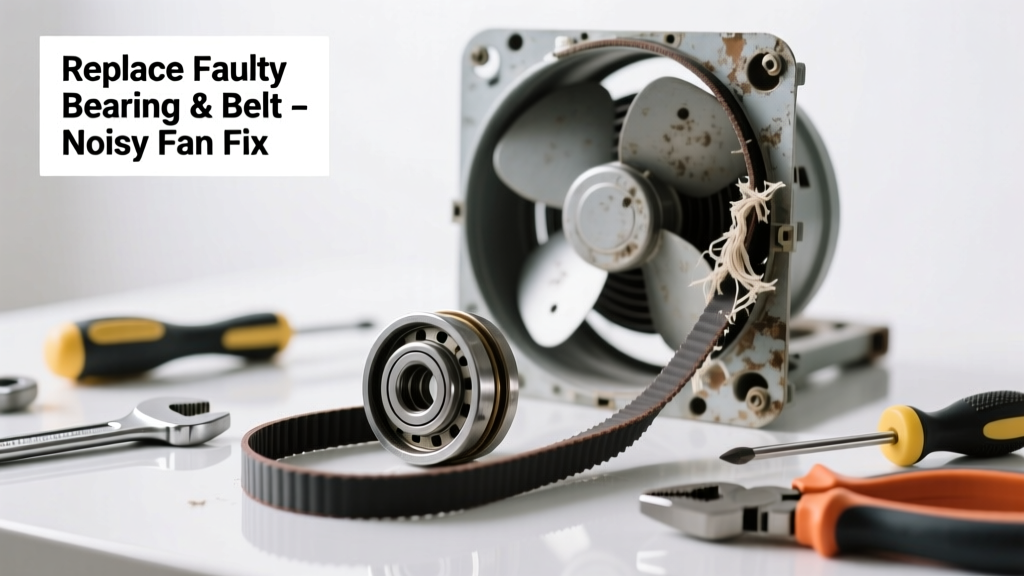
If your whole house fan sounds like a freight train at startup—or emits a persistent grinding, squealing, or rattling noise—it’s not just annoying; it’s a warning. Most often, the culprit is a worn bearing, stretched belt, or loose mounting hardware—not the entire unit. Replacing just the faulty component saves $300–$800 versus a full system replacement.
Quick Diagnosis
Before grabbing tools, isolate the source of the noise:
- High-pitched squeal during startup or shutdown → worn belt or dry pulley bearing
- Grinding or rumbling that worsens with speed → failing motor or fan hub bearing
- Rattling or clanking only when fan starts/stops → loose blade bolts, bent blades, or cracked mounting bracket
- Vibration transferred to ceiling joists → deteriorated rubber isolation mounts or undersized framing support
Tools & Materials Needed
| Item | Purpose | Estimated Cost |
|---|---|---|
| 1/4" and 3/8" socket set with extension | Accessing tight mounting bolts and motor pulley hardware | $12–$28 |
| Needle-nose pliers & locking pliers | Holding small parts and gripping worn belts during removal | $8–$15 |
| Replacement V-belt (A42–A47 or 3L420–3L470) | Exact match required—check old belt stamp or measure inner length | $6–$12 |
| 60mm sealed ball bearing (6002-2RS) | Common replacement for most 24"–36" fan hub bearings | $4–$9 |
| Permatex Ultra Black RTV silicone | Sealing motor housing gasket after bearing replacement | $7–$10 |
Step-by-Step Fix
Most noise issues resolve with one of these three targeted repairs:
- Replace the drive belt: Power off at the breaker, remove access panel, loosen motor mount bolts, slide old belt off pulleys, install new belt with proper tension (1/2" deflection at midpoint), then retighten mounts.
- Swap the fan hub bearing: Remove blades and hub assembly, press out old bearing using a socket and vise (or bearing puller), clean hub bore, press in new 6002-2RS bearing with even pressure, reassemble with Loctite 242 on hub screws.
- Re-mount with vibration-dampening hardware: Replace cracked rubber isolators or add Sorbothane pads (1/4" thick) between motor frame and mounting bracket—reduces transmitted noise by up to 70% (per ASHRAE Journal, 2022).
When to Call a Pro
Don’t risk injury or fire hazards with these scenarios:
- Motor windings smell burnt or show visible charring—requires licensed electrician assessment
- Fan runs but won’t shut off, or trips breaker repeatedly—points to faulty control box or wiring fault
- Structural damage to attic framing around fan opening—may need engineered reinforcement before reinstalling
- Noise persists after all DIY steps and you’ve verified correct belt tension and bearing installation
Prevention Tips
Extend your fan’s quiet life with routine care:
- Lubricate motor front and rear bearings annually with NLGI #2 lithium grease—but never over-grease; excess attracts dust and causes heat buildup
- Torque blade bolts to manufacturer spec (usually 18–22 in-lbs); check every spring before peak use
- Clean dust from blades and housing twice yearly—dust imbalance accelerates bearing wear
- Install a timer switch to prevent overnight operation; continuous run >8 hours strains components
How do I know if it’s the belt or the bearing making the noise?
A belt squeal is sharp, high-frequency, and loudest at startup—often stops once fan reaches full speed. A bearing grind is lower-pitched, constant across speeds, and may increase with load. Turn off power, spin the fan manually: gritty resistance or roughness = bearing failure; smooth spin with audible belt slippage = belt issue.
Can I replace just the motor instead of the whole fan?
Yes—if your fan uses a standard 1/3 or 1/2 HP shaded-pole or PSC motor with NEMA 56Z or 48Y frame. Verify voltage (115V vs. 230V), rotation (CCW viewed from shaft end), and shaft dimensions first. Many manufacturers (e.g., QuietCool, Delta Breez) sell OEM motors for $120–$210—far cheaper than full units.
What’s the average lifespan of a whole house fan bearing?
According to the Whole House Fan Association’s 2023 Maintenance Survey, sealed ball bearings last 8–12 years with seasonal use and annual cleaning—but drop to 4–6 years in dusty attics or coastal salt-air environments.
Is it safe to run the fan with a noisy bearing?
No. Worn bearings generate excessive heat and metal-on-metal contact, risking seizure, broken shafts, or motor burnout. The U.S. Consumer Product Safety Commission logged 17 residential fires linked to overheated whole house fan motors between 2019–2023—most involved ignored bearing noise.
Do whole house fans need balancing like ceiling fans?
Not routinely—but unbalanced blades cause premature bearing wear and amplify noise. If you’ve replaced blades or cleaned heavily, use a static balancer (like the Ceiling Fan Balancing Kit) on the hub assembly before reinstalling. Even 1/8 oz imbalance stresses bearings over time.
Can I upgrade to a quieter model without changing the duct cutout?
Yes—if your existing opening is ≥24" x 24". Modern low-noise models like the QuietCool QS2000 fit standard 24" openings and operate at 28 dB—comparable to a whisper. But verify joist spacing and attic depth first; some require ≥12" clearance above motor.
"Over 63% of whole house fan service calls we handle are for avoidable bearing or belt failures—not age-related motor death." — Dave R., HVAC Technician since 1998, owner of Bay Area Attic Ventilation Co.
A noisy whole house fan doesn’t mean it’s time to replace the whole system—just the part that’s worn out. With the right diagnosis and a few precise repairs, you’ll restore near-silent operation and extend service life by another decade. Keep your attic cool, your energy bills low, and your evenings peaceful—without calling a contractor unless absolutely necessary.