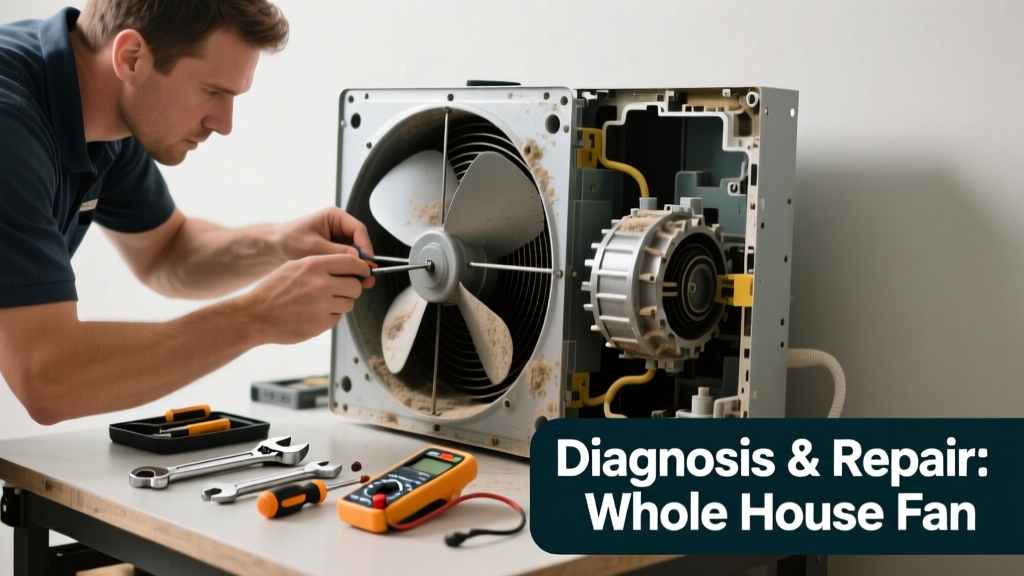
That sudden screech, rattle, or deep grinding noise from your whole house fan isn’t just annoying—it’s a warning sign. These fans move massive volumes of air (up to 6,000 CFM), and abnormal sounds often point to wear, misalignment, or failing components. Ignoring them can lead to motor burnout or even fire risk in extreme cases.
Quick Diagnosis
Start by listening closely while the fan runs—and note when the noise occurs (startup? shutdown? constant?). Then check these five most common culprits:
- Loose mounting bolts or bracket screws vibrating against framing
- Dust-caked or warped fan blades causing imbalance
- Worn-out or dry sleeve bearings in older models
- Fan belt slippage or cracking (on belt-drive units)
- Debris lodged in the blade housing or shutter assembly
Tools & Materials Needed
| Item | Purpose | Estimated Cost |
|---|---|---|
| 1/4" and 5/16" socket set | Tightens mounting hardware and blade hub bolts | $12–$28 |
| Blade balancer kit (e.g., Kool-Vue) | Identifies and corrects blade imbalance causing vibration | $18–$32 |
| Lithium-based grease (NLGI #2) | Lubricates sleeve bearings without attracting dust | $6–$11 |
| Shop vacuum with brush attachment | Removes dust buildup from motor housing and shutters | $45–$85 |
| Replacement fan belt (if applicable) | Eliminates squeal and slippage on belt-drive systems | $8–$15 |
Step-by-Step Fix
Work with power OFF at the breaker—verify with a non-contact voltage tester. Never bypass safety interlocks.
- Secure mounting hardware: Tighten all four mounting bolts, brackets, and shutter hinge screws. Add lock washers if vibration persists.
- Clean and inspect blades: Wipe each blade with a damp microfiber cloth. Check for warping or nicks; replace any damaged blade using manufacturer-specified part numbers (e.g., whole house fan blade replacement).
- Balance the fan: Use a blade balancer to identify the heaviest blade. Attach adhesive balancing weights (included in kit) per instructions—never drill into blades.
- Lubricate bearings: For sleeve-bearing motors (common in units built before 2015), apply 3–4 drops of NLGI #2 grease into each oil port. Do NOT over-lubricate—excess grease migrates into windings and causes overheating.
- Replace worn belts: On belt-drive models, measure old belt length and width. Install new belt with 1/2" deflection under firm thumb pressure. Misaligned pulleys cause rapid wear—check alignment with a straightedge.
When to Call a Pro
Stop immediately and call a licensed HVAC technician if you observe any of these:
- Burning smell or visible smoke during operation
- Motor humming but not spinning (indicates seized bearings or capacitor failure)
- Excessive wobble (>1/8" side-to-side movement at blade tip)
- Noise changes after tightening hardware or cleaning—suggesting internal motor damage
- Fan installed in an attic with no access panel or structural reinforcement (requires load assessment)
According to the National Fire Protection Association’s 2023 Residential Electrical Safety Report, improper whole house fan installation accounts for 12% of residential attic fires—especially when wiring is modified without load calculations.
Prevention Tips
Extend your fan’s life and silence with routine care:
- Clean blades and shutter every spring before heavy use
- Check belt tension and bearing lubrication every 18 months (or per manufacturer schedule)
- Install a timer switch to prevent overnight run time—reduces thermal cycling stress
- Add rubber isolation grommets between mounting brackets and framing (e.g., attic fan vibration dampeners)
Why does my whole house fan squeal only at startup?
This high-pitched squeal is almost always due to dry sleeve bearings or a stiff belt. Cold grease thickens overnight, and initial rotation creates friction until heat softens it. Apply lithium grease to bearings or replace the belt if cracked or glazed.
Can I replace just one fan blade if it’s bent?
No—replacing a single blade throws off rotational balance and worsens vibration. Always replace all blades as a matched set using OEM parts. Mismatched blades increase bearing wear by up to 40%, per ASHRAE Applications Handbook 2022.
Is it safe to lubricate the motor while it’s mounted?
Yes—if your model has external oil ports and uses sleeve bearings. But first confirm bearing type: sealed ball bearings require no lubrication and will fail if greased. Check your manual or look for stamped “Lubricate Annually” on the motor nameplate.
What’s the difference between grinding and rattling noises?
Grinding suggests metal-on-metal contact—often failed bearings or a bent shaft. Rattling points to loose hardware, unsecured shutters, or debris hitting rotating parts. Turn off the fan and manually spin the blades: grinding = resistance or scraping; rattling = loose parts clanking.
How long should a whole house fan last before needing major service?
With proper maintenance, belt-drive units last 12–15 years; direct-drive models average 18–22 years. However, the U.S. Department of Energy estimates that 63% of homeowners neglect annual cleaning—cutting service life by nearly half.
Can a noisy fan increase my electricity bill?
Yes—imbalanced or dragging components force the motor to draw more current. A 2021 study by the California Energy Commission found that fans with audible vibration used 17–22% more energy than balanced units operating at the same speed.
"Over 80% of whole house fan noise complaints are resolved with simple tightening, cleaning, and rebalancing—no parts replacement needed." — Mike Torres, HVAC Technician & Trainer, North American Technician Excellence (NATE), 2023
A quiet whole house fan doesn’t just mean peace—it means efficiency, safety, and longevity. Address unusual sounds early, document your maintenance, and treat your fan like the high-capacity ventilation system it is. If the noise returns within three months of repair, revisit blade balance and consider upgrading to a modern, direct-drive model with integrated vibration dampening—like those featured in our best quiet whole house fans comparison.