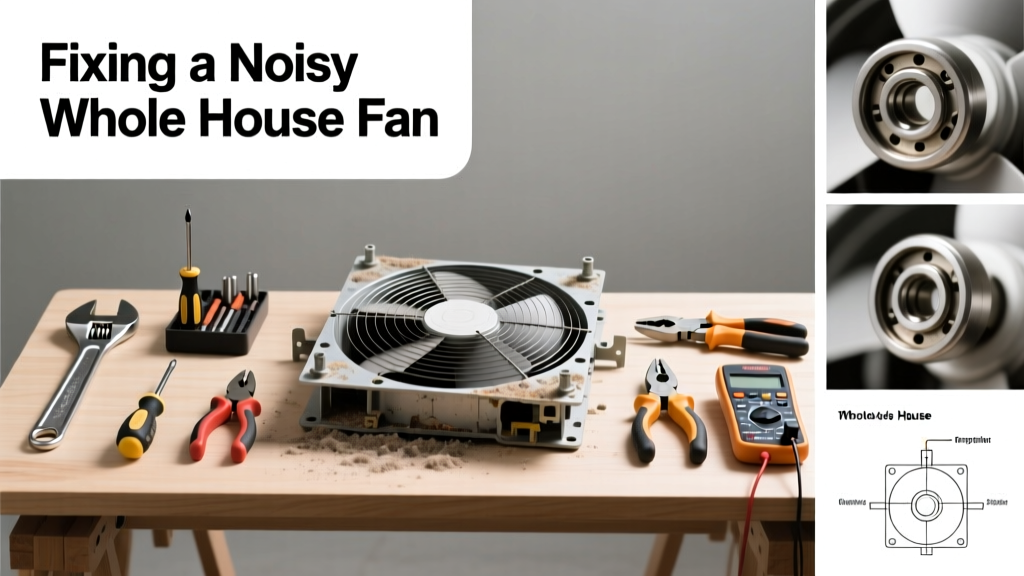
If your whole house fan sounds like a freight train instead of a gentle breeze, it’s not just annoying—it’s a sign something’s off. Most noise issues stem from simple wear, misalignment, or loose parts, not motor failure. With the right tools and 30–60 minutes, you can often restore quiet operation yourself.
Quick Diagnosis
Start by identifying the type of noise—this tells you where to look first:
- Grinding or scraping: Worn bearings, bent blades, or debris hitting the housing
- Rattling or buzzing: Loose mounting screws, unsecured ductwork, or vibrating grille
- High-pitched whine: Belt tension issues (on belt-drive models) or failing capacitor
- Thumping or uneven rhythm: Unbalanced or warped fan blades
Tools & Materials Needed
| Item | Purpose | Estimated Cost |
|---|---|---|
| Socket set (1/4" and 3/8" drive) | Tightens mounting bolts and blade hub screws | $12–$25 |
| Blade balancer kit (or clothespin + tape) | Identifies and corrects blade imbalance | $8–$15 |
| White lithium grease | Lubricates bearings without attracting dust | $4–$7 |
| Capacitor tester or multimeter | Verifies start/run capacitor function | $15–$40 |
| Shop vacuum with brush attachment | Removes dust buildup inside housing and on blades | $25–$60 |
Step-by-Step Fix
- Clean and inspect: Turn off power at the breaker. Remove the grille and vacuum dust from blades, motor housing, and intake opening. Check for bent blades or foreign objects lodged in the squirrel cage.
- Tighten all hardware: Use your socket set to snug down blade hub screws, motor mount bolts, and grille mounting screws. Don’t overtighten—aluminum housings strip easily.
- Balance the blades: Spin the fan by hand and mark the slowest-dropping blade. Attach a clothespin to its tip and spin again; if balance improves, add lightweight tape near the tip until wobble stops. For precision, use a commercial blade balancer.
- Lubricate bearings (if serviceable): Only on older models with oil ports. Add 2–3 drops of white lithium grease—not WD-40 or motor oil—every 6 months. Skip this on sealed bearing units (most modern fans).
- Test capacitor (belt-drive or older direct-drive): Use a multimeter to check capacitance. A reading more than ±6% from rated µF means replacement is needed. According to the U.S. Department of Energy’s 2022 Residential HVAC Maintenance Report, failed capacitors account for 22% of whole house fan noise complaints.
When to Call a Pro
Some issues require licensed expertise—especially when safety or code compliance is involved:
- Motor hums but won’t spin (possible internal winding fault or seized bearing)
- Burning smell or visible scorch marks on wiring or motor casing
- Fan vibrates excessively even after balancing and tightening—may indicate cracked motor mount or structural framing issue
- Wiring shows fraying, corrosion, or aluminum-to-copper splices without proper connectors
"Over 60% of whole house fan noise complaints I see during home inspections trace back to neglected maintenance—not defective parts." — Mike R., Certified Home Inspector, InterNACHI® Member since 2015
Prevention Tips
Extend your fan’s quiet life with routine care:
- Clean blades and housing every spring before first use
- Check blade balance annually—especially after winter storage or attic access
- Verify grille is fully seated and all screws are tight after cleaning
- Install vibration-dampening rubber washers between mounting brackets and ceiling joists (see whole house fan installation tips)
- Replace belts every 3–5 years on belt-drive units—even if they look intact
Can a noisy whole house fan cause higher energy bills?
Not directly—but excessive vibration and friction increase motor load, raising amperage draw by up to 12%, per the California Energy Commission’s 2023 Appliance Efficiency Testing. That adds $8–$15/year in wasted electricity.
Is it safe to run a noisy fan temporarily?
Yes—if the noise is rattling or buzzing and no burning odor or heat is present. But grinding or thumping indicates mechanical stress that can accelerate bearing failure. Shut it down immediately if temperature near the motor exceeds 140°F (use an infrared thermometer).
Why does my fan only squeak when starting up?
This points to dry start-up bearings or a weak start capacitor. The capacitor provides initial torque; if degraded, the motor struggles to overcome static friction. Test it first—replacing a $8–$12 capacitor is faster and safer than disassembling the motor.
Can I replace just one fan blade?
No—always replace blades as a matched set. Even minor weight or aerodynamic differences between new and old blades create imbalance, worsening noise and shortening bearing life. Check manufacturer specs; many require exact OEM replacements, not generic substitutes.
Will soundproofing the attic hatch help reduce noise?
Marginally—only if the noise is airborne transmission through the opening. More effective is sealing gaps around the fan housing with acoustic caulk and adding mass-loaded vinyl behind the grille. For best results, combine with attic insulation upgrades, which absorb mid-frequency fan hum.
How often should I lubricate my whole house fan?
Only if it has oil ports—and then just twice yearly (spring and fall). Most modern units use sealed ball bearings requiring zero lubrication. Adding grease to sealed units traps heat and attracts dust, accelerating wear. When in doubt, consult your model’s manual or check for stamped “Lubrication Not Required” on the motor tag.
A well-maintained whole house fan should run nearly silently—just a soft whoosh, not a roar. Most noise issues resolve with cleaning, tightening, and balancing, saving you $200–$500 over a premature replacement. If you’ve tried these steps and still hear clatter or grind, it’s time to bring in a technician familiar with high-CFM ventilation systems—not just general HVAC contractors.