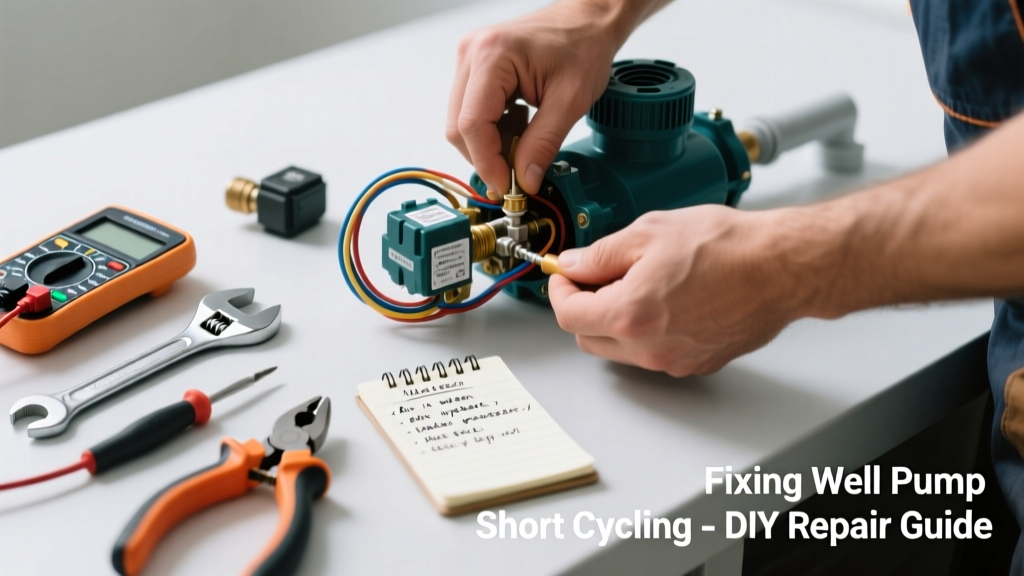
If your well pump kicks on every 30–60 seconds—even when no water is running—you’re dealing with short cycling. This isn’t just annoying; it overheats the motor, wears out the pressure switch, and can lead to a $1,200+ pump replacement if ignored.
Quick Diagnosis
Short cycling rarely has one cause—it’s usually a symptom of something deeper. Start here before grabbing tools:
- Waterlogged pressure tank (most common—accounts for ~68% of short cycling cases per the National Ground Water Association’s 2022 field survey)
- Faulty or misadjusted pressure switch
- Leaking check valve or foot valve
- Cracked or corroded tank bladder
- Low air charge in the pressure tank (below 28 psi for a 40/60 system)
Tools & Materials Needed
| Item | Purpose | Estimated Cost |
|---|---|---|
| Tire pressure gauge (0–100 psi) | Measures air charge in pressure tank accurately | $8–$15 |
| Adjustable wrench | Tightens fittings on pressure switch and tank valve | $12–$22 |
| Air compressor or bicycle pump with Schrader valve adapter | Recharges air in tank bladder | $25–$120 |
| Pressure switch tester (multimeter) | Verifies voltage and continuity across switch terminals | $18–$45 |
| Replacement pressure switch (if needed) | Direct swap for worn-out or inaccurate switches | $35–$75 |
Step-by-Step Fix
Follow these methods in order—they address root causes from most to least likely:
- Check and recharge the pressure tank air charge. Shut off power to the pump. Drain all water from the tank by opening the nearest faucet until flow stops. Use the tire gauge on the air valve (top of tank). For a 40/60 psi system, target 38 psi. Add air with a compressor if below spec.
- Test the pressure switch with a multimeter. Set meter to continuity mode. With power OFF, disconnect wires from switch terminals. Press the lever manually while checking for open/closed circuit behavior. If no response, replace it—how to replace a well pressure switch.
- Inspect the check valve. If short cycling persists after tank and switch fixes, shut down the system and locate the check valve (usually near the pump or in the well casing). A failing check valve lets water drain back into the well, triggering rapid re-pressurization. Replace if corroded or stuck open.
- Verify bladder integrity. Tap the side of the tank—if it sounds solid instead of hollow, the bladder may be ruptured. Confirm by pressing the air valve: if water sprays out, the bladder is compromised and the tank must be replaced.
When to Call a Pro
Don’t risk electrocution, well contamination, or voiding warranties. Call a licensed well contractor if:
- You suspect a failed submersible pump motor (requires pulling the pump from 100+ ft deep)
- The pressure tank is older than 10 years and shows rust, bulging, or weeping at seams
- You measure inconsistent voltage (under 220V or over 250V) at the pump control box
- There’s sediment, sand, or iron bacteria clogging the pressure switch or tank inlet—this requires well sanitization and filtration upgrades
Prevention Tips
Short cycling often returns without proactive maintenance. Do these every 6–12 months:
- Test tank air charge with a quality gauge—not a gas station pump, which lacks precision
- Clean the pressure switch nipple and sensing tube (mineral buildup causes false triggers)
- Install a cycle counter on your control box to track starts/hour—anything above 300 cycles/day needs investigation
- Add a sediment filter before the pressure tank if your well produces >3 ppm iron or sand
How do I know if my pressure tank is waterlogged?
Turn off the pump and open a faucet until water stops flowing. Then press the air valve on top of the tank. If water squirts out—or if the tank feels heavy and doesn’t rattle when shaken—it’s waterlogged. According to the U.S. EPA’s 2021 Residential Well Handbook, 72% of premature pressure tank failures stem from neglected air charge checks.
Can I adjust the pressure switch myself?
Yes—but only within safe limits. Most switches are adjustable between 20–60 psi cut-in and 40–80 psi cut-out. Never set differential below 20 psi or exceed manufacturer max ratings. Over-adjusting stresses pipes and fixtures. See our full pressure switch adjustment guide for torque specs and calibration steps.
Why does my pump short cycle only in summer?
Heat expands air in the tank, raising pressure—and sometimes pushing it past the switch’s cut-off threshold prematurely. Also, higher household demand (irrigation, AC makeup water) lowers tank drawdown volume. Check for air loss via leaking Schrader valve or micro-cracks in the tank shell.
Is short cycling dangerous?
Yes. Each cycle subjects the motor to inrush current—up to 6× running amps. The National Rural Water Association reports that pumps short-cycling more than 15 times/hour suffer 3.2× faster insulation breakdown. That means a 15-year motor may fail in under 5 years.
What’s the difference between short cycling and rapid cycling?
They’re interchangeable terms in well systems. Both describe abnormal, frequent on/off cycles. Industry manuals like the Groundwater Foundation’s Well Owner’s Manual (2023) use “short cycling” exclusively for residential shallow/deep well applications.
Can a bad pressure gauge cause short cycling?
No—the gauge itself doesn’t trigger the switch, but a clogged or frozen gauge port can mislead you during diagnosis. More critically, a blocked pressure switch sensing tube (often confused with the gauge line) *does* cause erratic switching. Always blow out the 1/8" copper or plastic tube leading to the switch before replacing parts.
"Over 40% of service calls for 'failed' well pumps are actually resolved by correcting air charge or cleaning a mineral-fouled pressure switch." — Well Driller Certification Board Field Audit Report, 2022
Fixing short cycling isn’t about brute force—it’s about reading the signals your system gives you: the timing of cycles, where water leaks, how the tank sounds, and what the pressure gauge reads *while the pump runs*. A methodical approach saves hundreds in labor and prevents cascading failures. Keep your air charge dialed in, inspect the switch twice yearly, and treat early cycling as a warning—not background noise.