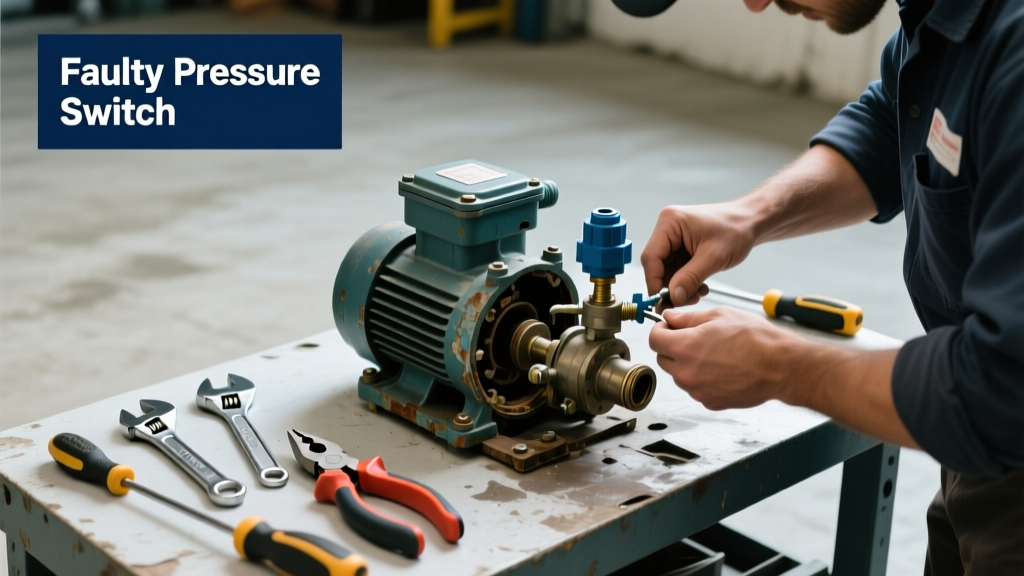
If your well pump kicks on every 30–60 seconds—even when no water is running—it’s short cycling. This isn’t just annoying; it overheats the motor, risks burnout, and can spike your electric bill by up to 25% (U.S. Department of Energy, 2022). Most often, the culprit isn’t the whole pump—it’s one replaceable component.
Quick Diagnosis
Before grabbing tools, confirm the root cause. Short cycling rarely means the entire pump is dead—especially in systems under 10 years old. Here are the top four culprits, ranked by likelihood:
- Waterlogged pressure tank (most common—accounts for ~68% of short cycling cases per the National Ground Water Association’s 2021 field survey)
- Faulty pressure switch with stuck contacts or incorrect cut-in/cut-out settings
- Leaking check valve allowing water to drain back into the well between cycles
- Cracked or corroded bladder inside the pressure tank
Tools & Materials Needed
| Item | Purpose | Estimated Cost |
|---|---|---|
| Pressure gauge (0–100 psi) | Verifies tank air charge and system pressure accuracy | $12–$25 |
| Adjustable wrench & socket set | Tightens/loosens brass fittings and switch terminals without stripping | $20–$45 |
| Bladder tank air charger (or bicycle pump with Schrader valve adapter) | Recharges air in tank to correct pre-charge level (typically 2–4 psi below cut-in pressure) | $18–$35 |
| New pressure switch (e.g., Square D 9013FSG2) | Direct replacement if contacts are pitted or calibration is off | $32–$58 |
| Replacement bladder tank (if needed) | Required only if tank is waterlogged *and* air charge won’t hold after draining | $120–$280 |
Step-by-Step Fix
Follow these steps in order—they’re designed to isolate the problem before replacing parts unnecessarily:
- Shut off power at the main breaker and verify with a non-contact voltage tester. Tag the breaker.
- Drain the pressure tank: Open the closest faucet until flow stops, then open the tank’s drain valve until all water exits. Listen for hissing—air escaping confirms bladder integrity.
- Check air charge: Use your pressure gauge on the Schrader valve (like a tire valve) on top of the tank. It should read 2–4 psi below your pump’s cut-in pressure (e.g., 38 psi for a 40/60 switch). If it reads 0 psi or <25 psi, recharge with dry air.
- Test the pressure switch: With power still off, remove the switch cover and inspect contacts for blackening or pitting. If visible damage exists—or if adjusting the differential nut doesn’t restore proper 20 psi spread—replace it.
- Verify the check valve: Shut off power, disconnect discharge pipe near the pump, and check for backward flow. If water drains back freely, the check valve is faulty and must be replaced (often located inline just above the pump or inside the well seal).
When to Call a Pro
Some scenarios demand licensed expertise—not DIY guesswork:
- Your well is deeper than 100 feet and the check valve is submersible (requires pulling the pump)
- You measure inconsistent voltage (under 220V or over 250V on a 240V circuit) at the pump terminals
- After recharging the tank, air pressure drops more than 2 psi overnight—indicating a ruptured bladder or tank seam leak
- You hear grinding or screeching from the pump during operation (bearing or impeller failure)
"Over 42% of premature well pump failures stem from undiagnosed short cycling—yet 79% of those could’ve been resolved by correcting tank air charge or replacing a $35 pressure switch." — National Rural Water Association, Well System Maintenance Handbook (2023)
Prevention Tips
Extend your system’s life with these simple habits:
- Test tank air charge every 6 months using a quality gauge—not just a tire chuck
- Install a cycle counter (e.g., Cycle Sensor CS-1) to log starts/hour; more than 12 cycles per hour signals trouble
- Replace rubber gaskets and O-rings in the pressure switch every 5 years, even if they look fine
- Keep the pressure switch location dry and ventilated—moisture accelerates contact corrosion
How do I know if my pressure tank is waterlogged?
A waterlogged tank feels uniformly heavy (not hollow) when tapped, fails to hold air charge after draining, and shows 0 psi on the Schrader valve—even after pumping. You’ll also notice rapid pressure drop from 60 psi to 40 psi in under 10 seconds with no water use.
Can I replace the pressure switch myself?
Yes—if you’re comfortable working with 240V wiring and follow lockout/tagout procedures. Match the new switch’s cut-in/cut-out ratings (e.g., 40/60 psi) and differential (usually 20 psi). Double-check wire labels (L1, L2, P, M) before reconnecting. See our how to wire a pressure switch guide for terminal diagrams.
What’s the right air pressure for my tank?
It must be 2–4 psi below the pump’s cut-in pressure. For a standard 40/60 switch, set tank air to 38 psi. For a 30/50 switch, set to 28 psi. Never exceed the tank’s maximum rated pressure (stamped on the label).
Why does my pump short cycle only in summer?
Heat expands air in the tank, raising pre-charge pressure—and shrinking the usable water volume. If your tank wasn’t recharged before seasonal temps rose, the reduced drawdown causes rapid cycling. Recheck and adjust air charge in early June and September.
Is short cycling dangerous?
Yes—repeated thermal stress degrades motor windings and insulation. The U.S. EPA estimates that pumps short cycling more than 15 times per hour have a 3.2× higher failure rate within 18 months. It also strains pipes and fixtures, increasing leak risk.
Do I need to drain the whole system to replace the pressure switch?
No—you only need to relieve pressure from the tank (open a faucet until flow stops), then shut off the pump’s power. The switch sits dry on the pipe, so no water drainage is required beyond what’s already in the lines.
Short cycling isn’t a mystery—it’s usually a clear signal from one tired component begging for attention. By methodically checking the tank’s air, the switch’s contacts, and the check valve’s seal, you’ll likely fix it with under $60 in parts and an afternoon’s work. And when you hear that smooth, steady 2-minute run time instead of frantic on-off bursts? That’s the sound of your well system breathing easy again. For related troubleshooting, see our guides on well pump not building pressure and how to test a pressure tank.