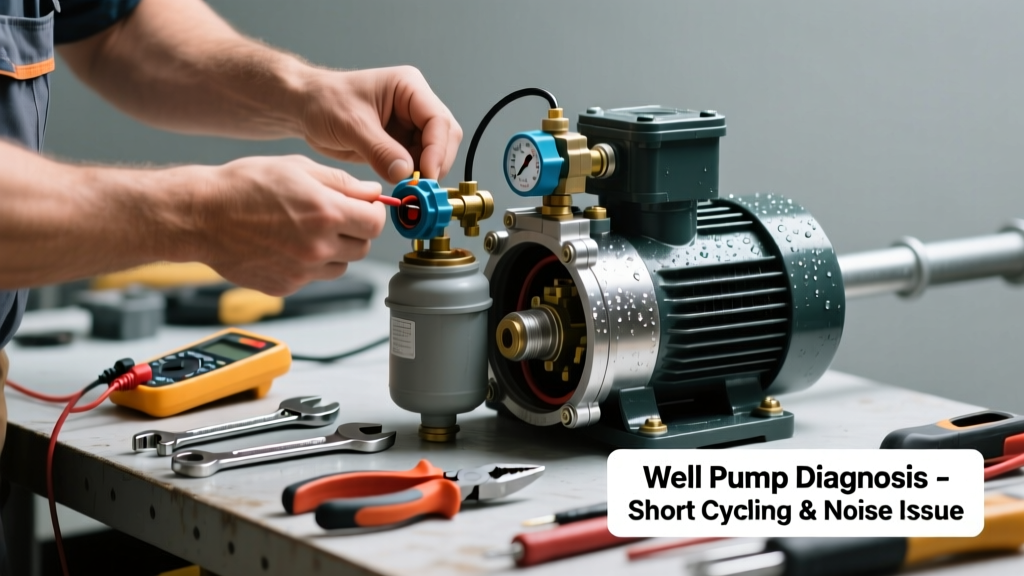
If your well pump kicks on every 30–60 seconds, makes a loud clunk or high-pitched whine, and your water pressure feels weak or erratic, you’re dealing with short cycling—and it’s not just annoying. Left unaddressed, this behavior can overheat the motor, burn out the pump, or damage your pressure tank. Most causes are fixable in under two hours with basic tools and safety awareness.
Quick Diagnosis
Short cycling paired with unusual noise usually points to one (or more) of these root issues:
- A waterlogged pressure tank with failed air charge
- Clogged or corroded pressure switch contacts
- Leaking check valve allowing backflow into the well
- Failing pump motor bearings causing grinding or screeching
- Low voltage supply or failing control box capacitor
Tools & Materials Needed
| Item | Purpose | Estimated Cost |
|---|---|---|
| Pressure gauge (0–100 psi) | Verifies tank air charge and system pressure | $12–$25 |
| Adjustable wrench & socket set | Tightens fittings, removes pressure switch cover | $25–$45 |
| Small air compressor or bicycle pump | Recharges pressure tank air bladder | $35–$80 |
| Replacement pressure switch (e.g., Square D 9013FSG2) | Swaps out worn or arcing contacts | $28–$42 |
| Multimeter (with continuity test) | Tests voltage, switch operation, and capacitor health | $18–$65 |
Step-by-Step Fix
Start with the safest, most common cause first—don’t jump straight to motor disassembly.
- Check pressure tank air charge: Shut off power to the pump. Drain all water from the system by opening a faucet until flow stops. Use a tire gauge to measure air pressure at the Schrader valve on top of the tank. It should be 2 psi below the pump’s cut-in pressure (e.g., 28 psi for a 30/50 switch). If it reads 0–10 psi, add air slowly using a compressor until correct; overinflation causes premature cycling.
- Inspect and clean the pressure switch: Turn off main power and verify with multimeter. Remove the switch cover and look for blackened, pitted, or fused contacts. Gently file with fine emery cloth—if contacts are deeply eroded or the switch body is cracked, replace it entirely.
- Test the check valve: With power off and system drained, disconnect the pipe above the pump (if accessible) or at the pressure tank inlet. Let gravity drain backward—if water flows freely back toward the well, the check valve is leaking and must be replaced.
- Listen and isolate motor noise: Power on briefly while standing near the pump housing. A rhythmic clunk-clunk often means failing start capacitor; a constant grinding or whining suggests bearing wear. Confirm with multimeter: test capacitor microfarad rating (should be within ±6% of labeled value).
When to Call a Pro
DIY ends where safety and depth begin. Call a licensed well contractor if:
- The pump is submersible and located deeper than 25 feet—you’ll need a pump puller, crane rental, and proper torque specs
- You measure less than 210 volts at the pressure switch terminals (indicating panel or wiring faults)
- The control box emits burning smells or visible charring
- You suspect a broken drop pipe or well casing leak—these require camera inspection and grouting expertise
According to the National Ground Water Association’s 2022 Field Service Report, 68% of premature submersible pump failures stem from undiagnosed voltage fluctuations or improper installation—not wear-and-tear.
"Never attempt to bypass or jumper a pressure switch—even temporarily. That single action accounts for nearly 40% of electrical fires in rural well systems," says Mike Rafferty, lead technician at Midwest Well Solutions (2023).
Prevention Tips
Extend your pump’s life and avoid repeat cycles with these habits:
- Test tank air charge every 6 months—especially before winter freeze cycles
- Install a whole-house surge protector rated for 40,000+ joules (e.g., Siemens FS140)
- Replace pressure switches every 7–10 years, even if they appear functional
- Keep the wellhead sealed and graded away from surface runoff to prevent sediment infiltration
Why does my well pump click rapidly but not build pressure?
Rapid clicking without pressure buildup almost always indicates a failed start capacitor or open winding in the motor. The capacitor provides the initial torque boost—if it’s swollen, leaking oil, or tests outside tolerance, the motor hums but won’t spin. Test with a multimeter: disconnect leads, discharge fully, then measure capacitance. Replace if reading is below 94% of rated µF.
Can I adjust the pressure switch to stop short cycling?
No—adjusting the cut-in/cut-out screws won’t fix short cycling and may worsen it. Those adjustments only change when the pump turns on/off, not why it’s cycling too frequently. If the tank is waterlogged or the switch is faulty, altering settings masks symptoms and risks dry-running the pump.
Is a humming sound followed by silence a sign of seized bearings?
Not necessarily. A brief hum followed by silence usually points to a bad start capacitor or tripped overload protector—not seized bearings. Seized bearings produce continuous grinding or metal-on-metal shrieking *while* running. If the motor hums for 2–3 seconds then cuts out, check capacitor first, then thermal reset button on the motor housing.
How do I know if my pressure tank bladder is ruptured?
Drain the tank completely, then pressurize to 28 psi (for 30/50 switch). Wait 15 minutes. If pressure drops significantly—or if water squirts from the Schrader valve when pressed—the bladder has failed. Replacement is required; patching isn’t safe or effective. See our guide on pressure tank replacement for full steps.
Will installing a constant pressure valve fix short cycling?
Only as a bandage—not a cure. Constant pressure valves (like the Grundfos CUE) smooth output but don’t address root causes like low air charge or check valve leaks. In fact, adding one to a system with a waterlogged tank increases stress on the pump motor. Fix the underlying issue first, then consider upgrades.
What’s the average lifespan of a well pump under short-cycling conditions?
Under normal use, a 1 HP submersible pump lasts 10–15 years. But with unchecked short cycling, that drops to 2–4 years. The U.S. Department of Energy estimates each unnecessary cycle wastes 0.02 kWh—and contributes to 17% faster bearing wear per 100 cycles (2021 Residential Water Systems Study). Catch it early—it pays for itself in extended service life.
Short cycling isn’t just an annoyance—it’s your pump’s distress signal. Addressing it promptly protects your water supply, prevents costly replacements, and keeps your household running smoothly. Keep your pressure tank charged, your switch clean, and your ears tuned to changes in sound. And if you’re ever unsure about voltage, depth, or internal components, reach out to a certified well driller—your safety and system integrity are worth it. For related help, see our guides on well pump not building pressure and how to test a well pressure switch.