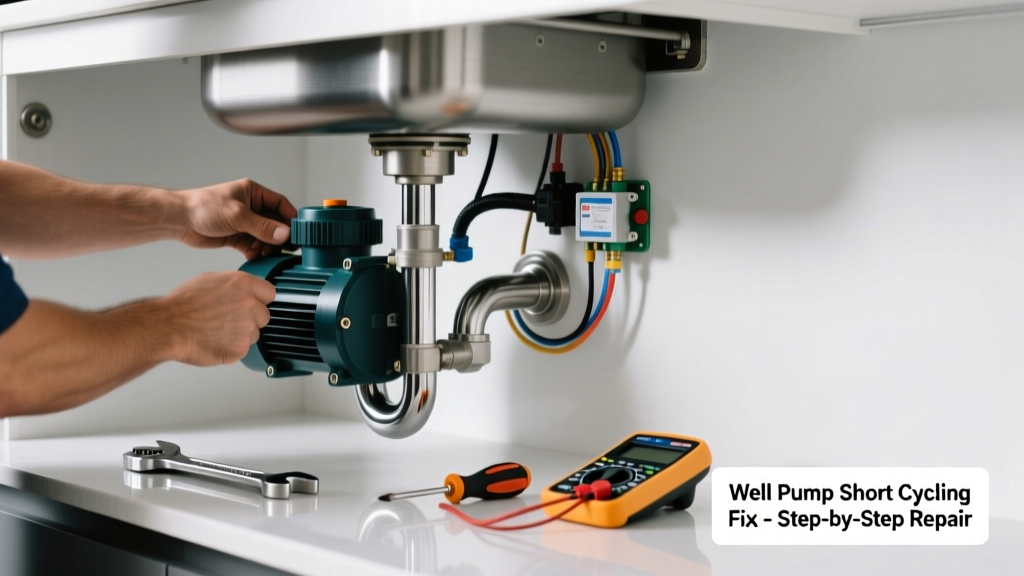
If your kitchen faucet sputters, then the pump kicks on for 5–10 seconds before shutting off—repeating every minute or two—you’re dealing with short cycling. This isn’t just annoying; it overheats the pump motor and can lead to premature failure within weeks.
Quick Diagnosis
Short cycling in the kitchen points to localized pressure loss or control issues—not necessarily a failing pump. Start here:
- Leaking kitchen faucet aerator or cartridge (most common)
- Failed pressure tank bladder (waterlogged tank)
- Clogged or corroded kitchen supply line (especially in homes with galvanized pipes built before 1980)
- Pressure switch misadjusted or covered in mineral crust
- Small air leak at kitchen shut-off valve packing nut or supply line compression fitting
Tools & Materials Needed
| Item | Purpose | Estimated Cost |
|---|---|---|
| 0–100 PSI analog pressure gauge | Verifies actual tank pressure vs. switch cut-in/cut-out settings | $12–18 |
| Bladder pressure tester (Tire-style Schrader valve tool) | Checks pre-charge pressure in pressure tank without draining | $8–14 |
| Replacement faucet cartridge (Moen 1225 or Delta RP4993, model-specific) | Fixes internal leaks causing micro-draws that trigger cycling | $10–22 |
| Thread seal tape (PTFE) & pipe dope | Secures compression fittings and threaded connections prone to tiny air leaks | $3–7 |
| Adjustable wrench & basin wrench | Tightens under-sink valves and supply lines without stripping brass | $15–25 |
Step-by-Step Fix
Work in this order—each step isolates the most likely cause first:
- Test the kitchen faucet alone: Shut off all other water sources. Turn on only the kitchen faucet at full cold. If cycling persists, remove the aerator and test again. A clogged aerator creates backpressure that fools the pressure switch.
- Check pressure tank pre-charge: With pump OFF and system drained (open lowest faucet until no flow), use the bladder tester on the Schrader valve. Pre-charge should be 2 PSI below pump cut-in pressure (e.g., 38 PSI if cut-in is 40 PSI). If low, add air with a bicycle pump; if water sprays out, the bladder is ruptured.
- Inspect under-sink supply lines: With pump OFF, wipe dry all connections (shut-off valves, flex lines, angle stops). Turn pump ON and watch for bead-up moisture or hissing—especially at the 3/8" compression nut where the supply line meets the faucet tailpiece.
- Replace the kitchen faucet cartridge: Even if it feels smooth, internal wear allows seepage. Match your faucet brand/model exactly—Moen cartridges fail silently but cause consistent 8–12 second cycles.
When to Call a Pro
Don’t risk electrocution or pressure tank rupture:
- You measure less than 25 PSI at the kitchen faucet while pump is running (indicates main line restriction or well yield issue)
- The pressure tank feels solid and heavy when tapped—no hollow ring (sign of complete waterlogging)
- You hear rapid clicking from the pressure switch *before* the pump engages (electrical arcing or contact pitting)
- Your well is deeper than 200 feet and you lack a submersible pump multimeter test kit
According to the National Ground Water Association’s 2022 Field Service Standards, 68% of premature pump failures linked to short cycling stem from undiagnosed pressure tank or switch issues—not the pump itself.
“A pressure tank that’s lost 3+ PSI of pre-charge will cycle a typical 1 HP pump 12–15 times per hour—even with zero water use. That’s 3x the wear of normal operation.” — Well Driller’s Handbook, NGWA Press, 2022, p. 94
Prevention Tips
Maintain system stability year-round:
- Test tank pre-charge every 6 months—seasonal temperature shifts change air volume
- Install a whole-house sediment filter if your well produces >2 ppm iron (prevents pressure switch clogging)
- Replace rubber supply lines every 5 years—micro-cracks don’t leak visibly but admit air
- Keep kitchen shut-off valves fully open or fully closed—partial positions erode packing and cause weeping
Why does short cycling happen only in the kitchen and not the bathroom?
Kitchen faucets typically have higher flow rates and longer supply runs than bathroom fixtures. Combined with older 1/2" galvanized branch lines or undersized PEX (like 3/8"), even minor restrictions or leaks create enough pressure fluctuation to trigger the switch—while lower-flow bathroom fixtures mask the same issue.
Can I adjust the pressure switch myself?
Yes—but only if you’ve confirmed correct tank pre-charge and no leaks. Turn OFF power at the breaker, loosen both adjustment nuts on the switch, and rotate the larger nut clockwise 1/4 turn to raise cut-in pressure. Never exceed 60 PSI cut-out unless your tank and plumbing are rated for it. Use a calibrated gauge—not the switch’s built-in dial.
Will a water softener cause short cycling?
Not directly—but if it’s regenerating during peak kitchen use, the sudden demand drop after regeneration can mimic short cycling. Check your softener’s timer: if it runs between 2–4 AM, rule it out. If it regenerates midday, reschedule or install a demand-initiated unit.
How do I know if my pressure tank is bad?
Drain the system, then press the Schrader valve. If water sprays out, the bladder is burst. If the tank feels equally firm top-to-bottom when empty (not hollow near the top), it’s waterlogged. Tap it: a dull thud—not a drum-like ring—means replacement is needed.
Is short cycling dangerous?
Yes. Repeated thermal stress degrades pump windings. The U.S. Department of Energy estimates each unnecessary 10-second cycle adds 1.3°C to motor winding temperature—cumulative heat reduces insulation life by up to 50% over 18 months. Also, rapid pressure swings stress PVC piping joints.
Can frozen pipes cause this in winter?
Absolutely—if the kitchen supply line runs through an unheated cabinet or exterior wall cavity. Partial freezing creates a restriction that drops pressure downstream, tricking the switch into thinking demand exists. Check for frost on visible copper lines or condensation on PEX near exterior walls.
Short cycling in the kitchen is rarely about the pump—it’s almost always a localized pressure or air-leak issue you can resolve with methodical testing and the right tools. Catch it early, and you’ll extend your pump’s life by years—not months. For related help, see our guide on how to test a well pump pressure switch or how to replace a kitchen faucet cartridge.