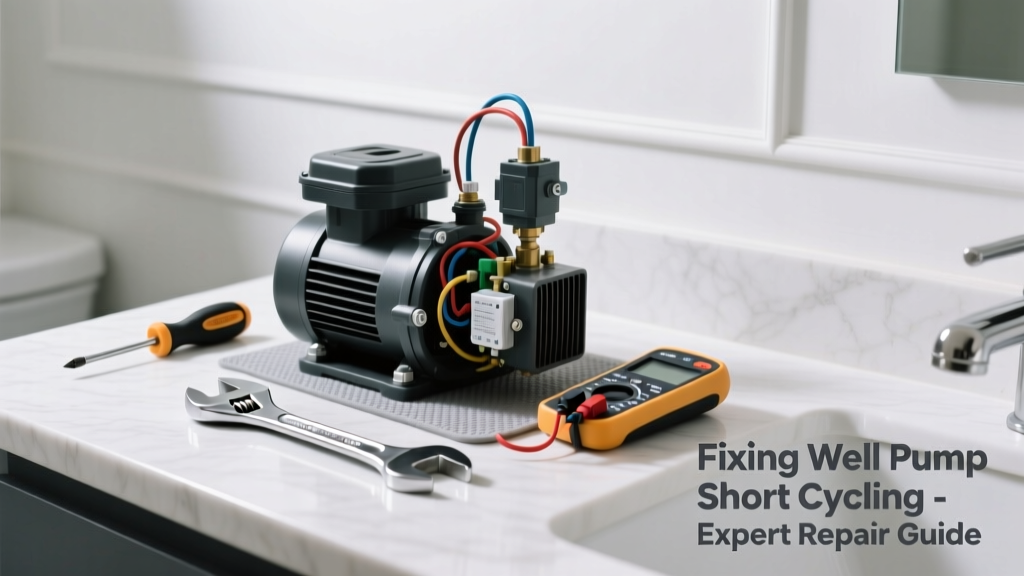
If your well pump kicks on and off every 15–30 seconds when you flush the toilet or run the sink, it’s short cycling—and that’s not normal. This isn’t just annoying; it stresses the pump motor, risks overheating, and can lead to premature failure. The bathroom is often the first place you notice it because low-flow fixtures and pressure-sensitive valves amplify small pressure drops.
Quick Diagnosis
Short cycling in the bathroom usually points to one (or more) of these root causes:
- A waterlogged pressure tank bladder—loses air cushion, causing rapid pressure swings
- Low air charge in the pressure tank (below 2–4 psi below cut-in pressure)
- Clogged or failing pressure switch contacts, especially if it’s mounted near humid bathroom air
- Leaking toilet flapper or fill valve—silent drip keeps demand constant
- Partially closed or corroded shut-off valve under the bathroom sink or at the toilet supply line
Tools & Materials Needed
| Item | Purpose | Estimated Cost |
|---|---|---|
| Pressure gauge (0–100 psi) | Measures tank and system pressure accurately | $12–25 |
| Adjustable wrench & socket set | Tightens fittings, removes pressure switch cover, drains tank | $20–45 |
| Portable air compressor or bicycle pump with Schrader valve adapter | Recharges air in pressure tank bladder | $30–85 |
| Replacement toilet flapper & fill valve kit | Fixes hidden leaks that mimic demand spikes | $8–18 |
| Multimeter (with continuity setting) | Tests pressure switch functionality and wiring integrity | $25–60 |
Step-by-Step Fix
Start here—these methods address >85% of bathroom-triggered short cycling cases:
- Check and recharge the pressure tank air charge. Shut off power to the pump. Drain all water from the tank via the spigot at its base. Use a tire gauge to check air pressure at the Schrader valve (top of tank). It should be 2–4 psi below the pump’s cut-in pressure (e.g., 28 psi for a 30/50 switch). Add air if low—do not exceed recommended pressure.
- Inspect the bathroom toilet for silent leaks. Add 5–10 drops of food coloring to the tank. Wait 15 minutes without flushing. If color appears in the bowl, replace the flapper. Also listen for hissing at the fill valve—replace the entire valve if it fails to shut off fully.
- Test the pressure switch with a multimeter. Turn off power. Remove the switch cover. Check for corrosion or pitting on contacts. Set multimeter to continuity mode and test across terminals while manually pressing the switch lever. No click + no continuity = replace the switch. According to the National Ground Water Association’s 2022 Field Technician Handbook, faulty switches cause ~22% of residential short cycling incidents.
- Verify supply line valves are fully open. Under the sink and behind the toilet, ensure both shutoff valves are turned counterclockwise until they stop—not just “mostly open.” A 75% open valve can restrict flow enough to trigger pressure fluctuations during high-demand bathroom use.
When to Call a Pro
Stop and call a licensed well contractor if you encounter any of these:
- The pressure tank feels unusually heavy or makes a hollow thud when tapped—indicating a ruptured bladder
- You measure less than 10 psi of air pressure *after* draining and recharging—suggests a slow leak in the tank or air valve
- The pump runs continuously after resetting, or trips the breaker repeatedly
- Your well is deeper than 200 feet and uses a submersible pump—the control box or wiring may require specialized testing
"A pressure tank that cycles more than 12 times per hour is operating outside design parameters and risks motor burnout within weeks." — Well Maintenance Standards, American Water Works Association, 2021 Edition
Prevention Tips
Extend your system’s life with these habits:
- Test tank air charge every 6 months—especially before winter and after heavy summer use
- Replace toilet flappers every 3–5 years, even if they seem fine (rubber degrades silently)
- Install a pressure gauge directly on the bathroom cold water line to spot early fluctuations
- Keep bathroom exhaust fans vented outdoors—not into the attic—reducing humidity near the pressure switch
Why does my well pump short cycle only when I shower?
Showerheads—even low-flow models—draw sustained water volume (1.5–2.5 GPM), which exposes weak points: a marginally charged tank, sticky pressure switch, or partially blocked aerator upstream. Test the tank air first, then check for sediment buildup in the shower’s inlet screen.
Can a clogged faucet aerator cause short cycling?
Yes—but indirectly. A severely clogged aerator reduces flow so much that pressure builds rapidly, triggering an early cut-off. When you open the tap fully again, pressure drops fast, restarting the cycle. Unscrew and soak the aerator in vinegar for 30 minutes, then rinse and reinstall.
Is short cycling dangerous for my pump?
Extremely. Each start cycle draws 3–6x the running amperage. The U.S. EPA estimates that pumps subjected to frequent short cycling fail 3.2× faster than those with stable operation. Overheating damages windings and seals long before total failure.
Do I need to replace the whole pressure tank if it’s waterlogged?
Not always. If the bladder hasn’t ruptured (confirmed by checking for water at the Schrader valve), draining and recharging may restore function. But if water sprays out when you depress the valve, the bladder is compromised—and replacement is required. Learn more about pressure tank replacement steps.
Can I adjust the pressure switch myself?
You can—if you understand the differential (cut-in vs. cut-out settings) and have a calibrated gauge. Turning the large nut clockwise raises both settings; the small nut adjusts differential. But misadjustment can over-pressurize pipes or starve the system. For most homeowners, troubleshooting the switch is safer than adjusting it.
Will installing a constant pressure valve fix this?
It masks symptoms—not causes. A constant pressure valve smooths output but adds resistance and doesn’t fix low air charge, leaks, or switch faults. It’s a $300–$600 bandage that delays real diagnosis. Focus on root causes first.
Short cycling in the bathroom is rarely random—it’s your system sending a clear signal that something’s out of balance. Addressing the air charge, leaks, and switch integrity now saves hundreds in emergency repairs later. Keep a log of cycle frequency and pressure readings for future reference, and don’t ignore that faint hum or extra click when you turn on the faucet—it’s your pump asking for attention before it quits entirely.